Practise 23 questions on Negative numbers and the number line for Year 7 Maths. Tap or type your answer and find out straight away if you are right, with the Study Helper on hand if you get stuck.
23 questions
1–5 marks each
Instant marking
No sign-up needed
20 questions, marked as you go
Sample questions with model answers
Here are 4 of the questions in this topic, each with a model answer, an explanation of why it earns the marks and the mark scheme.
Question 1
1 mark
Which symbol, < or >, goes between these two numbers?
\(-5\) \(-2\)
Model answer
On a number line, \(-5\) is to the left of \(-2\). \(-5 < -2\)
Explanation
On a number line, numbers get smaller as you go left. \(-5\) is further left than \(-2\), so \(-5\) is less than \(-2\). A common mistake is to think \(-5\) is bigger because 5 is bigger than 2.
Mark scheme
1 mark
\(-5 < -2\)
Accept the symbol < on its own, the words 'is less than', or the statement written the other way round with the correct symbol (\(-2 > -5\)). Do not accept >.
Question 2
2 marks
At 6 am the temperature was \(-5\) °C.
At midday the temperature was 4 °C.
By how many degrees did the temperature rise?
Model answer
From \(-5\) °C up to 0 °C is 5 degrees. From 0 °C up to 4 °C is 4 degrees. \(5 + 4 = 9\) The temperature rose by 9 degrees.
Explanation
When one temperature is below zero and the other is above, split the rise at zero. It takes 5 degrees to get from \(-5\) °C up to 0 °C, then 4 more to reach 4 °C, so the rise is 9 degrees. A common mistake is to work out \(5 - 4 = 1\).
Mark scheme
1 mark
A correct method, e.g. 5 degrees up to 0 and then 4 more, or \(5 + 4\), or \(4 - (-5)\); or the correct answer 9 with no working
1 mark
9 (degrees)
Do not accept 1 (from \(5 - 4\)) or \(-9\). A correct answer with no working scores full marks.
Question 3
3 marks
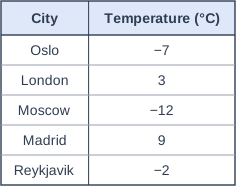
The table shows the temperature at midday in five cities on one day in January.
Which city was the coldest? How many degrees warmer was the warmest city than the coldest city?
Model answer
Coldest: Moscow, \(-12\) °C. Warmest: Madrid, 9 °C. From \(-12\) up to 0 is 12, and from 0 up to 9 is 9. \(12 + 9 = 21\) Moscow was coldest, and Madrid was 21 degrees warmer.
Explanation
The coldest temperature is the one furthest below zero, which is Moscow's \(-12\) °C, and the warmest is Madrid's 9 °C. To find the difference across zero, add the two distances from zero: \(12 + 9 = 21\) degrees. A common mistake is to choose Oslo as coldest, or to work out \(12 - 9 = 3\).
Mark scheme
1 mark
Moscow (the coldest city)
1 mark
A correct method for the difference between 9 °C and \(-12\) °C, e.g. \(12 + 9\) or counting 12 up to 0 and 9 more; or the correct answer 21 with no working
Follow through from their warmest and coldest temperatures if one is wrong.
1 mark
21 (degrees)
Do not accept 3 (from \(12 - 9\)). A correct answer with no working scores full marks.
Question 4
4 marks
The table shows the temperature at 7 am on five days.
Between which two days did the temperature rise the most? By how many degrees did it rise?
Model answer
Monday to Tuesday: \(-3\) to 2, up 5 Tuesday to Wednesday: 2 to \(-6\), down 8 Wednesday to Thursday: \(-6\) to 1, up \(6 + 1 = 7\) Thursday to Friday: 1 to 4, up 3 The biggest rise is from Wednesday to Thursday, 7 degrees.
Explanation
Work out the change from each day to the next, and notice whether it goes up or down. When a change crosses zero, add the distances on each side: from \(-6\) up to 1 is 6 degrees to zero and 1 more, so 7. The change from Tuesday to Wednesday is bigger, 8 degrees, but it is a fall, not a rise.
Mark scheme
1 mark
At least two of the changes worked out correctly: Monday to Tuesday up 5, Tuesday to Wednesday down 8, Wednesday to Thursday up 7, Thursday to Friday up 3; or the correct answer with no working
1 mark
All four changes correct (the fall of 8 may be shown as a fall, or as \(-8\))
1 mark
Wednesday and Thursday
Tuesday and Wednesday is a common wrong answer: that is the biggest change, but it is a fall.
1 mark
7 (degrees)
Follow through from their changes. A correct answer with no working scores full marks.
Ready to try the rest? Tap or type your answers and see straight away how you did.
Ctrl + Enter to check
Study HelperHints first, answers after you try
Stuck on this one? Ask for a hint and I’ll point you in the right direction, without giving the answer away. Once you’ve checked your answer, I’ll show you how the marks are awarded.