Practise 29 questions on Squares, cubes and roots for Year 7 Maths. Tap or type your answer and find out straight away if you are right, with the Study Helper on hand if you get stuck.
29 questions
1–5 marks each
Instant marking
No sign-up needed
20 questions, marked as you go
Sample questions with model answers
Here are 4 of the questions in this topic, each with a model answer, an explanation of why it earns the marks and the mark scheme.
Question 1
1 mark
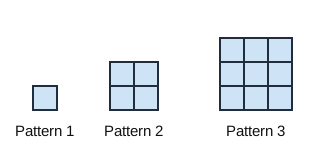
Here are the first three patterns in a sequence made from square tiles.
How many tiles will there be in Pattern 6?
Model answer
Pattern 6 is a 6 by 6 square. \(6^2 = 6 \times 6 = 36\) tiles
Explanation
Each pattern is a square: Pattern 1 is 1 by 1, Pattern 2 is 2 by 2 and Pattern 3 is 3 by 3. So Pattern 6 is a 6 by 6 square, which has \(6 \times 6 = 36\) tiles. The numbers of tiles, 1, 4, 9, 16 ..., are the square numbers, which is how square numbers get their name.
The cube root of 1,000 is the number that multiplies by itself three times to make 1,000, which is 10. The square root of 196 is 14, because \(14 \times 14 = 196\). Adding them gives 24. A common mistake is to divide 1,000 by 3 for the cube root.
Mark scheme
1 mark
\(\sqrt[3]{1000} = 10\) or \(\sqrt{196} = 14\) seen; or the correct answer 24 with no working
1 mark
24
Do not accept 1,196 or 333.3... A correct answer with no working scores full marks.
Question 3
3 marks
A square rug has sides of length 1.5 m.
A square mat has sides of length 0.8 m.
How much greater is the area of the rug than the area of the mat?
Model answer
Rug: \(1.5^2 = 1.5 \times 1.5 = 2.25\) m² Mat: \(0.8^2 = 0.8 \times 0.8 = 0.64\) m² Difference: \(2.25 - 0.64 = 1.61\) m²
Explanation
The area of a square is the side length squared. For \(1.5 \times 1.5\), work out \(15 \times 15 = 225\) and put back the two decimal places to get 2.25. In the same way, \(0.8 \times 0.8 = 0.64\), not 6.4, because squaring a number less than 1 makes it smaller. Then subtract: \(2.25 - 0.64 = 1.61\) m². A common mistake is to subtract the side lengths first and square the answer, which gives \(0.7^2 = 0.49\).
Mark scheme
1 mark
Area of the rug \(1.5^2 = 2.25\) m² or area of the mat \(0.8^2 = 0.64\) m²; or the correct answer 1.61 m² with no working
Accept \(15 \times 15 = 225\) or \(8 \times 8 = 64\) with the decimal point put back correctly.
1 mark
Both areas correct: 2.25 m² and 0.64 m²
1 mark
1.61 (m²)
Follow through: their area of the rug minus their area of the mat, worked out correctly. Do not accept 0.49 (squaring the difference in the side lengths, \(0.7^2\)), 0.7 (the difference in the side lengths) or \(-4.15\) (from \(2.25 - 6.4\)). A correct answer with no working scores full marks.
Question 4
4 marks
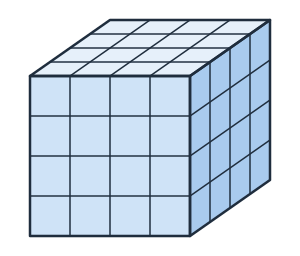
The diagram shows a large cube made from 64 small cubes, all the same size.
The whole outside of the large cube is painted, including the bottom.
How many of the small cubes have no paint on them at all?
Model answer
\(4 \times 4 \times 4 = 64\), so the large cube is 4 cubes along each edge. Removing the outside layer leaves 2 along each edge. Unpainted cubes: \(2 \times 2 \times 2 = 8\)
Explanation
Since \(4^3 = 64\), the large cube is 4 small cubes long, wide and tall. Every cube touching the outside gets some paint, so take one layer off each side: the left and right, the front and back, and the top and bottom. That leaves a 2 by 2 by 2 cube hidden in the middle, which is 8 cubes. A common mistake is to take off only one cube from each edge and get \(3^3 = 27\).
Mark scheme
1 mark
\(\sqrt[3]{64} = 4\) (4 small cubes along each edge); or the correct answer 8 with no working
Accept counting 4 along an edge from the diagram.
1 mark
The unpainted cubes form a smaller cube inside, with 2 cubes along each edge (4 - 2)
Accept a correct description, e.g. 'take off one layer on every side'.
1 mark
\(2^3\) or \(2 \times 2 \times 2\)
Follow through: their inner edge cubed.
1 mark
8
Do not accept 27 (\(3^3\), removing only one layer from each edge), 16, 24 or 56. A correct answer with no working scores full marks.
Ready to try the rest? Tap or type your answers and see straight away how you did.
Ctrl + Enter to check
Study HelperHints first, answers after you try
Stuck on this one? Ask for a hint and I’ll point you in the right direction, without giving the answer away. Once you’ve checked your answer, I’ll show you how the marks are awarded.