Practise 25 questions on Powers and index notation for Year 7 Maths. Tap or type your answer and find out straight away if you are right, with the Study Helper on hand if you get stuck.
25 questions
1–5 marks each
Instant marking
No sign-up needed
20 questions, marked as you go
Sample questions with model answers
Here are 4 of the questions in this topic, each with a model answer, an explanation of why it earns the marks and the mark scheme.
\(2^5\) means five 2s multiplied together. Multiplying by 2 again and again is the same as doubling, so go 2, 4, 8, 16, 32. A common mistake is to work out \(2 \times 5 = 10\) instead.
Mark scheme
1 mark
32
Do not accept 10 (from \(2 \times 5\)) or 25 (from \(5^2\)). A correct answer with no working scores full marks.
Question 2
2 marks
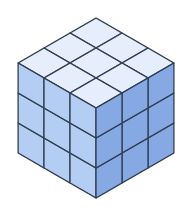
The diagram shows a large cube made from small cubes, all the same size. The large cube is 3 small cubes long, 3 small cubes wide and 3 small cubes high.
What is the number of small cubes as a power of 3? Then work out how many small cubes there are.
Model answer
Number of cubes \(= 3 \times 3 \times 3 = 3^3\) Each layer has \(3 \times 3 = 9\) cubes and there are 3 layers. \(9 \times 3 = 27\) small cubes
Explanation
The cube is 3 long, 3 wide and 3 high, so the number of small cubes is \(3 \times 3 \times 3\), which is \(3^3\). That is why \(3^3\) is called '3 cubed'. A common mistake is to count only the cubes you can see, and forget the ones hidden inside.
Mark scheme
1 mark
\(3^3\)
Do not accept \(3 \times 3\) or \(3^2\). \(3 \times 3 \times 3\) on its own is not a power and does not score this mark.
1 mark
27
Award this mark for 27 even if the power is missing or wrong. The answer 27 with no power scores 1 mark, because the question also asks for a power of 3.
Question 3
2 marks
Ali says that \(2^5\) and \(5^2\) have the same value, because they use the same two numbers.
What are the values of \(2^5\) and \(5^2\)? Is Ali right?
Model answer
\(2^5 = 2 \times 2 \times 2 \times 2 \times 2 = 32\) \(5^2 = 5 \times 5 = 25\) No, Ali is not right, because 32 is not equal to 25.
Explanation
Swapping the base and the power usually changes the value. \(2^5\) is five 2s multiplied together, but \(5^2\) is two 5s multiplied together. Working out both values is the clearest way to show that they are different.
Mark scheme
1 mark
No, with a relevant but incomplete reason, e.g. only one of the values worked out correctly (\(2^5 = 32\) or \(5^2 = 25\)), or '\(2^5\) is \(2 \times 2 \times 2 \times 2 \times 2\) but \(5^2\) is \(5 \times 5\)' with no values
'No' on its own scores 0. 'No, because the numbers are the other way round' with nothing else scores 0.
1 mark
A complete correct reason: \(2^5 = 32\) and \(5^2 = 25\), so they are not equal / \(2^5\) is 7 more than \(5^2\)
Both values must be correct. A complete correct reason on its own scores both marks.
Question 4
4 marks
Put these numbers in order of size, starting with the largest.
You cannot order powers just by looking at the base or the power, so work out each value. Build each one up by multiplying by the base again and again. A common mistake is to think \(10^3\) must be the largest because 10 is the biggest base, but \(2^{10}\) is 1,024, which is just bigger than 1,000.
Mark scheme
1 mark
\(2^{10} = 1{,}024\); or the correct order with no working
1 mark
\(3^6 = 729\)
1 mark
\(5^4 = 625\) and \(10^3 = 1{,}000\)
Both needed for this mark.
1 mark
\(2^{10}\), \(10^3\), \(3^6\), \(5^4\)
Accept the values in this order: 1,024, 1,000, 729, 625. Follow through from the pupil's own values if they are ordered correctly, largest first. The order smallest first scores 0 for this mark. A correct order with no working scores full marks.
Ready to try the rest? Tap or type your answers and see straight away how you did.
Ctrl + Enter to check
Study HelperHints first, answers after you try
Stuck on this one? Ask for a hint and I’ll point you in the right direction, without giving the answer away. Once you’ve checked your answer, I’ll show you how the marks are awarded.