Level:
Correct: 0
Incorrect: 0
Marks: 0/0
Practice
Course:
Topics:
Year 7 Maths Smart practice A mixed round aimed at your weak spots
Unit 1
Place value and the number system
Unit 2
Calculating
Unit 3
Factors, multiples and powers
Unit 4
Fractions
Unit 5
Fractions, decimals and percentages
Unit 6
Algebraic expressions
Unit 7
Equations and inequalities
Unit 8
Sequences and graphs
Unit 9
Ratio and proportion
Ratio, proportion and rates of change
Writing and simplifying ratios
Quick practice5 skills
Sharing in a ratio
Quick practice5 skills
Proportion and best buys
Quick practice5 skills
Scale drawings and maps
Quick practice4 skills
Unit 10
Measures, perimeter, area and volume
Unit 11
Angles and shapes
Unit 12
Probability
Unit 13
Statistics
Avg
score:
–
Topics
done:
0/63

Sets and Venn diagrams

Practise 23 questions on Sets and Venn diagrams for Year 7 Maths. Tap or type your answer and find out straight away if you are right, with the Study Helper on hand if you get stuck.

  • 23 questions
  • 1–5 marks each
  • Instant marking
  • No sign-up needed
20 questions, marked as you go

Sample questions with model answers

Here are 4 of the questions in this topic, each with a model answer, an explanation of why it earns the marks and the mark scheme.

Question 1

1 mark

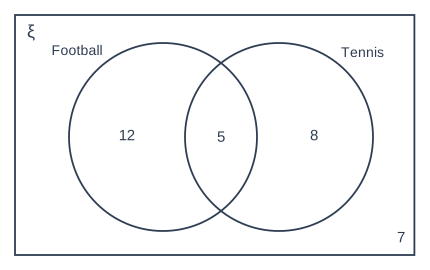
The Venn diagram shows how many pupils in a class play football and how many play tennis.

How many pupils play both football and tennis?

A Venn diagram: a rectangle labelled ξ (the universal set) containing two overlapping circles labelled "Football" and "Tennis". The numbers written in each region are: in "Football" only: 12; in both "Football" and "Tennis": 5; in "Tennis" only: 8; outside both circles: 7.

Model answer

The pupils who play both are in the overlap of the two circles: 5

Explanation

The overlap, where the two circles cross, is for pupils who are in both sets. Here that number is 5. The 12 pupils play football only, the 8 pupils play tennis only, and the 7 outside the circles play neither.

Mark scheme
  1. 1 mark

    5

    Do not accept 25 (12 + 5 + 8) or 32.

Question 2

2 marks

P = {factors of 12}
Q = {factors of 15}

List the members of \(P \cup Q\).

Model answer

P = {1, 2, 3, 4, 6, 12}
Q = {1, 3, 5, 15}
\(P \cup Q\) = {1, 2, 3, 4, 5, 6, 12, 15}

Explanation

The symbol \(\cup\) means union: everything that is in P or in Q or in both. List both sets, then write every number that appears in either list. Numbers in both lists, such as 1 and 3, only need writing once. A common mistake is to give only the numbers in both sets, which is \(P \cap Q\).

Mark scheme
  1. 1 mark

    P = {1, 2, 3, 4, 6, 12} and Q = {1, 3, 5, 15} listed; or the correct answer 1, 2, 3, 4, 5, 6, 12, 15 with no working

    Allow one slip in one of the lists.

  2. 1 mark

    1, 2, 3, 4, 5, 6, 12, 15

    All eight numbers and no others, in any order, with or without curly brackets. Writing 1 or 3 twice is fine. An answer of 1, 3 (the intersection) scores 0. A correct answer with no working scores full marks.

Question 3

3 marks

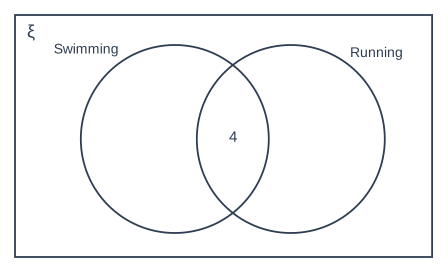
There are 30 pupils in a class.
17 pupils go swimming.
11 pupils go running.
4 pupils go swimming and running.

The Venn diagram shows the 4 pupils who do both.

How many pupils do neither swimming nor running?

A Venn diagram: a rectangle labelled ξ (the universal set) containing two overlapping circles labelled "Swimming" and "Running". The numbers written in each region are: in "Swimming" only: empty; in both "Swimming" and "Running": 4; in "Running" only: empty; outside both circles: empty.

Model answer

Swimming only: 17 - 4 = 13
Running only: 11 - 4 = 7
At least one: 13 + 4 + 7 = 24
Neither: 30 - 24 = 6

Explanation

The 17 swimmers include the 4 who also run, so only 13 swim and do not run. In the same way, 7 run and do not swim. That makes 13 + 4 + 7 = 24 pupils inside the circles, so 30 - 24 = 6 pupils do neither. A common mistake is to work out 30 - 17 - 11, which counts the 4 pupils twice.

Mark scheme
  1. 1 mark

    Swimming only = 17 - 4 = 13, or running only = 11 - 4 = 7; or the correct answer 6 with no working

  2. 1 mark

    13 + 4 + 7 = 24 pupils do at least one, or 17 + 11 - 4 = 24

  3. 1 mark

    6

    An answer of 2 (from 30 - 17 - 11, which counts the 4 twice) scores 0. A correct answer with no working scores full marks.

Question 4

4 marks

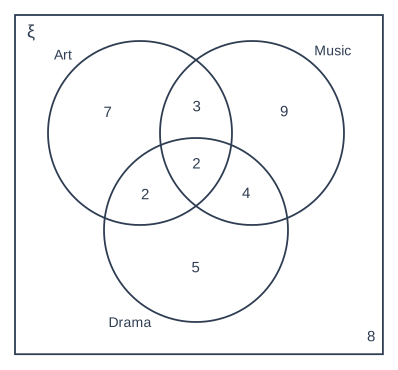
The Venn diagram shows the clubs that the pupils in Year 7 go to.

One pupil is chosen at random.

Work out the probability that this pupil goes to Music but not Drama.
Give your answer as a fraction in its simplest form.

A Venn diagram: a rectangle labelled ξ (the universal set) containing three overlapping circles labelled "Art", "Music" and "Drama", each overlapping the other two. The numbers written in each region are: in "Art" only: 7; in "Music" only: 9; in "Drama" only: 5; in "Art" and "Music" but not "Drama": 3; in "Art" and "Drama" but not "Music": 2; in "Music" and "Drama" but not "Art": 4; in all three: 2; outside all three circles: 8.

Model answer

Total: 7 + 9 + 5 + 3 + 2 + 4 + 2 + 8 = 40
Music but not Drama: Music only 9, Art and Music only 3
9 + 3 = 12
P = \(\dfrac{12}{40} = \dfrac{3}{10}\)

Explanation

Look at the Music circle and leave out every part that is also inside the Drama circle. That leaves Music only (9) and the part shared with Art only (3), so 12 pupils. The total is every number in the diagram, including the 8 outside the circles: 40. Then simplify \(\dfrac{12}{40}\) by dividing by 4. A common mistake is to use only the 9 in Music only.

Mark scheme
  1. 1 mark

    Total of 40 pupils (7 + 9 + 5 + 3 + 2 + 4 + 2 + 8); or the correct answer \(\dfrac{3}{10}\) with no working

  2. 1 mark

    The regions for Music but not Drama identified: 9 (Music only) and 3 (Art and Music only)

  3. 1 mark

    \(\dfrac{12}{40}\)

    Follow through their count over 40.

  4. 1 mark

    \(\dfrac{3}{10}\)

    Simplest form only. 9/40 (Music only) scores the first mark only. A correct answer with no working scores full marks.

Ready to try the rest? Tap or type your answers and see straight away how you did.

Topic notes

Sets and Venn diagrams

The big idea

A set is a collection of things, such as numbers, letters or people. A Venn diagram sorts the members of two sets into overlapping circles, so you can see straight away what is in one set, in both, or in neither. You can then count each part and work out probabilities.

Sets and their members

A set is written inside curly brackets, with its members (the things in it) separated by commas. A capital letter is used as the set's name.

  • S = {square numbers less than 30} = {1, 4, 9, 16, 25}
  • C = {colours on a traffic light} = {red, amber, green}

The order of the members does not matter, and each member is written only once.

The universal set, written \(\xi\) (the Greek letter "xi"), is everything you are choosing from, such as "the whole numbers from 1 to 16".

Venn diagrams

In a Venn diagram, \(\xi\) is a rectangle and each set is a circle inside it. The part where the circles overlap is for members of both sets. Members of \(\xi\) that are in neither set go inside the rectangle but outside both circles.

Sort the numbers in \(\xi\) = {whole numbers from 1 to 16} into a Venn diagram for A = {square numbers} and B = {even numbers}

List each set first: A = {1, 4, 9, 16} and B = {2, 4, 6, 8, 10, 12, 14, 16}

4 and 16 are in both sets, so they go in the overlap.

1 and 9 are in A only. 2, 6, 8, 10, 12 and 14 are in B only.

The numbers left over, 3, 5, 7, 11, 13 and 15, go outside both circles.

A Venn diagram: a rectangle labelled ξ (the universal set) containing two overlapping circles labelled A and B. The elements written in each region are: A ∩ B′ (in A only): 1, 9; A ∩ B (in both A and B): 4, 16; A′ ∩ B (in B only): 2, 6, 8, 10, 12, 14; A′ ∩ B′ (outside both circles): 3, 5, 7, 11, 13, 15. (ξ = {1, 2, 3, 4, 5, 6, 7, 8, 9, 10, 11, 12, 13, 14, 15, 16}; A = {1, 4, 9, 16}; B = {2, 4, 6, 8, 10, 12, 14, 16}.)
A = square numbers and B = even numbers, for the whole numbers from 1 to 16.

Check: \(2 + 2 + 6 + 6 = 16\), so every number appears exactly once.

Intersection and union

SymbolNameMeaningIn the example
\(A \cap B\)intersectionin A and in B (the overlap){4, 16}
\(A \cup B\)unionin A or B or both{1, 2, 4, 6, 8, 9, 10, 12, 14, 16}

\(A \cup B\) has 10 members, not \(4 + 8 = 12\): 4 and 16 are in both sets, so they are only counted once.

Venn diagrams with numbers

A Venn diagram can show how many are in each part instead of listing the members. To find a probability, divide by the total of every part, including the outside.

Reading a Venn diagram that shows numbers

40 people at a fair said which rides they went on.

A Venn diagram: a rectangle labelled ξ (the universal set) containing two overlapping circles labelled "Big wheel" and "Dodgems". The numbers written in each region are: in "Big wheel" only: 11; in both "Big wheel" and "Dodgems": 7; in "Dodgems" only: 14; outside both circles: 8. (n(ξ) = 40; n(Big wheel) = 18; n(Dodgems) = 21; n(Big wheel ∩ Dodgems) = 7; n(Big wheel ∪ Dodgems) = 32.)
11 went on the big wheel only, 7 on both rides, 14 on the dodgems only and 8 on neither.

How many went on the dodgems? Everyone inside the Dodgems circle: \(7 + 14 = 21\)

How many went on at least one ride? \(11 + 7 + 14 = 32\) (or \(40 - 8 = 32\))

One person is chosen at random. What is the probability they went on at least one ride? \(\dfrac{32}{40} = \dfrac{4}{5}\)

Common mistakes

  • Using only the "dodgems only" part (14) for "how many went on the dodgems". The overlap is inside the circle too: the answer is 21.
  • Adding the sizes of the two sets to find the union. Members in the overlap get counted twice.
  • Leaving out the people outside both circles when you find the total.
  • Mixing up \(\cap\) and \(\cup\). The union symbol \(\cup\) looks like a U, for "union".

Top tip

When you are told how many are in each set, fill in the overlap first. Then take it away from each set's total to find the "only" parts, and check that all the parts add up to the total.

Stretch: the complement and three sets

The complement of A, written \(A'\), is everything in \(\xi\) that is not in A. In the first example, \(A'\) = {2, 3, 5, 6, 7, 8, 10, 11, 12, 13, 14, 15}. \((A \cup B)'\) is everything outside both circles: {3, 5, 7, 11, 13, 15}.

A Venn diagram can have three circles. Then there are 8 parts: three for one set only, three for exactly two sets, one in the middle for all three sets, and the outside. To count everyone in one set, add all four parts inside its circle.

Study Helper Hints first, answers after you try

Stuck on this one? Ask for a hint and I’ll point you in the right direction, without giving the answer away. Once you’ve checked your answer, I’ll show you how the marks are awarded.