Level:
Correct: 0
Incorrect: 0
Marks: 0/0
Practice
Course:
Topics:
Year 7 Maths Smart practice A mixed round aimed at your weak spots
Unit 1
Place value and the number system
Unit 2
Calculating
Unit 3
Factors, multiples and powers
Unit 4
Fractions
Unit 5
Fractions, decimals and percentages
Unit 6
Algebraic expressions
Unit 7
Equations and inequalities
Unit 8
Sequences and graphs
Unit 9
Ratio and proportion
Ratio, proportion and rates of change
Writing and simplifying ratios
Quick practice5 skills
Sharing in a ratio
Quick practice5 skills
Proportion and best buys
Quick practice5 skills
Scale drawings and maps
Quick practice4 skills
Unit 10
Measures, perimeter, area and volume
Unit 11
Angles and shapes
Unit 12
Probability
Unit 13
Statistics
Avg
score:
–
Topics
done:
0/63

Order of operations

Practise 29 questions on Order of operations for Year 7 Maths. Tap or type your answer and find out straight away if you are right, with the Study Helper on hand if you get stuck.

  • 29 questions
  • 1–5 marks each
  • Instant marking
  • No sign-up needed
20 questions, marked as you go

Sample questions with model answers

Here are 4 of the questions in this topic, each with a model answer, an explanation of why it earns the marks and the mark scheme.

Question 1

1 mark

Work out \(2 \times 3^2\)

Model answer

Powers first: \(3^2 = 3 \times 3 = 9\)
Then multiply: \(2 \times 9 = 18\)
Answer: 18

Explanation

The power belongs only to the 3, and powers come before multiplication (the I for indices in BIDMAS). So square the 3 first to get 9, then multiply by 2. A common mistake is to multiply first and square 6, which gives 36. Another is to think \(3^2\) means \(3 \times 2\).

Mark scheme
  1. 1 mark

    18

    Do not accept 36 (squaring 6) or 12 (\(2 \times 3 \times 2\)).

Question 2

2 marks

Work out \(3 \times (8 - 2)^2\)

Model answer

Brackets first: \(8 - 2 = 6\)
Power next: \(6^2 = 36\)
Multiply last: \(3 \times 36 = 108\)
Answer: 108

Explanation

Work out the bracket first to get 6. The square belongs to the bracket, so square 6 to get 36. Only then multiply by 3. A common mistake is to multiply \(3 \times 6 = 18\) and then square it, which gives 324.

Mark scheme
  1. 1 mark

    \(8 - 2 = 6\) and \(6^2 = 36\) seen; or the correct answer 108 with no working

  2. 1 mark

    108

    Do not accept 324 (squaring 18) or 36. A correct answer with no working scores full marks.

Question 3

2 marks

Max works out \(20 - 8 + 6\) like this:

\(8 + 6 = 14\)
\(20 - 14 = 6\)

What is Max's mistake? Then work out the correct answer.

Model answer

Max added first, but addition and subtraction are done from left to right.
\(20 - 8 = 12\)
\(12 + 6 = 18\)
Answer: 18

Explanation

In BIDMAS, addition and subtraction have equal priority, so you work through them from left to right. That means \(20 - 8 = 12\) first, then \(12 + 6 = 18\). Max took away the 6 as well as the 8, which is why his answer is too small. The A before S in BIDMAS does not mean addition always comes first.

Mark scheme
  1. 1 mark

    Explanation: addition and subtraction have the same priority, so they should be done from left to right; Max did the addition first

    Accept 'he should do 20 − 8 first'. Do not accept 'addition comes before subtraction' or 'he did it in the wrong order' with no detail.

  2. 1 mark

    18

    This mark can be scored without the explanation.

Question 4

4 marks

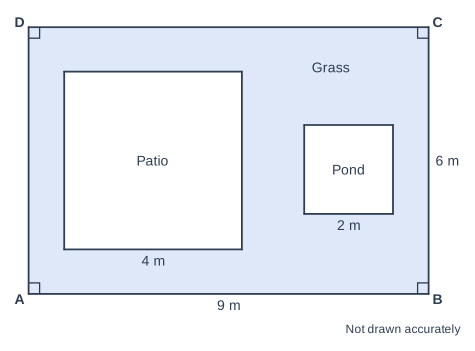
The diagram shows a rectangular garden, 9 m long and 6 m wide. It has a square patio with sides of 4 m and a square pond with sides of 2 m. The rest of the garden is grass.

Which single calculation gives the area of the grass? Then work out the area of the grass.

Geometry diagram, marked "Not drawn accurately". Rectangle ABCD (shaded). A square patio (its vertices are not labelled) (filled white). A square pond (its vertices are not labelled) (filled white). Angle DAB is marked as a right angle (90°). Angle ABC is marked as a right angle (90°). Angle BCD is marked as a right angle (90°). Angle CDA is marked as a right angle (90°). Side AB is labelled 9 m. Side BC is labelled 6 m. The unlabelled side going to the right is labelled 4 m. The unlabelled side going to the right is labelled 2 m. The text "Patio" is written inside rectangle ABCD. The text "Pond" is written inside rectangle ABCD. The text "Grass" is written inside rectangle ABCD.

Model answer

\(9 \times 6 - 4^2 - 2^2\)
\(= 54 - 16 - 4\)
\(= 34\)
Answer: 34 m²

Explanation

The grass is the whole garden with the patio and the pond taken away. The garden is \(9 \times 6 = 54\) m², the patio is \(4^2 = 16\) m² and the pond is \(2^2 = 4\) m². Because powers and multiplication come before subtraction, \(9 \times 6 - 4^2 - 2^2\) needs no brackets. A common mistake is to add the pond on, \(54 - 16 + 4\), instead of taking it away.

Mark scheme
  1. 1 mark

    Area of the garden \(9 \times 6 = 54\), or the patio \(4^2 = 16\) and the pond \(2^2 = 4\)

    Any one of these areas used correctly.

  2. 1 mark

    A correct single calculation, e.g. \(9 \times 6 - 4^2 - 2^2\) or \(9 \times 6 - (4^2 + 2^2)\)

    Accept \(4 \times 4\) for \(4^2\) and \(2 \times 2\) for \(2^2\). Do not accept \(9 \times 6 - 4^2 + 2^2\) (which adds the pond).

  3. 1 mark

    All three areas correct: 54, 16 and 4 (or 54 and 20)

  4. 1 mark

    34 (m²)

    Units not needed. The last two marks can be scored without the single calculation. A correct answer with no calculation written scores 3 marks (all but the single calculation mark).

Ready to try the rest? Tap or type your answers and see straight away how you did.

Topic notes

Order of operations

The big idea

What is \(6 + 2 \times 5\)? If you work from left to right you get 40, but if you multiply first you get 16. Both cannot be right! Mathematicians everywhere agree on one set of rules, called the order of operations, so that a calculation always has just one answer. The correct answer is 16.

BIDMAS

The order is often remembered as BIDMAS:

OrderLettersStands forExamples
1stBBrackets\((3 + 4)\)
2ndIIndices (powers and roots)\(5^2\), \(\sqrt{49}\)
3rdD and MDivision and Multiplication\(\div\) and \(\times\)
4thA and SAddition and Subtraction\(+\) and \(-\)

Some people say BODMAS, where O stands for "Orders". It means the same thing.

An index (or power) tells you how many times to multiply a number by itself. \(5^2\) means "5 squared", which is \(5 \times 5 = 25\). A square root undoes squaring: \(\sqrt{49} = 7\), because \(7 \times 7 = 49\).

The rule people forget

Division and multiplication have the same priority, so you do them in order from left to right. The same goes for addition and subtraction.

  • \(12 \div 4 \times 3 = 3 \times 3 = 9\) (not \(12 \div 12 = 1\))
  • \(15 - 6 + 4 = 9 + 4 = 13\) (not \(15 - 10 = 5\))

Work out \(20 - 3 \times 2^2 + 8 \div 4\)

There are no brackets.

Indices: \(2^2 = 4\), so it becomes \(20 - 3 \times 4 + 8 \div 4\)

Division and multiplication: \(3 \times 4 = 12\) and \(8 \div 4 = 2\), so it becomes \(20 - 12 + 2\)

Addition and subtraction, left to right: \(20 - 12 = 8\), then \(8 + 2 = 10\)

Answer: 10

The line in a fraction works like brackets: work out the top and the bottom first, then divide.

\(\dfrac{4 + 8}{9 - 6} = \dfrac{12}{3} = 4\)

Using brackets

Brackets change the order, because whatever is inside them is done first.

Put brackets into \(18 - 6 \div 3 \times 2\) to make the answer 8. Then put brackets in to make the answer 2.

Without brackets: \(6 \div 3 \times 2 = 2 \times 2 = 4\), so \(18 - 4 = 14\). That is too big, so try doing the subtraction first.

\((18 - 6) \div 3 \times 2 = 12 \div 3 \times 2 = 4 \times 2 = 8\)

To get 2, also put brackets round \(3 \times 2\), so that you divide 12 by 6:

\((18 - 6) \div (3 \times 2) = 12 \div 6 = 2\)

Writing a calculation for a problem

Turn the words into one calculation, then use BIDMAS. Only add brackets when part of the calculation must be done first and BIDMAS would not do it first.

Mia has 50 stickers. She gives 6 stickers to each of her 4 friends. Then she buys a pack of 9 more. Write one calculation for the number of stickers she has now, and work it out.

She gives away \(6 \times 4\) stickers, then gets 9 more:

\(50 - 6 \times 4 + 9\)

Multiply first: \(6 \times 4 = 24\). Then left to right: \(50 - 24 = 26\), and \(26 + 9 = 35\).

Mia has 35 stickers. No brackets are needed, because BIDMAS already does the multiplication first.

Here brackets are needed: 3 friends each buy a £2 drink and a £4 sandwich. The total is \(3 \times (2 + 4) = 3 \times 6 = 18\), so £18. Without brackets, \(3 \times 2 + 4 = 10\) would pay for only one sandwich.

Remember

  • Brackets, then Indices, then Division and Multiplication, then Addition and Subtraction.
  • Division and multiplication: left to right. Addition and subtraction: left to right.
  • A fraction line acts like brackets round the top and round the bottom.

Common mistakes

  • Working straight from left to right: \(9 + 3 \times 2 = 9 + 6 = 15\), not \(12 \times 2 = 24\).
  • Thinking D always comes before M, or A always before S, because of the order of the letters in BIDMAS. Each pair is done left to right.
  • Multiplying before squaring: \(3 \times 4^2 = 3 \times 16 = 48\), not \(12^2 = 144\).
  • Thinking \((4 + 2)^2\) is the same as \(4^2 + 2^2\). It is \(6^2 = 36\), not \(16 + 4 = 20\).

Top tip

Do one step at a time. Write the whole calculation out again after each step, with that part worked out, until only the answer is left.

Study Helper Hints first, answers after you try

Stuck on this one? Ask for a hint and I’ll point you in the right direction, without giving the answer away. Once you’ve checked your answer, I’ll show you how the marks are awarded.