Level:
Correct: 0
Incorrect: 0
Marks: 0/0
Practice
Course:
Topics:
Year 7 Maths Smart practice A mixed round aimed at your weak spots
Unit 1
Place value and the number system
Unit 2
Calculating
Unit 3
Factors, multiples and powers
Unit 4
Fractions
Unit 5
Fractions, decimals and percentages
Unit 6
Algebraic expressions
Unit 7
Equations and inequalities
Unit 8
Sequences and graphs
Unit 9
Ratio and proportion
Ratio, proportion and rates of change
Writing and simplifying ratios
Quick practice5 skills
Sharing in a ratio
Quick practice5 skills
Proportion and best buys
Quick practice5 skills
Scale drawings and maps
Quick practice4 skills
Unit 10
Measures, perimeter, area and volume
Unit 11
Angles and shapes
Unit 12
Probability
Unit 13
Statistics
Avg
score:
–
Topics
done:
0/63

Calculating with negative numbers

Practise 30 questions on Calculating with negative numbers for Year 7 Maths. Tap or type your answer and find out straight away if you are right, with the Study Helper on hand if you get stuck.

  • 30 questions
  • 1–5 marks each
  • Instant marking
  • No sign-up needed
20 questions, marked as you go

Sample questions with model answers

Here are 4 of the questions in this topic, each with a model answer, an explanation of why it earns the marks and the mark scheme.

Question 1

1 mark

Work out \(5 - (-2)\)

Model answer

\(5 - (-2) = 5 + 2 = 7\)

Explanation

Subtracting a negative number is the same as adding the positive number, so \(5 - (-2)\) becomes \(5 + 2 = 7\). You can also think of it as the gap between \(-2\) and 5 on a number line, which is 7. A common mistake is to give 3 by working out 5 - 2.

Mark scheme
  1. 1 mark

    7

    Accept 7 or +7. Do not accept 3 (a common mistake: working out 5 - 2), \(-3\) or \(-7\).

Question 2

2 marks

The number line shows two arrows, A and B.

Work out the number at A minus the number at B.

A horizontal scale from −5 to 5, divided into 10 equal parts by long marks. Every long mark is numbered (−5, −4, −3, −2, −1, 0, 1, 2, 3, 4 and 5). An arrow labelled A points to a mark on the scale. An arrow labelled B points to a mark on the scale.

Model answer

A is \(-4\) and B is 3.
\(-4 - 3 = -7\)

Explanation

Read each arrow first: A is 4 places to the left of zero, so it is \(-4\), and B is 3. Then start at \(-4\) and move 3 to the left, which takes you to \(-7\). A common mistake is to work out B minus A instead, which gives 7.

Mark scheme
  1. 1 mark

    Reads A as \(-4\) and B as 3; or the correct answer \(-7\) with no working

    Both readings are needed for this mark. They may be seen in a calculation such as \(-4 - 3\).

  2. 1 mark

    \(-7\)

    Follow through from their readings: their A minus their B, worked out correctly. Do not accept 7 (B minus A) or \(-1\). A correct answer with no working scores full marks.

Question 3

3 marks

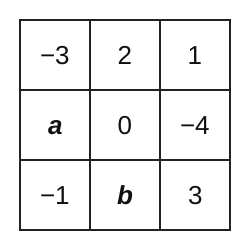
In a magic square, the numbers in each row, each column and each diagonal add up to the same total.

The diagram shows a magic square with two missing numbers, \(a\) and \(b\).

Work out the value of \(a\) and the value of \(b\).

A 3 by 3 magic square. Top row, left to right: −3, 2, 1. Middle row: a, 0, −4. Bottom row: −1, b, 3.

Model answer

Top row: \(-3 + 2 + 1 = 0\), so every line adds to 0.
Middle row: \(a + 0 + (-4) = 0\), so \(a = 4\)
Middle column: \(2 + 0 + b = 0\), so \(b = -2\)

Explanation

Start with a line that is complete to find the magic total, which is 0 here. Then choose a line with only one missing number. The middle row needs \(a - 4 = 0\), so \(a = 4\), and the middle column needs \(2 + b = 0\), so \(b = -2\). Check with another line, such as the left column: \(-3 + 4 + (-1) = 0\). A common mistake is to give \(a = -4\).

Mark scheme
  1. 1 mark

    Finds the total of 0, e.g. from the top row \(-3 + 2 + 1 = 0\); or the correct answers \(a = 4\) and \(b = -2\) with no working

    Any complete line may be used: the top row, the right-hand column or a diagonal.

  2. 1 mark

    \(a = 4\)

    Accept 4. Follow through from a wrong total T: \(a = T + 4\).

  3. 1 mark

    \(b = -2\)

    Accept \(-2\). Follow through from a wrong total T: \(b = T - 2\). A correct answer with no working scores full marks.

Question 4

4 marks

Scientists arrive at a hut in Antarctica at 06:50. The temperature inside the hut is \(-18^\circ\text{C}\).

They switch on a heater. The temperature inside the hut goes up by 2 degrees every 3 minutes.

At what time will the temperature inside the hut reach \(4^\circ\text{C}\)?

Model answer

Rise needed: \(4 - (-18) = 22\) degrees
\(22 \div 2 = 11\) lots of 3 minutes
\(11 \times 3 = 33\) minutes
06:50 + 33 minutes = 07:23

Explanation

First find how far the temperature must rise: from \(-18\) up to 0 is 18 degrees, and then 4 more, so 22 degrees. It rises 2 degrees every 3 minutes, so it needs 11 lots of 3 minutes, which is 33 minutes. Adding 33 minutes to 06:50 crosses the hour: 10 minutes takes you to 07:00, and 23 more takes you to 07:23. A common mistake is to work out 18 - 4 = 14 for the rise.

Mark scheme
  1. 1 mark

    Finds the rise needed: 22 degrees, e.g. \(4 - (-18) = 22\); or the correct answer 07:23 with no working

    Accept 18 + 4 = 22.

  2. 1 mark

    \(22 \div 2 = 11\) (lots of 2 degrees)

    Follow through: their rise \(\div\) 2.

  3. 1 mark

    \(11 \times 3 = 33\) minutes

    Follow through: their number of lots \(\times\) 3.

  4. 1 mark

    07:23

    Accept 7:23 am or 7.23 am. Follow through: 06:50 plus their number of minutes, added correctly. Do not accept 06:83. A correct answer with no working scores full marks.

Ready to try the rest? Tap or type your answers and see straight away how you did.

Topic notes

Calculating with negative numbers

The big idea

You can add, subtract, multiply and divide with negative numbers, just as with positive ones. A number line shows you how adding and subtracting work, and two short sign rules deal with multiplying and dividing. You need these skills for temperature changes, scores in games and number puzzles.

Adding and subtracting

Start at the first number on a number line, then move.

  • Adding a positive number: move right. \(-3 + 5 = 2\)
  • Subtracting a positive number: move left. \(-2 - 4 = -6\)
A horizontal scale from −8 to 4, divided into 12 equal parts by long marks. Every long mark is numbered (−8, −7, −6, −5, −4, −3, −2, −1, 0, 1, 2, 3 and 4). Long marks are every 1. Arrow start points to −2. Arrow end points to −6.
−2 − 4: start at −2 and move 4 to the left. You end at −6.

When the number you add or subtract is negative, swap the direction:

You seeIt is the same asExample
add a negativesubtract\(4 + (-7) = 4 - 7 = -3\)
subtract a negativeadd\(1 - (-5) = 1 + 5 = 6\)

Why does subtracting a negative add? Subtraction finds a difference. \(1 - (-5)\) asks how far it is from \(-5\) up to 1, and that is 6 steps.

Work out \(-4 + 9\), \(3 - 10\), \(-2 - (-7)\) and \(5 + (-8)\)

\(-4 + 9\): start at \(-4\) and move 9 right. Answer: 5

\(3 - 10\): start at 3 and move 10 left. Answer: \(-7\)

\(-2 - (-7)\): subtracting a negative is adding, so \(-2 + 7 = 5\)

\(5 + (-8)\): adding a negative is subtracting, so \(5 - 8 = -3\)

Multiplying and dividing

Work out the answer as if both numbers were positive, then use the sign rules to decide if it is positive or negative:

SignsAnswerExamples
the samepositive\(4 \times 3 = 12\), \((-4) \times (-3) = 12\)
differentnegative\((-4) \times 3 = -12\), \(12 \div (-3) = -4\)

The rules are the same for division. You can see why a negative times a positive is negative: \(3 \times (-4)\) means three lots of \(-4\), and \((-4) + (-4) + (-4) = -12\).

Work out \(-7 \times 4\), \(-36 \div (-9)\) and \((-2) \times (-3) \times (-5)\)

\(-7 \times 4\): \(7 \times 4 = 28\). The signs are different, so the answer is \(-28\).

\(-36 \div (-9)\): \(36 \div 9 = 4\). The signs are the same, so the answer is 4.

\((-2) \times (-3) \times (-5)\): do it in two steps. \((-2) \times (-3) = 6\), then \(6 \times (-5) = -30\).

With three or more numbers, count the negative signs. An even number of them gives a positive answer, and an odd number gives a negative answer.

Squaring a negative number

\((-8)^2\) means \((-8) \times (-8)\). The signs are the same, so \((-8)^2 = 64\). In fact, the square of any number except 0 is positive. So if \(\square^2 = 49\), the missing number could be 7 or \(-7\).

Temperature changes and puzzles

A diver is 24 m below the surface, at \(-24\) m. She swims up 3 m every minute. Where is she after 5 minutes?

In 5 minutes she rises \(5 \times 3 = 15\) m.

\(-24 + 15 = -9\)

She is at \(-9\) m, which is 9 m below the surface.

Temperature changes work the same way: a fall of 4 degrees from \(-7\) °C gives \(-7 - 4 = -11\) °C.

In a missing-number puzzle, use the inverse operation. For \(\square - 6 = -10\), undo the subtraction by adding 6: \(\square = -10 + 6 = -4\). In a magic square, every row, column and diagonal adds up to the same total, so start by adding up a line that is already complete.

Stretch: order of operations with negative numbers

BIDMAS works in the same way with negative numbers. Take extra care with the signs:

  • \(-10 + 3 \times (-2)^2 = -10 + 3 \times 4 = -10 + 12 = 2\)
  • \(8 - 12 \div (-4) = 8 - (-3) = 8 + 3 = 11\)

Remember

  • Adding a negative is the same as subtracting. Subtracting a negative is the same as adding.
  • Multiplying or dividing: same signs give a positive, different signs give a negative.
  • A negative number squared is positive: \((-3)^2 = 9\).

Common mistakes

  • Subtracting when you should add: \(6 - (-4)\) is \(6 + 4 = 10\), not 2.
  • Using "two negatives make a positive" for adding: \(-3 - 5\) is \(-8\), not 8. The sign rules are for multiplying and dividing.
  • Writing \((-5)^2 = -25\). It is \((-5) \times (-5) = 25\).
  • Getting the number right but losing the sign: \(-4 \times 5 = -20\), not 20.

Top tip

For adding and subtracting, picture the number line. For multiplying and dividing, work out the number first, then decide the sign. Always write brackets round a negative number you are squaring: \((-3)^2\).

Study Helper Hints first, answers after you try

Stuck on this one? Ask for a hint and I’ll point you in the right direction, without giving the answer away. Once you’ve checked your answer, I’ll show you how the marks are awarded.