Practise 27 questions on Solving two-step equations for Year 7 Maths. Tap or type your answer and find out straight away if you are right, with the Study Helper on hand if you get stuck.
27 questions
1–5 marks each
Instant marking
No sign-up needed
20 questions, marked as you go
Sample questions with model answers
Here are 4 of the questions in this topic, each with a model answer, an explanation of why it earns the marks and the mark scheme.
Question 1
1 mark
Solve \(5x + 10 = 35\)
Model answer
\(5x + 10 = 35\) \(5x = 25\) \(x = 5\)
Explanation
Subtract 10 from both sides to get \(5x = 25\), then divide both sides by 5 to get \(x = 5\). Check: \(5 \times 5 + 10 = 35\). Always deal with the number that is added or subtracted before the number that multiplies \(x\).
Mark scheme
1 mark
\(x = 5\)
Accept 5. Do not accept 9 (adding 10) or \(-3\) (\(35 \div 5 - 10\)).
Add 2 to both sides: \(\dfrac{x}{3} = 7\). A third of \(x\) is 7, so multiply both sides by 3 to get \(x = 21\). Check: \(21 \div 3 - 2 = 7 - 2 = 5\).
Mark scheme
1 mark
\(\dfrac{x}{3} = 7\); or the correct answer \(x = 21\) with no working, or found by trial and checking
1 mark
\(x = 21\)
Accept 21. Do not accept 9 (subtracting 2), 13 or \(\dfrac{7}{3}\). A correct answer with no working, or found by trial and checking, scores full marks.
Question 3
3 marks
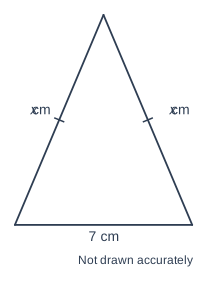
The diagram shows an isosceles triangle. Its perimeter is 25 cm.
The perimeter is all three sides added: \(x + x + 7\), which is \(2x + 7\), so \(2x + 7 = 25\). Subtract 7 to get \(2x = 18\), then divide by 2: \(x = 9\). Check: \(9 + 9 + 7 = 25\). A common mistake is to use only one \(x\) and get 18.
Mark scheme
1 mark
\(2x + 7 = 25\)
Accept \(x + x + 7 = 25\).
1 mark
\(2x = 18\) or \(18 \div 2\); or the correct answer \(x = 9\) with no working, or found by trial and checking
1 mark
\(x = 9\)
Accept 9. Do not accept 16 or 18. A correct answer with no equation scores the last two marks.
Question 4
4 marks
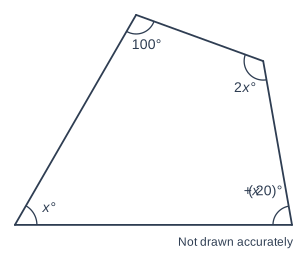
The diagram shows a quadrilateral.
The angles in a quadrilateral add up to \(360^\circ\).
Work out the size of the largest angle.
Model answer
\(x + x + 20 + 2x + 100 = 360\) \(4x + 120 = 360\) \(4x = 240\) \(x = 60\) The angles are \(60^\circ\), \(80^\circ\), \(120^\circ\) and \(100^\circ\). The largest angle is \(2x = 120^\circ\).
Explanation
Add all four angles and set the total equal to 360. Collect the \(x\) terms (\(x + x + 2x = 4x\)) and the numbers (\(20 + 100 = 120\)) to get \(4x + 120 = 360\). Solving gives \(x = 60\), so the angles are 60, 80, 120 and 100, which add up to 360. A common mistake is to give \(x\) itself as the answer instead of the largest angle.
Mark scheme
1 mark
\(x + (x + 20) + 2x + 100 = 360\) or \(4x + 120 = 360\); or the correct answer \(120^\circ\) with no working, or found by trial and checking
1 mark
\(4x = 240\)
Follow through from an equation with one slip.
1 mark
\(x = 60\)
1 mark
\(120^\circ\)
Follow through: 2 × their \(x\), if it is the largest. Do not accept 60 (the value of \(x\)). A correct answer with no working, or found by trial and checking, scores full marks.
Ready to try the rest? Tap or type your answers and see straight away how you did.
Ctrl + Enter to check
Study HelperHints first, answers after you try
Stuck on this one? Ask for a hint and I’ll point you in the right direction, without giving the answer away. Once you’ve checked your answer, I’ll show you how the marks are awarded.