Practise 24 questions on Straight-line graphs for Year 7 Maths. Tap or type your answer and find out straight away if you are right, with the Study Helper on hand if you get stuck.
24 questions
1–5 marks each
Instant marking
No sign-up needed
20 questions, marked as you go
Sample questions with model answers
Here are 4 of the questions in this topic, each with a model answer, an explanation of why it earns the marks and the mark scheme.
Question 1
1 mark
Which of these points lies on the line \(y = 4\)?
Model answer
Every point on \(y = 4\) has y-coordinate 4. Only \((2, 4)\) has y-coordinate 4.
Explanation
The equation \(y = 4\) means the y-coordinate is always 4; the x-coordinate can be anything. So look at the second number in each pair. Only \((2, 4)\) has a 4 there. A common mistake is to choose \((4, 1)\), which has the 4 in the x position: that point is on the line \(x = 4\).
Mark scheme
1 mark
\((2, 4)\)
Accept (2, 4) only.
Question 2
2 marks
Which two of these points lie on the line \(y = x + 3\)?
\((2, 5)\) \((5, 2)\) \((-1, 2)\) \((-4, 1)\)
Model answer
\((2, 5)\): \(2 + 3 = 5\) ✓ \((5, 2)\): \(5 + 3 = 8\), not 2 ✗ \((-1, 2)\): \(-1 + 3 = 2\) ✓ \((-4, 1)\): \(-4 + 3 = -1\), not 1 ✗ The points are \((2, 5)\) and \((-1, 2)\).
Explanation
To test a point, put its x-coordinate into the rule and see whether you get its y-coordinate. For \((2, 5)\), \(2 + 3 = 5\), so it is on the line. For \((-1, 2)\), \(-1 + 3 = 2\), so it is on the line too. The other two do not work. A common mistake is to choose \((5, 2)\) because 5 and 2 differ by 3, but y must be 3 more than x, not 3 less.
Mark scheme
1 mark
\((2, 5)\)
1 mark
\((-1, 2)\)
If a wrong point ((5, 2) or (-4, 1)) is also given, award at most 1 mark in total. Correct answers with no working score full marks.
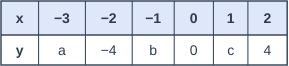
\(y = 2x\) means y is 2 times x, so double each x value. Doubling a negative number gives a negative number: two lots of \(-3\) make \(-6\). Check your answers with the pattern: the y values go up by 2 each time, \(-6, -4, -2, 0, 2, 4\). A common mistake is to add 2 to x instead of multiplying x by 2.
Mark scheme
1 mark
\(a = -6\)
Accept -6 typed with a hyphen, with or without 'a ='. Do not accept -1 (\(-3 + 2\)) or 6.
1 mark
\(b = -2\)
Do not accept 1 (\(-1 + 2\)) or 2.
1 mark
\(c = 2\)
Do not accept 3 (\(1 + 2\)) or 21 (writing the 2 next to the 1). Correct answers with no working score full marks.
Question 4
4 marks
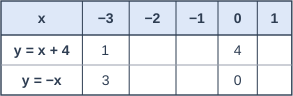
The table shows some values of y for the lines \(y = x + 4\) and \(y = -x\).
The two lines cross at one point.
Use the table to find the coordinates of the point where the lines cross.
Model answer
\(y = x + 4\): x = \(-3, -2, -1, 0, 1\) gives y = \(1, 2, 3, 4, 5\) \(y = -x\): x = \(-3, -2, -1, 0, 1\) gives y = \(3, 2, 1, 0, -1\) When \(x = -2\), both lines have \(y = 2\). The lines cross at \((-2, 2)\).
Explanation
Fill in the gaps by putting each x value into each rule. Where the lines cross, they share the same point, so look for the x value where both rules give the same y. At \(x = -2\), \(y = -2 + 4 = 2\) and \(y = -(-2) = 2\). So the crossing point is \((-2, 2)\). A common mistake is to write the coordinates the wrong way round.
Mark scheme
1 mark
Correct values for \(y = x + 4\) in the gaps: 2, 3, 5 (for x = \(-2\), \(-1\), 1); or the correct answer \((-2, 2)\) with no working
At least two of the three correct.
1 mark
Correct values for \(y = -x\) in the gaps: 2, 1, \(-1\) (for x = \(-2\), \(-1\), 1)
At least two of the three correct.
1 mark
Finds that both lines have the same y value (2) when \(x = -2\)
1 mark
\((-2, 2)\)
Do not accept (2, -2). A correct answer with no working scores full marks.
Ready to try the rest? Tap or type your answers and see straight away how you did.
Ctrl + Enter to check
Study HelperHints first, answers after you try
Stuck on this one? Ask for a hint and I’ll point you in the right direction, without giving the answer away. Once you’ve checked your answer, I’ll show you how the marks are awarded.