Practise 28 questions on Collecting like terms for Year 7 Maths. Tap or type your answer and find out straight away if you are right, with the Study Helper on hand if you get stuck.
28 questions
1–4 marks each
Instant marking
No sign-up needed
20 questions, marked as you go
Sample questions with model answers
Here are 4 of the questions in this topic, each with a model answer, an explanation of why it earns the marks and the mark scheme.
Question 1
1 mark
Which of these is a like term with \(4p\)?
Model answer
\(7p\)
Explanation
Like terms have exactly the same letter part. \(7p\) and \(4p\) are both in \(p\), so they are like terms. \(4q\) has a different letter, \(p^2\) is \(p \times p\), and 4 has no letter, so none of those are like terms with \(4p\). A common mistake is to choose \(4q\) because it has the same number.
Collect the \(m\) terms: \(4m - m = 3m\). Then collect the numbers: \(9 - 12 = -3\). So the answer is \(3m - 3\). A common mistake is to work out \(12 - 9\) and write \(3m + 3\).
Mark scheme
1 mark
\(3m\) or \(-3\) seen as part of a two-term answer; or the correct answer \(3m - 3\) with no working
1 mark
\(3m - 3\)
Accept \(-3 + 3m\) or \(3(m - 1)\). Do not accept \(3m + 3\), \(3m - 21\) or \(0m\). A correct answer with no working scores full marks.
Question 3
2 marks
Simplify \(4x \times 3x\)
Simplify \(\dfrac{15ab}{5}\)
Model answer
\(4 \times 3 = 12\) and \(x \times x = x^2\), so \(4x \times 3x = 12x^2\) \(15 \div 5 = 3\), so \(\dfrac{15ab}{5} = 3ab\)
Explanation
To multiply, multiply the numbers and then the letters: \(4 \times 3 = 12\) and \(x \times x = x^2\), so the answer is \(12x^2\). To divide by a number, divide the number part only: \(15 \div 5 = 3\), and the \(ab\) stays, giving \(3ab\). A common mistake is to write \(12x\) instead of \(12x^2\).
Mark scheme
1 mark
\(12x^2\)
Accept 12x² however the power is typed. Do not accept \(12x\), \(7x^2\) or \(12xx\) (not simplified).
1 mark
\(3ab\)
Accept \(3ba\). Do not accept \(10ab\) or \(75ab\). Each answer is marked on its own.
Question 4
4 marks
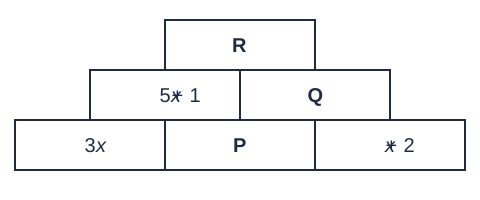
In this algebra pyramid, each brick is the sum of the two bricks directly below it.
Work out the expressions for P, Q and R. Give each answer in its simplest form.
The brick \(5x + 1\) is the sum of \(3x\) and P, so ask what you add to \(3x\) to make \(5x + 1\): you need \(2x\) more and 1 more, so \(P = 2x + 1\). Then add pairs of bricks as usual: \(Q = 3x + 3\) and \(R = 8x + 4\). A common mistake is to add \(3x\) and \(5x + 1\) to find P, but P is below \(5x + 1\), not above it.
Mark scheme
1 mark
A correct method for P, e.g. \(5x + 1 - 3x\) or 'what adds to \(3x\) to make \(5x + 1\)'; or the correct answers \(P = 2x + 1\), \(Q = 3x + 3\), \(R = 8x + 4\) with no working
1 mark
\(P = 2x + 1\)
Do not accept \(8x + 1\) (adding instead of subtracting).
1 mark
\(Q = 3x + 3\)
Follow through their P: their P \(+ x + 2\).
1 mark
\(R = 8x + 4\)
Accept \(4(2x + 1)\). Follow through their Q: \(5x + 1 +\) their Q. A correct answer with no working scores full marks.
Ready to try the rest? Tap or type your answers and see straight away how you did.
Ctrl + Enter to check
Study HelperHints first, answers after you try
Stuck on this one? Ask for a hint and I’ll point you in the right direction, without giving the answer away. Once you’ve checked your answer, I’ll show you how the marks are awarded.