Level:
Correct: 0
Incorrect: 0
Marks: 0/0
Practice
Course:
Topics:
Year 7 Maths Smart practice A mixed round aimed at your weak spots
Unit 1
Place value and the number system
Unit 2
Calculating
Unit 3
Factors, multiples and powers
Unit 4
Fractions
Unit 5
Fractions, decimals and percentages
Unit 6
Algebraic expressions
Unit 7
Equations and inequalities
Unit 8
Sequences and graphs
Unit 9
Ratio and proportion
Ratio, proportion and rates of change
Writing and simplifying ratios
Quick practice5 skills
Sharing in a ratio
Quick practice5 skills
Proportion and best buys
Quick practice5 skills
Scale drawings and maps
Quick practice4 skills
Unit 10
Measures, perimeter, area and volume
Unit 11
Angles and shapes
Unit 12
Probability
Unit 13
Statistics
Avg
score:
–
Topics
done:
0/63

Angles in triangles and quadrilaterals

Practise 27 questions on Angles in triangles and quadrilaterals for Year 7 Maths. Tap or type your answer and find out straight away if you are right, with the Study Helper on hand if you get stuck.

  • 27 questions
  • 1–5 marks each
  • Instant marking
  • No sign-up needed
20 questions, marked as you go

Sample questions with model answers

Here are 4 of the questions in this topic, each with a model answer, an explanation of why it earns the marks and the mark scheme.

Question 1

1 mark

An equilateral triangle has three equal sides and three equal angles.

What is the size of each angle?

Model answer

\(180 \div 3 = 60\)
Each angle is \(60^\circ\).

Explanation

The three angles of any triangle add up to \(180^\circ\). In an equilateral triangle they are all equal, so share 180 equally between the three angles. A common mistake is to divide 360 by 3 and get \(120^\circ\).

Mark scheme
  1. 1 mark

    \(60^\circ\)

    Accept 60. 120 (from \(360 \div 3\)) scores 0.

Question 2

2 marks

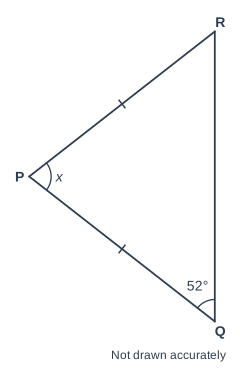
The diagram shows an isosceles triangle PQR with PQ = PR.

Work out the size of angle \(x\).

Geometry diagram, marked "Not drawn accurately". Triangle PQR. Angle PQR is marked 52°. Angle QPR is marked x. PQ and PR are each marked with one short dash (equal lengths).

Model answer

Angle PRQ \(= 52^\circ\) (the triangle is isosceles).
\(52 + 52 = 104\)
\(180 - 104 = 76\)
\(x = 76^\circ\)

Explanation

PQ and PR are equal, so the angles opposite them, at R and Q, are equal: both are \(52^\circ\). The three angles add up to \(180^\circ\), so \(x = 180 - 52 - 52\). A common mistake is to think the angle at P is one of the two equal angles.

Mark scheme
  1. 1 mark

    Angle PRQ \(= 52^\circ\), or \(52 + 52 = 104\), or \(180 - 2 \times 52\) seen; or the correct answer \(76^\circ\) with no working

  2. 1 mark

    \(76^\circ\)

    Accept 76 or \(x = 76\). 128 (from \(180 - 52\)) or 64 (from \((180 - 52) \div 2\)) scores 0 for this mark. A correct answer with no working scores full marks.

Question 3

3 marks

One of the angles in an isosceles triangle is \(100^\circ\).

Work out the sizes of the other two angles.
Why can the \(100^\circ\) angle not be one of the two equal angles?

Model answer

If two angles were \(100^\circ\): \(100 + 100 = 200\), which is more than \(180^\circ\). So \(100^\circ\) is the odd angle.
\(180 - 100 = 80\)
\(80 \div 2 = 40\)
The other two angles are \(40^\circ\) and \(40^\circ\).

Explanation

An isosceles triangle has two equal angles and one odd angle. The \(100^\circ\) angle cannot be one of a pair, because two of them would already be more than \(180^\circ\). So the other two angles are the equal pair: they share \(180 - 100 = 80^\circ\) equally. A common mistake is to write \(100^\circ\) and \(-20^\circ\).

Mark scheme
  1. 1 mark

    \(180 - 100 = 80\); or the correct answer \(40^\circ\) and \(40^\circ\) with no working

  2. 1 mark

    \(40^\circ\) and \(40^\circ\)

    Accept 40 and 40. 100 and -20 scores 0. A correct answer with no working scores the first two marks; the third mark needs the explanation.

  3. 1 mark

    A correct explanation: two angles of \(100^\circ\) would add up to \(200^\circ\), which is more than the \(180^\circ\) in a triangle

    Accept '100 + 100 is already more than 180' or 'a triangle cannot have two obtuse angles because they would add up to more than 180'. A complete correct explanation on its own scores this mark.

Question 4

4 marks

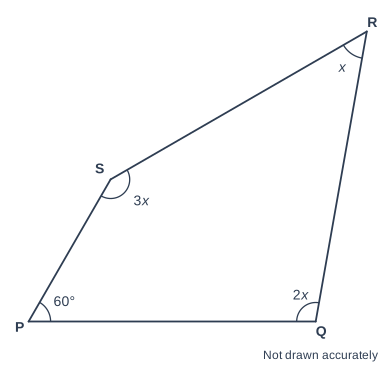
The diagram shows a quadrilateral PQRS.

Work out the size of the largest angle in the quadrilateral.

Geometry diagram, marked "Not drawn accurately". Quadrilateral PQRS. Angle SPQ is marked 60°. Angle PQR is marked 2x. Angle QRS is marked x. Angle RSP is marked 3x.

Model answer

\(x + 2x + 3x + 60 = 360\)
\(6x + 60 = 360\)
\(6x = 300\)
\(x = 50\)
The angles are \(50^\circ\), \(100^\circ\), \(150^\circ\) and \(60^\circ\).
The largest angle is \(3x = 150^\circ\).

Explanation

The angles in a quadrilateral add up to \(360^\circ\), so write an equation and solve it. Collect the \(x\) terms (\(x + 2x + 3x = 6x\)), subtract 60 and divide by 6. The largest angle is \(3x\). A common mistake is to use 180 instead of 360, which gives \(x = 20\).

Mark scheme
  1. 1 mark

    \(x + 2x + 3x + 60 = 360\) or \(6x + 60 = 360\); or the correct answer \(150^\circ\) with no working

  2. 1 mark

    \(6x = 300\)

    Or \(300 \div 6\) seen.

  3. 1 mark

    \(x = 50\)

  4. 1 mark

    \(150^\circ\)

    Accept 150. Follow through 3 times their x. An answer of 50 scores 0 for this mark. A correct answer with no working scores full marks.

Ready to try the rest? Tap or type your answers and see straight away how you did.

Topic notes

Angles in triangles and quadrilaterals

The big idea

The angles inside any triangle add up to 180°, and the angles inside any quadrilateral add up to 360°. With these two facts, and the special properties of some shapes, you can work out missing angles step by step.

Angles in a triangle add up to 180°

Tear the three corners off a paper triangle and put them side by side: they always make a straight line, which is 180°. So to find a missing angle, add the angles you know and subtract the total from 180.

Some triangles have extra facts:

  • Equilateral: all three angles are equal, so each is \(180 \div 3 = 60^\circ\).
  • Isosceles: the two angles at the ends of the third side (the base angles) are equal. They are opposite the two equal sides.
  • Right-angled: one angle is 90°, so the other two add up to 90°.
Geometry diagram, marked "Diagram NOT accurately drawn". Isosceles triangle ABC. Angle BAC is marked 50°. Angle ABC is marked 65°. Angle ACB is marked 65°. AB and AC are each marked with one short dash (equal lengths).
An isosceles triangle with AB = AC. The base angles at B and C are equal, and 50° + 65° + 65° = 180°.

A triangle can never have two angles of 90° or more: together they would already make 180° or more.

Find the angles of a set square

One kind of set square is a right-angled triangle with two equal sides. Work out its other two angles.

The right angle is 90°, so the other two angles share \(180 - 90 = 90^\circ\).

Two equal sides make it isosceles, so these two angles are equal: \(90 \div 2 = 45^\circ\) each.

The angles are 90°, 45° and 45°.

Angles in a quadrilateral add up to 360°

A diagonal (a line joining two opposite corners) cuts any quadrilateral into two triangles. Each triangle's angles add up to 180°, so the four angles add up to \(2 \times 180 = 360^\circ\).

QuadrilateralAngle facts
Square and rectangleall four angles are 90°
Parallelogram and rhombusopposite angles are equal; two angles next to each other add up to 180°
Kiteone pair of opposite angles is equal: the angles where a short side meets a long side

Find the reflex angle in an arrowhead

A quadrilateral shaped like an arrowhead has angles of 30°, 40° and 30°. Its fourth angle is reflex. How big is it?

\(30 + 40 + 30 = 100^\circ\)

Fourth angle: \(360 - 100 = 260^\circ\). The 360° rule works even when one angle is reflex.

Problems with more than one step

Work towards the angle you want one fact at a time, and give a reason for each step.

Geometry diagram, marked "Diagram NOT accurately drawn". House shape PQRTS (shaded). Dashed line segment SR is drawn. Angle SPQ is marked as a right angle (90°). Angle PQR is marked as a right angle (90°). Angle QRT is marked x (x = 150°). PQ, QR, SP, ST, TR and SR are each marked with one short dash (equal lengths).
A house shape made from a square PQRS and a triangle STR. All six marked sides are the same length.

Find angle x in the house shape, giving reasons

PQRS has four equal sides and right angles at P and Q, so it is a square: angle QRS = 90° (the angles in a square are all 90°).

Triangle STR has three equal sides, so it is equilateral: angle SRT = 60° (the angles in an equilateral triangle are all 60°).

\(x = 90 + 60 = 150^\circ\)

Stretch: angles as expressions

Form an equation and find the three angles

In triangle PQR, angle Q is three times angle P, and angle R is 20° more than angle P.

Call angle P \(x\). Then angle Q is \(3x\) and angle R is \(x + 20\).

Angles in a triangle add up to 180°: \(x + 3x + x + 20 = 180\)

\(5x + 20 = 180\), so \(5x = 160\) and \(x = 32\).

Angle P = 32°, angle Q = 96°, angle R = 52°. Check: \(32 + 96 + 52 = 180\).

Remember

  • Angles in a triangle add up to 180°.
  • Angles in a quadrilateral add up to 360°.
  • An isosceles triangle has two equal base angles; an equilateral triangle has three 60° angles.
  • Facts from straight lines (180°) and points (360°) often give the first step.

Common mistakes

  • Using 360° for a triangle or 180° for a quadrilateral.
  • Choosing the wrong pair of equal angles in an isosceles triangle. The equal angles are opposite the equal sides, not between them.
  • Forgetting a right angle that is shown only by a small square.
  • In a parallelogram, saying angles next to each other are equal. It is the opposite angles that are equal.
  • Stopping at \(x\) when the question asks for an angle such as \(2x\).

Top tip

When an isosceles triangle has one angle given, ask: is it one of the two equal angles, or the odd one out? If the question does not say, there may be two possible answers.

Study Helper Hints first, answers after you try

Stuck on this one? Ask for a hint and I’ll point you in the right direction, without giving the answer away. Once you’ve checked your answer, I’ll show you how the marks are awarded.