Level:
Correct: 0
Incorrect: 0
Marks: 0/0
Practice
Course:
Topics:
Year 7 Maths Smart practice A mixed round aimed at your weak spots
Unit 1
Place value and the number system
Unit 2
Calculating
Unit 3
Factors, multiples and powers
Unit 4
Fractions
Unit 5
Fractions, decimals and percentages
Unit 6
Algebraic expressions
Unit 7
Equations and inequalities
Unit 8
Sequences and graphs
Unit 9
Ratio and proportion
Ratio, proportion and rates of change
Writing and simplifying ratios
Quick practice5 skills
Sharing in a ratio
Quick practice5 skills
Proportion and best buys
Quick practice5 skills
Scale drawings and maps
Quick practice4 skills
Unit 10
Measures, perimeter, area and volume
Unit 11
Angles and shapes
Unit 12
Probability
Unit 13
Statistics
Avg
score:
–
Topics
done:
0/63

Algebraic notation and writing expressions

Practise 28 questions on Algebraic notation and writing expressions for Year 7 Maths. Tap or type your answer and find out straight away if you are right, with the Study Helper on hand if you get stuck.

  • 28 questions
  • 1–4 marks each
  • Instant marking
  • No sign-up needed
20 questions, marked as you go

Sample questions with model answers

Here are 4 of the questions in this topic, each with a model answer, an explanation of why it earns the marks and the mark scheme.

Question 1

1 mark

Lily writes 'half of \(m\)' as \(0.5m\).

In algebra, coefficients are usually written as fractions, not decimals.

Which of these shows 'half of \(m\)' using a fraction?

Model answer

\(\dfrac{1}{2}m\) (or \(\dfrac{m}{2}\))

Explanation

A half is the fraction \(\dfrac{1}{2}\), so half of \(m\) is \(\dfrac{1}{2}m\). This is the same as \(m\) divided by 2, so \(\dfrac{m}{2}\) is also right. A common mistake is to write \(\dfrac{2}{m}\), which means 2 divided by \(m\).

Mark scheme
  1. 1 mark

    \(\dfrac{1}{2}m\) or \(\dfrac{m}{2}\)

    Accept 1/2 m, (1/2)m, m/2 or ½m. Do not accept \(0.5m\), \(m \div 2\), \(\dfrac{2}{m}\) or \(2m\).

Question 2

2 marks

A bag of apples costs £\(a\).
A bag of bananas costs £\(b\).

Zainab buys 3 bags of apples and 2 bags of bananas.

Write an expression for the total cost, in pounds.

Model answer

3 bags of apples cost \(3a\) pounds.
2 bags of bananas cost \(2b\) pounds.
Total cost \(= 3a + 2b\) pounds

Explanation

Work out each part first: 3 bags at £\(a\) each cost \(3a\), and 2 bags at £\(b\) each cost \(2b\). Then add them to get \(3a + 2b\). A common mistake is to write \(5ab\), but \(3a\) and \(2b\) are different kinds of term, so they cannot be joined into one term.

Mark scheme
  1. 1 mark

    \(3a\) or \(2b\) seen as part of an expression; or the correct answer \(3a + 2b\) with no working

    For example \(3a + b\) or \(a + 2b\) scores this mark.

  2. 1 mark

    \(3a + 2b\)

    Accept \(2b + 3a\), or £ signs included. The question does not ask for the simplest form, so accept any correct equivalent expression for both marks, e.g. \(3 \times a + 2 \times b\) or \(a + a + a + b + b\). Do not accept \(5ab\), \(6ab\) or \(5(a + b)\). A correct answer with no working scores full marks.

Question 3

2 marks

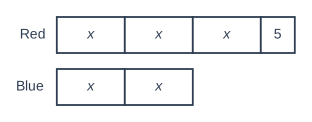
The bar model shows the lengths, in cm, of a red ribbon and a blue ribbon.

Write an expression for how much longer the red ribbon is than the blue ribbon.
Give your answer in its simplest form.

A bar model: 2 bars, one above the other, lined up at the left and drawn to the same scale: bar 1 (labelled "Red") made of 4 parts whose lengths are in the ratio 2 : 2 : 2 : 1; written in the parts (counting from the left): part 1: x, part 2: x, part 3: x, part 4: 5; bar 2 (labelled "Blue") made of 2 parts whose lengths are in the ratio 2 : 2; written in the parts (counting from the left): part 1: x, part 2: x. The bars have lengths in the ratio 7 : 4.

Model answer

Red: \(x + x + x + 5 = 3x + 5\)
Blue: \(x + x = 2x\)
The red ribbon has one more \(x\) and the extra 5, so it is \(x + 5\) cm longer.

Explanation

Line the two bars up. Both have two parts of \(x\), so those match. The red bar has one more \(x\) and an extra 5 cm, so the difference is \(x + 5\). A common mistake is to add the two lengths instead of finding the difference.

Mark scheme
  1. 1 mark

    \(3x + 5\) for the red ribbon or \(2x\) for the blue ribbon seen, or a method such as \(3x + 5 - 2x\); or the correct answer \(x + 5\) with no working

  2. 1 mark

    \(x + 5\)

    Accept \(5 + x\). Ignore cm. The question asks for the simplest form, so an unsimplified expression such as \(3x + 5 - 2x\) scores the first mark only. Do not accept \(5x + 5\) (adding the lengths) or \(3x + 5\). A correct answer with no working scores full marks.

Question 4

4 marks

Five friends order 2 large pizzas.
Each pizza costs £\(p\).
There is also a delivery charge of £3.

Write an expression for the total cost.

The friends share the total cost equally.
Write an expression for the amount each friend pays.

Model answer

2 pizzas cost \(2p\) pounds.
Total cost \(= 2p + 3\) pounds
Each friend pays \(\dfrac{2p + 3}{5}\) pounds.

Explanation

The pizzas cost \(2p\) and the delivery adds 3, so the total is \(2p + 3\). Sharing between 5 means dividing the whole total by 5, so write \(\dfrac{2p + 3}{5}\) with all of \(2p + 3\) on top. A common mistake is to write 2p + 3/5, which shares only the delivery charge.

Mark scheme
  1. 1 mark

    \(2p\) seen; or the correct answers \(2p + 3\) and \(\dfrac{2p + 3}{5}\) with no working

  2. 1 mark

    Total cost: \(2p + 3\)

    Accept \(3 + 2p\) or any correct equivalent, e.g. \(p + p + 3\). Ignore £ signs.

  3. 1 mark

    Their total cost divided by 5, in any form

    For example 2p + 3/5 or \(2p + 3 \div 5\) (brackets missing) scores this mark.

  4. 1 mark

    Each friend: \(\dfrac{2p + 3}{5}\)

    Accept (2p + 3)/5, \((2p + 3) \div 5\), \(\dfrac{1}{5}(2p + 3)\) or any other correct equivalent, e.g. \(\dfrac{2p}{5} + \dfrac{3}{5}\). Do not accept 2p + 3/5 or \(2p + 3 \div 5\) without brackets (these divide only the 3 by 5). A correct answer with no working scores full marks.

Ready to try the rest? Tap or type your answers and see straight away how you did.

Topic notes

Algebraic notation and writing expressions

The big idea

In algebra, a letter stands for a number. It might be a number you do not know yet (an unknown), or a number that can change (a variable). Letters let you write rules that work for any number: if a bag holds \(n\) sweets, then 3 bags hold \(3n\) sweets, whatever \(n\) is.

Writing algebra the usual way

In algebra we leave out × and ÷ signs and write things in a set way.

Instead ofWriteBecause
\(n \times 4\) or \(n + n + n + n\)\(4n\)the number goes first, with no × sign
\(a \times b\)\(ab\)letters next to each other are multiplied
\(1 \times x\)\(x\)there is no need to write the 1
\(m \times m\)\(m^2\) ("\(m\) squared")a small raised number is a power
\(m \times m \times m\)\(m^3\) ("\(m\) cubed")three \(m\)s multiplied together
\(m \times m \times k\)\(m^2k\)powers and letters together
\(y \div 3\)\(\dfrac{y}{3}\)division is written as a fraction
\(0.25 \times y\)\(\dfrac{1}{4}y\) or \(\dfrac{y}{4}\)use fractions, not decimals

Letters usually go in alphabetical order, so write \(5xy\), not \(5yx\).

Brackets keep things together. \(3(n + 2)\) means "add 2 to \(n\), then multiply the answer by 3".

The words you need

  • A term is a number, a letter, or numbers and letters multiplied together, such as 6, \(x\), \(4y\) or \(3ab\).
  • An expression is one term, or several terms joined by + and − signs, such as \(4y + 3x - 2\). It has no equals sign.
  • An equation has an equals sign. It says two things are equal, such as \(4y + 3 = 23\), and you can solve it to find the letter (here \(y = 5\)).
  • A coefficient is the number that multiplies a letter. In \(4y + 3x - 2\), the coefficient of \(y\) is 4 and the coefficient of \(x\) is 3.

Writing expressions from words

WordsExpression
5 more than \(n\)\(n + 5\)
5 less than \(n\)\(n - 5\)
\(n\) less than 5\(5 - n\)
5 times \(n\)\(5n\)
\(n\) shared equally between 5\(\dfrac{n}{5}\)
\(n\) squared\(n^2\)

A bus has \(b\) passengers. At the next stop, 6 people get off and 9 people get on. Write an expression for the number of passengers now.

6 people get off: \(b - 6\)

9 people get on: \(b - 6 + 9\)

Taking 6 away and adding 9 is the same as adding 3, so the bus has \(b + 3\) passengers.

Amira has \(n\) sweets. Ben has twice as many sweets as Amira. Cara has 5 more sweets than Ben. Write expressions for the number of sweets Ben has and the number Cara has.

"Twice as many" means multiply by 2, so Ben has \(2n\) sweets.

Cara has 5 more than Ben, so she has \(2n + 5\) sweets.

A bar model: 3 bars, one above the other, lined up at the left and drawn to the same scale: bar 1 (labelled "Amira") a single part with n written in it (2 units long); bar 2 (labelled "Ben") made of 2 parts whose lengths are in the ratio 2 : 2; written in the parts (counting from the left): part 1: n, part 2: n (4 units long); bar 3 (labelled "Cara") made of 3 parts whose lengths are in the ratio 2 : 2 : 1; written in the parts (counting from the left): part 1: n, part 2: n, part 3: 5; part 3 shaded (5 units long). The bars have lengths in the ratio 2 : 4 : 5. A brace below bar 3 spans the whole bar and is labelled 2n + 5.
A bar model for the sweets: Ben has two lots of n, and Cara has two lots of n and 5 more.

A rectangle is \(w\) cm wide. Its length is 3 cm more than its width. Write an expression for its perimeter.

The length is \(w + 3\) cm.

The perimeter is the distance all the way round, so add all four sides: \(w + (w + 3) + w + (w + 3)\)

That is 4 lots of \(w\) and two lots of 3, so the perimeter is \(4w + 6\) cm.

Common mistakes

  • Writing "7 more than \(n\)" as \(7n\). It is \(n + 7\): \(7n\) means \(7 \times n\), which is 7 lots of \(n\).
  • Mixing up \(2t\) and \(t^2\): \(2t = t + t\), but \(t^2 = t \times t\).
  • Writing "\(k\) divided by 3" as \(\dfrac{3}{k}\). It is \(\dfrac{k}{3}\).
  • Joining different terms: \(4c + 5d\) cannot be written as \(9cd\).
  • Leaving out brackets: "add 2, then multiply by 3" is \(3(n + 2)\), not \(3n + 2\).

Top tip

Test your expression with a number. If Amira has 10 sweets, Ben has 20 and Cara has 25. Put \(n = 10\) into \(2n + 5\): \(20 + 5 = 25\), so the expression works.

Study Helper Hints first, answers after you try

Stuck on this one? Ask for a hint and I’ll point you in the right direction, without giving the answer away. Once you’ve checked your answer, I’ll show you how the marks are awarded.