Level:
Correct: 0
Incorrect: 0
Marks: 0/0
Practice
Course:
Topics:
Year 7 Maths Smart practice A mixed round aimed at your weak spots
Unit 1
Place value and the number system
Unit 2
Calculating
Unit 3
Factors, multiples and powers
Unit 4
Fractions
Unit 5
Fractions, decimals and percentages
Unit 6
Algebraic expressions
Unit 7
Equations and inequalities
Unit 8
Sequences and graphs
Unit 9
Ratio and proportion
Ratio, proportion and rates of change
Writing and simplifying ratios
Quick practice5 skills
Sharing in a ratio
Quick practice5 skills
Proportion and best buys
Quick practice5 skills
Scale drawings and maps
Quick practice4 skills
Unit 10
Measures, perimeter, area and volume
Unit 11
Angles and shapes
Unit 12
Probability
Unit 13
Statistics
Avg
score:
–
Topics
done:
0/63

Money, time and multi-step problems

Practise 30 questions on Money, time and multi-step problems for Year 7 Maths. Tap or type your answer and find out straight away if you are right, with the Study Helper on hand if you get stuck.

  • 30 questions
  • 1–5 marks each
  • Instant marking
  • No sign-up needed
20 questions, marked as you go

Sample questions with model answers

Here are 4 of the questions in this topic, each with a model answer, an explanation of why it earns the marks and the mark scheme.

Question 1

1 mark

Ben buys a sandwich for £2.35. He pays with a £5 note.

How much change should he get?

Model answer

Count on from £2.35: 5p to £2.40, 60p to £3, then £2 to £5.
5p + 60p + £2 = £2.65

Explanation

Change is the amount you pay minus the cost: \(£5.00 - £2.35\). Counting on, like a shopkeeper, makes this easy: from £2.35 add 5p to get £2.40, then 60p to get £3, then £2 to get £5. Altogether that is £2.65. A common mistake is £2.75, from making an error when subtracting across the zeros.

Mark scheme
  1. 1 mark

    £2.65

    Accept 265p. Do not accept £3.75, £2.75 or £3.65. No working is needed.

Question 2

2 marks

Five friends share the bill for a pizza meal equally.

The bill is £43.75. How much does each friend pay?

Model answer

\(£43.75 \div 5\)
\(£40 \div 5 = £8\)
\(£3.75 \div 5 = £0.75\)
Each friend pays £8.75.

Explanation

Sharing equally means dividing by the number of people. Split £43.75 into parts that are easy to divide by 5: £40 shared by 5 is £8, and £3.75 shared by 5 is 75p. So each friend pays £8.75. Check: \(5 \times £8.75 = £43.75\). Money answers need two decimal places, so write £8.75, not £8.7.

Mark scheme
  1. 1 mark

    A correct method, e.g. \(£43.75 \div 5\), or \(£40 \div 5 = £8\) and \(£3.75 \div 5 = 75\text{p}\); or the correct answer £8.75 with no working

  2. 1 mark

    £8.75

    Accept 875p. Do not accept £8.7 or £8.70. A correct answer with no working scores full marks.

Question 3

3 marks

Freya is making party bags for 8 friends.

Each bag has a toy costing £1.35 and some sweets costing 90p.

The empty bags cost £1.20 for a pack of 8.

How much does Freya spend altogether?

Model answer

One bag's toy and sweets: \(£1.35 + £0.90 = £2.25\)
For 8 bags: \(8 \times £2.25 = £18.00\)
Add the pack of bags: \(£18.00 + £1.20 = £19.20\)

Explanation

Find the cost of what goes in one bag first: £1.35 + 90p = £2.25. Eight bags need eight of these: \(8 \times £2.25 = £18\). The empty bags come in one pack of 8 for £1.20, so add that just once, giving £19.20. A common mistake is to pay £1.20 for every bag.

Mark scheme
  1. 1 mark

    \(£1.35 + 90\text{p} = £2.25\) for one bag's toy and sweets, or \(8 \times £1.35 = £10.80\), or \(8 \times 90\text{p} = £7.20\); or the correct answer £19.20 with no working

  2. 1 mark

    £18 for the toys and sweets in all 8 bags

    Follow through from one wrong value if the method is correct.

  3. 1 mark

    £19.20

    Do not accept £27.60 (paying £1.20 for each bag) or £3.45 (the cost of one bag). Follow through: their £18 + £1.20. A correct answer with no working scores full marks.

Question 4

4 marks

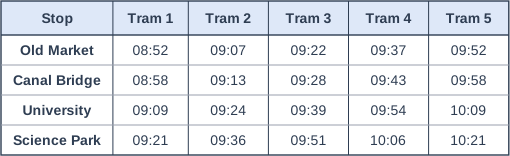
The table shows part of a tram timetable.

Grace lives a 14-minute walk from the Canal Bridge stop. She wants to arrive at the Science Park by 10:00.

What is the latest time she can leave home? How long will her whole journey take, from leaving home to arriving at the Science Park?

Table with columns "Stop", "Tram 1", "Tram 2", "Tram 3", "Tram 4", "Tram 5". Stop: Old Market; Tram 1: 08:52; Tram 2: 09:07; Tram 3: 09:22; Tram 4: 09:37; Tram 5: 09:52 | Stop: Canal Bridge; Tram 1: 08:58; Tram 2: 09:13; Tram 3: 09:28; Tram 4: 09:43; Tram 5: 09:58 | Stop: University; Tram 1: 09:09; Tram 2: 09:24; Tram 3: 09:39; Tram 4: 09:54; Tram 5: 10:09 | Stop: Science Park; Tram 1: 09:21; Tram 2: 09:36; Tram 3: 09:51; Tram 4: 10:06; Tram 5: 10:21.

Model answer

Trams reach the Science Park at 09:21, 09:36, 09:51, 10:06 ...
The latest one before 10:00 arrives at 09:51.
It leaves Canal Bridge at 09:28.
09:28 - 14 minutes = 09:14, so she leaves home at 09:14.
09:14 to 09:51 is 37 minutes.

Explanation

Work backwards from where Grace needs to be. The latest tram to reach the Science Park by 10:00 arrives at 09:51, and that tram is at Canal Bridge at 09:28. She needs 14 minutes to walk there, so she must leave home by 09:14. From 09:14 to 09:51 is 37 minutes. A common mistake is to use the Old Market row instead of Canal Bridge.

Mark scheme
  1. 1 mark

    Chooses the tram that arrives at the Science Park at 09:51 (the next one arrives at 10:06, too late); or the correct answers 09:14 and 37 minutes with no working

  2. 1 mark

    Finds that this tram leaves Canal Bridge at 09:28

  3. 1 mark

    Latest time to leave home: 09:14

    Accept 9:14 am. Follow through: their Canal Bridge time minus 14 minutes.

  4. 1 mark

    Whole journey: 37 minutes

    Follow through: from their leaving time to their arrival time at the Science Park. A correct answer with no working scores full marks.

Ready to try the rest? Tap or type your answers and see straight away how you did.

Topic notes

Money, time and multi-step problems

The big idea

Real-life maths problems usually need more than one step: add up some costs, find the change, check a bus time. The skill is to break the problem into small steps, choose the right operation for each one, and check that your final answer makes sense.

Money

  • £1 = 100p. Write amounts in pounds with two decimal places: £3.05, £0.60.
  • Never mix pounds and pence in one calculation. Change everything to pounds, or everything to pence, first.
  • To find change, count up from the cost to the amount paid, as a shopkeeper does.
  • With special offers such as "3 for 2", work out exactly what you pay for.
  • Many bills have a fixed charge plus an amount for each thing used.

T-shirts cost £8.50 each. The offer is "buy one, get the second half price". Leo buys 2 T-shirts and pays with a £20 note. How much change does he get?

The second T-shirt costs half of £8.50: \(8.50 \div 2 = 4.25\), so £4.25.

Total cost: £8.50 + £4.25 = £12.75

Count up from £12.75 to £20: to £13 is 25p, and from £13 to £20 is £7.

Leo gets £7.25 change.

The 12-hour and 24-hour clock

The 12-hour clock uses am for times from midnight to midday and pm for times from midday to midnight. The 24-hour clock always uses four digits and runs from 00:00 (midnight) to 23:59.

12-hour clock24-hour clock
12:15 am (just after midnight)00:15
7:30 am07:30
12 noon12:00
2:20 pm14:20
11:05 pm23:05

For pm times from 1 pm onwards, add 12 to the hours: 2:20 pm is 14:20. Times between 12 noon and 1 pm keep the 12: 12:40 pm is 12:40.

Working out times and durations

An hour has 60 minutes, not 100, so never subtract times as if they were decimals. Instead, count on in steps, using the next whole hour as a stepping stone.

A podcast is 110 minutes long. Ella starts listening at 16:35. Tea is at 18:15. Will the podcast finish before tea?

110 minutes is 60 + 50, which is 1 hour 50 minutes.

16:35 plus 1 hour is 17:35.

From 17:35, 25 minutes takes you to 18:00, and the other 25 minutes take you to 18:25.

The podcast ends at 18:25, so it will not finish before tea. It ends 10 minutes late.

Timetables

In a timetable, each column is usually one bus or train, and each row is a stop. Read down a column to follow one journey.

Which bus has the quickest journey from Park Road to the Hospital?

StopBus ABus BBus C
Park Road08:0508:3509:10
Market Square08:2108:4909:28
Station08:3409:0209:43
Hospital08:5209:1510:04

Bus A: from 08:05 to 08:52 is 47 minutes.

Bus B: from 08:35 to 09:00 is 25 minutes, then 15 more minutes to 09:15. That is 40 minutes.

Bus C: from 09:10 to 10:00 is 50 minutes, then 4 more to 10:04. That is 54 minutes.

Bus B is the quickest, taking 40 minutes.

Solving multi-step problems

  1. Read the question carefully. What do you need to find?
  2. Write down what you know, with units.
  3. Choose an operation for each step: add for a total, subtract for change or a difference, multiply for several of the same thing, divide to share or to find how many groups.
  4. Work it out one step at a time, writing each step down.
  5. Check: is the answer sensible? An estimate helps. Have you answered the question that was asked?

Remember

  • £1 = 100p, and pounds are written with two decimal places.
  • An hour is 60 minutes. Count on to the next hour; never subtract times like decimals.
  • pm times from 1 pm onwards: add 12 to the hours for the 24-hour clock.

Common mistakes

  • Subtracting times like decimals: from 10:50 to 11:20 is 30 minutes, not 70 minutes.
  • Thinking 1 hour 20 minutes is 120 minutes. It is \(60 + 20 = 80\) minutes.
  • Mixing pounds and pence: 3 pens at 45p cost 135p, which is £1.35, not £135.
  • Adding 10 instead of 12 for a pm time: 4:10 pm is 16:10, not 14:10.

Top tip

When you finish, read the question again. Check that your answer is the thing it asked for (the change, not the total cost) and that it has the right units, such as £ or minutes.

Study Helper Hints first, answers after you try

Stuck on this one? Ask for a hint and I’ll point you in the right direction, without giving the answer away. Once you’ve checked your answer, I’ll show you how the marks are awarded.