Practise 28 questions on Adding and subtracting whole numbers and decimals for Year 7 Maths. Tap or type your answer and find out straight away if you are right, with the Study Helper on hand if you get stuck.
28 questions
1–5 marks each
Instant marking
No sign-up needed
20 questions, marked as you go
Sample questions with model answers
Here are 4 of the questions in this topic, each with a model answer, an explanation of why it earns the marks and the mark scheme.
Question 1
1 mark
Work out \(9.2 - 3.5\)
Model answer
Tenths: you cannot take 5 from 2, so exchange 1 one for 10 tenths: \(12 - 5 = 7\) Ones: \(8 - 3 = 5\) Answer: 5.7
Explanation
Line up the decimal points and subtract column by column, starting with the tenths. You cannot take 5 tenths from 2 tenths, so exchange 1 one for 10 tenths, which makes 12 tenths and leaves 8 ones. A common mistake is to take the smaller digit from the bigger one and get 6.3.
Mark scheme
1 mark
5.7
Accept 5.70. Do not accept 6.3 (taking 2 from 5 in the tenths column).
Line up the decimal points and fill any gaps with zeros: 14.60, 3.85 and 0.70. Then add the hundredths, tenths, ones and tens in turn, carrying when a column reaches 10. Adding 14.6 and 0.7 first is a nice shortcut, because it gives 15.3. A common mistake is to line up the last digits, which puts the 5 hundredths of 3.85 under the 6 tenths of 14.6.
Mark scheme
1 mark
The decimal points lined up, e.g. \(14.60 + 3.85 + 0.70\), or a correct partial total such as \(14.6 + 3.85 = 18.45\) or \(14.6 + 0.7 = 15.3\); or the correct answer 19.15 with no working
Allow one arithmetic slip in a complete correct method.
1 mark
19.15
A correct answer with no working scores full marks.
Question 3
3 marks
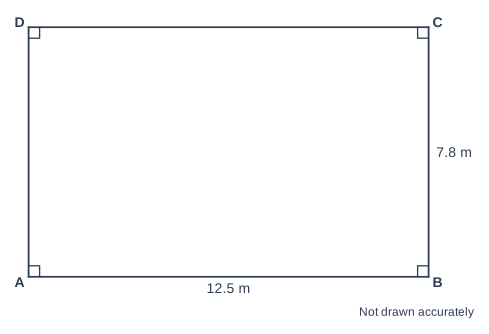
Kai's garden is a rectangle. It is 12.5 m long and 7.8 m wide, as shown in the diagram.
Kai has 35 m of fencing. He wants to put fencing all the way round the garden.
How many more metres of fencing does he need?
Model answer
Perimeter = \(12.5 + 7.8 + 12.5 + 7.8\) \(12.5 + 7.8 = 20.3\), and \(20.3 + 20.3 = 40.6\) m \(40.6 - 35 = 5.6\) Answer: 5.6 m more
Explanation
The fence goes all the way round, so you need the perimeter: a rectangle has two long sides and two short sides, so add all four. The perimeter is 40.6 m, and Kai has only 35 m, so take 35 away from 40.6 to find how much more he needs. A common mistake is to add just the two lengths shown, 12.5 + 7.8 = 20.3 m, and forget the other two sides.
Mark scheme
1 mark
Adds all four sides: \(12.5 + 7.8 + 12.5 + 7.8\), or \(12.5 + 7.8 = 20.3\) then doubled; or the correct answer 5.6 m with no working
Also accept \(2 \times 12.5 + 2 \times 7.8\).
1 mark
Perimeter 40.6 (m)
1 mark
5.6 (m)
Follow through: their perimeter minus 35, if their perimeter came from adding all four sides with one slip. An answer from adding only two sides (20.3 m, so 'he has enough') scores 0. Units not needed. A correct answer with no working scores full marks.
Question 4
4 marks
Here are five digit cards.
2 4 5 7 9
Ella uses each card once to make a 3-digit number and a 2-digit number. Then she adds the two numbers together.
What is the largest total Ella can make? Explain how you know it is the largest.
Model answer
The hundreds digit is worth most, so use 9 there. There are two tens places (one in each number), so use the next biggest digits, 7 and 5, there. The 4 and the 2 go in the ones places. \(974 + 52 = 1026\) Answer: 1026
Explanation
Think about what each digit is worth. Only the 3-digit number has a hundreds digit, so the 9 goes there. Both numbers have a tens digit, so the next two biggest digits, 7 and 5, should both be tens, and the smallest digits go in the ones. A common mistake is to make the 3-digit number as big as possible (975) and use what is left (42), which gives only 1017.
Mark scheme
1 mark
A 3-digit number with 9 as its hundreds digit
e.g. 974, 972, 954 or 952
1 mark
7 and 5 as the two tens digits (so 4 and 2 are the ones digits): \(974 + 52\), \(972 + 54\), \(954 + 72\) or \(952 + 74\)
1 mark
1026
An answer of 1026 with no explanation (with or without a correct pair of numbers) scores the first 3 marks, because only the correct arrangement gives 1026. A common wrong answer is \(975 + 42 = 1017\), which scores the first mark only.
1 mark
Explanation: the hundreds digit is worth the most, so it must be the biggest digit, 9; the tens are worth more than the ones, so the next biggest digits, 7 and 5, go in the two tens places, and the smallest, 4 and 2, in the ones places
Accept an equivalent explanation, e.g. 'biggest digit in the hundreds, the next two biggest in the tens because a digit in the tens is worth 10 times as much as in the ones'. 'I put the biggest digits first' alone is not enough, because it does not explain why 7 and 5 both go in the tens.
Ready to try the rest? Tap or type your answers and see straight away how you did.
Ctrl + Enter to check
Study HelperHints first, answers after you try
Stuck on this one? Ask for a hint and I’ll point you in the right direction, without giving the answer away. Once you’ve checked your answer, I’ll show you how the marks are awarded.