Level:
Correct: 0
Incorrect: 0
Marks: 0/0
Practice
Course:
Topics:
Year 7 Maths Smart practice A mixed round aimed at your weak spots
Unit 1
Place value and the number system
Unit 2
Calculating
Unit 3
Factors, multiples and powers
Unit 4
Fractions
Unit 5
Fractions, decimals and percentages
Unit 6
Algebraic expressions
Unit 7
Equations and inequalities
Unit 8
Sequences and graphs
Unit 9
Ratio and proportion
Ratio, proportion and rates of change
Writing and simplifying ratios
Quick practice5 skills
Sharing in a ratio
Quick practice5 skills
Proportion and best buys
Quick practice5 skills
Scale drawings and maps
Quick practice4 skills
Unit 10
Measures, perimeter, area and volume
Unit 11
Angles and shapes
Unit 12
Probability
Unit 13
Statistics
Avg
score:
–
Topics
done:
0/63

Area and perimeter of compound shapes

Practise 23 questions on Area and perimeter of compound shapes for Year 7 Maths. Tap or type your answer and find out straight away if you are right, with the Study Helper on hand if you get stuck.

  • 23 questions
  • 1–5 marks each
  • Instant marking
  • No sign-up needed
20 questions, marked as you go

Sample questions with model answers

Here are 4 of the questions in this topic, each with a model answer, an explanation of why it earns the marks and the mark scheme.

Question 1

1 mark

Which rectangle has the same area as a rectangle 6 cm long and 4 cm wide?

Model answer

\(6 \times 4 = 24\) cm² and \(8 \times 3 = 24\) cm²
8 cm by 3 cm

Explanation

The rectangle has an area of 6 × 4 = 24 cm². Only 8 cm by 3 cm also gives 24 cm². The 5 cm by 5 cm and 7 cm by 3 cm rectangles have the same perimeter (20 cm) as the 6 cm by 4 cm one, but different areas (25 cm² and 21 cm²). Same perimeter does not mean same area.

Mark scheme
  1. 1 mark

    8 cm by 3 cm

    Only 8 cm by 3 cm scores the mark.

Question 2

2 marks

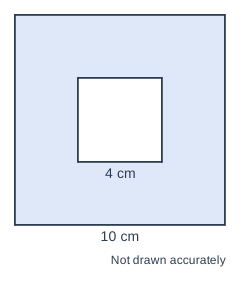
A square tile has sides of 10 cm. A square hole with sides of 4 cm is cut out of the middle, as shown in the diagram.

Work out the area of the tile that is left (the shaded part).

Geometry diagram, marked "Not drawn accurately". A square (its vertices are not labelled) (shaded). A square hole (its vertices are not labelled) (filled white). The unlabelled side going to the right is labelled 10 cm. The unlabelled side going to the right is labelled 4 cm.

Model answer

Whole tile: \(10 \times 10 = 100\) cm²
Hole: \(4 \times 4 = 16\) cm²
Left: \(100 - 16 = 84\) cm²

Explanation

When part of a shape is cut out, work out the area of the whole shape and subtract the part that is missing. The whole tile is 100 cm² and the hole is 16 cm², so 100 − 16 = 84 cm² is left. A common mistake is to subtract the lengths first and work out 6 × 6.

Mark scheme
  1. 1 mark

    Both areas found: \(10 \times 10 = 100\) and \(4 \times 4 = 16\); or the correct answer 84 cm² with no working

  2. 1 mark

    84 cm²

    Accept 84 with no unit. Do not accept 94 (100 − 6) or 36 ((10 − 4) × (10 − 4)). A correct answer with no working scores full marks.

Question 3

3 marks

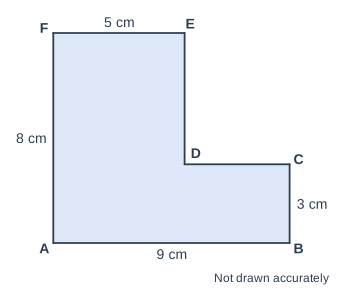
The diagram shows an L-shape. All the corners are right angles.

Work out the area of the L-shape.

Geometry diagram, marked "Not drawn accurately". L-shape ABCDEF (shaded). Side AB is labelled 9 cm. Side BC is labelled 3 cm. Side EF is labelled 5 cm. Side FA is labelled 8 cm.

Model answer

Missing length: CD = \(9 - 5 = 4\) cm
Left rectangle: \(5 \times 8 = 40\) cm²
Right rectangle: \(4 \times 3 = 12\) cm²
Total: \(40 + 12 = 52\) cm²

Explanation

Split the L-shape into two rectangles with a line straight down from E. The left one is 5 cm by 8 cm (40 cm²). The right one is 3 cm tall, and its width is 9 − 5 = 4 cm, so its area is 12 cm². The total is 52 cm². Another way is to work out the 9 cm by 8 cm rectangle (72 cm²) and take away the missing corner, 4 cm by 5 cm (20 cm²).

Mark scheme
  1. 1 mark

    A missing length found: CD = 4 cm (\(9 - 5\)) or DE = 5 cm (\(8 - 3\)); or the correct answer 52 cm² with no working

  2. 1 mark

    The shape split into two rectangles with at least one area correct, e.g. \(5 \times 8 = 40\) and \(4 \times 3 = 12\), or \(9 \times 3 = 27\) and \(5 \times 5 = 25\)

    Or the subtraction method: \(9 \times 8 = 72\) take away \(4 \times 5 = 20\).

  3. 1 mark

    52 cm²

    Accept 52 with no unit. Do not accept 72 (9 × 8) or 34 (the perimeter). A correct answer with no working scores full marks.

Question 4

4 marks

Sam has 12 square paving slabs. Each slab is 1 m by 1 m. He puts all 12 slabs together to make a rectangular patio.

Work out the difference between the largest and the smallest perimeter the patio could have.

Model answer

Rectangles with area 12 m²:
1 by 12: perimeter \(1 + 12 + 1 + 12 = 26\) m
2 by 6: perimeter 16 m
3 by 4: perimeter 14 m
Difference: \(26 - 14 = 12\) m

Explanation

All the rectangles have the same area, 12 m², so list the pairs of whole numbers that multiply to 12: 1 and 12, 2 and 6, 3 and 4. Their perimeters are 26 m, 16 m and 14 m. The long, thin patio has the largest perimeter and the one closest to a square has the smallest. The difference is 26 − 14 = 12 m.

Mark scheme
  1. 1 mark

    At least one correct rectangle with area 12 m², e.g. 3 m by 4 m; or the correct answer 12 m with no working

  2. 1 mark

    All three rectangles: 1 m by 12 m, 2 m by 6 m and 3 m by 4 m

  3. 1 mark

    Largest perimeter 26 m and smallest perimeter 14 m

    The 2 m by 6 m patio has a perimeter of 16 m.

  4. 1 mark

    12 (m)

    ft their largest minus their smallest perimeter. A correct answer with no working scores full marks.

Ready to try the rest? Tap or type your answers and see straight away how you did.

Topic notes

Area and perimeter of compound shapes

The big idea

A compound shape (also called a composite shape) is made by joining simpler shapes, such as rectangles, triangles and trapezia. There is no new formula: split it into parts you know, or work out a bigger shape and take away the part that is missing.

A quick reminder

  • Area is the space inside a shape. It is measured in square units, such as cm² and m².
  • Perimeter is the total distance around the outside edge. It is measured in lengths, such as cm and m.
ShapeArea
Rectanglelength × width
Triangle\(\dfrac{1}{2} \times \text{base} \times \text{height}\), where the height is perpendicular to (at right angles to) the base
Trapezium\(\dfrac{1}{2}(a + b)h\), where \(a\) and \(b\) are the two parallel sides

Two ways to find the area

  1. Split and add: cut the shape into rectangles, triangles or trapezia, work out each area, then add them.
  2. Subtract: work out a larger shape that fits round the whole thing, then take away the area of the part that is missing.

You can use one way to check the other.

Missing lengths come first. When all the corners are right angles, the lengths across the top add up to the length across the bottom, and the lengths up the left side add up to the length up the right side.

Geometry diagram, marked "Diagram NOT accurately drawn". Staircase shape ABCDEFGH (shaded). CD is extended beyond D with a dashed line. EF is extended beyond F with a dashed line. Side AB is labelled 75 cm. Side HA is labelled 60 cm. BC, DE and FG are each marked with one short dash (equal lengths). CD, EF and GH are each marked with two short dashes (equal lengths).
The side panel of a set of steps. Matching dashes show equal lengths, so the three steps are the same size. The dashed lines split the panel into three strips.

Find the perimeter and the area of the step panel

Missing lengths. The three flat parts share the 75 cm across: \(75 \div 3 = 25\) cm each. The three upright parts share the 60 cm: \(60 \div 3 = 20\) cm each.

Perimeter. Add all eight sides: \(75 + 60 + 25 + 25 + 25 + 20 + 20 + 20 = 270\) cm.

Area. Split along the dashed lines into three strips, each 20 cm tall. The bottom strip is 75 cm long, the middle one is \(75 - 25 = 50\) cm and the top one is 25 cm.

\(75 \times 20 + 50 \times 20 + 25 \times 20 = 1500 + 1000 + 500 = 3000\) cm²

Check by subtracting. The rectangle round the panel is \(75 \times 60 = 4500\) cm². The empty space above the steps is \(25 \times 20 + 50 \times 20 = 1500\) cm². \(4500 - 1500 = 3000\) cm², the same answer.

Geometry diagram, marked "Diagram NOT accurately drawn". An arrow shape (its vertices are not labelled) (shaded). A dashed vertical line with no labelled ends is drawn. A dashed horizontal line with no labelled ends is drawn. The unlabelled side going to the right is labelled 10 cm. The unlabelled side going downwards is labelled 4 cm. The unlabelled side going downwards is labelled 2 cm. The unlabelled side going downwards is labelled 2 cm. An unlabelled line going to the right is labelled 5 cm. The angle at an unlabelled point is marked as a right angle (90°).
An arrow made from a rectangle and a triangle. The triangle's height is the dashed 5 cm line.

Find the cost of covering the arrow sign

Shiny film for this arrow sign costs 2p for each cm². How much does the film cost?

Rectangle: \(10 \times 4 = 40\) cm²

The triangle's base is its whole back edge, which sticks out past the rectangle: \(2 + 4 + 2 = 8\) cm. Its perpendicular height is 5 cm.

Triangle: \(\dfrac{1}{2} \times 8 \times 5 = 20\) cm²

Total area: \(40 + 20 = 60\) cm², so the film costs \(60 \times 2 = 120\)p, which is £1.20.

For a cost, find the area first, then multiply by the price per square unit. If paint or tiles come in whole tins or boxes, round up.

Borders and paths

A border or path is the gap between two shapes, one inside the other. Work out the outer shape, then subtract the inner one.

Find the area of the card round a photo

A photo 15 cm wide and 10 cm tall is stuck on card. The card shows a border 3 cm wide at each side and 4 cm deep at the top and the bottom. Work out the area of the border.

The border is on both sides, so add it twice to each length.

Card: \(3 + 15 + 3 = 21\) cm wide and \(4 + 10 + 4 = 18\) cm tall, so \(21 \times 18 = 378\) cm².

Photo: \(15 \times 10 = 150\) cm².

Border: \(378 - 150 = 228\) cm².

Same area, different perimeter

Shapes with the same area can have very different perimeters. Here are rectangles with whole-number sides and an area of 36 cm².

RectanglePerimeter
6 cm by 6 cm24 cm
9 cm by 4 cm26 cm
12 cm by 3 cm30 cm
18 cm by 2 cm40 cm
36 cm by 1 cm74 cm

The closer a rectangle is to a square, the shorter its perimeter; long, thin shapes have long perimeters.

Common mistakes

  • Multiplying the two longest sides of an L-shape: that is the rectangle round the shape.
  • Forgetting to halve when you work out the area of a triangle.
  • Counting a dashed line inside the shape in the perimeter, which only goes round the outside.
  • Adding a border's width only once to each length: it is on both sides.
  • Adding areas when a part has been cut out: subtract it instead.

Top tip

Write the area of each part on the diagram before you add them up. For a perimeter, tick each side as you add it, so you do not miss one or count one twice.

Study Helper Hints first, answers after you try

Stuck on this one? Ask for a hint and I’ll point you in the right direction, without giving the answer away. Once you’ve checked your answer, I’ll show you how the marks are awarded.