Practise 14 exam-style questions on Thermopylae, the sack of Athens and Salamis for OCR GCSE Ancient History (Greece and Persia). Write your answer as you would in the exam and get it marked in seconds against the mark scheme, point by point, with the Study Helper on hand if you get stuck.
14 questions
1–25 marks each
Instant marking
No sign-up needed
14 questions, marked as you go
Sample questions with model answers
Here are 4 of the questions in this topic, each with a model answer, an explanation of why it earns the marks and the mark scheme an examiner would use.
Question 1
1 mark
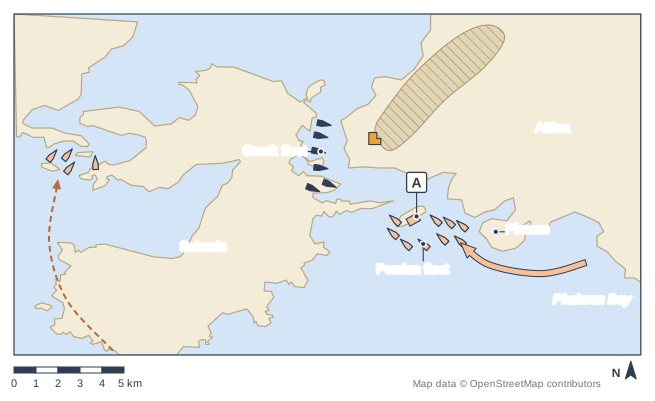
The map shows the positions of the fleets on the night before the Battle of Salamis in 480 BC.
Name the small island marked A, where Xerxes landed Persian troops before the battle.
Model answer
Psyttaleia.
Explanation
Herodotus says the Persians landed troops on Psyttaleia, at the eastern entrance to the straits, to save their own men and kill Greeks washed ashore during the battle. During the battle Aristides landed Athenian hoplites there and killed the Persians on the island.
Mark scheme
1 mark
Psyttaleia
1 mark for the correct answer. Allow recognisable spellings (e.g. Psyttalia, Psitalia). Do not accept Salamis, Aegina or Ceos.
Question 2
6 marks
Outline how the Persians won the Battle of Thermopylae in 480 BC.
Model answer
When Xerxes reached Thermopylae, a few thousand Greeks under the Spartan king Leonidas were holding the narrow pass. Xerxes waited four days, expecting them to leave, and then attacked. On the first day the Medes and Cissians suffered heavy losses, and even the Immortals under Hydarnes failed: in the narrow space their shorter spears were no match for the Greek hoplites and their numbers did not help. The second day's attacks also failed.
The breakthrough came when Ephialtes, a local Malian hoping for a reward, told Xerxes about the Anopaea path over the mountain. Hydarnes led the Immortals along it by night. At dawn they drove the thousand Phocian guards up the mountainside and came down behind the Greek position.
Warned of this, Leonidas sent most of the allies away. On the third day Xerxes attacked from the front, with officers driving their men forward with whips. Leonidas was killed, and when the Immortals arrived behind them the last Greeks were overwhelmed on a small hill. Herodotus says the victory cost the Persians about 20,000 men.
Explanation
Level 3 needs three or more developed points in prose: for example the failure of the frontal attacks and why, Ephialtes and the Anopaea path, and the final attack from both sides. Answers that tell only the story of the 300 Spartans, without explaining how the Persians won, stay in the lower levels.
Mark scheme
6 marks
Levels of response (6 marks, AO1). Level 3 (5-6 marks): Response demonstrates accurate and detailed knowledge of several features and/or characteristics that are fully relevant to the question. This is presented as a prose account that shows a clear understanding of the focus of the question. Level 2 (3-4 marks): Response demonstrates accurate and detailed knowledge of at least one feature and/or characteristic that is fully relevant to the question. This is presented as a prose account that shows some understanding of the focus of the question. Level 1 (1-2 marks): Response includes basic knowledge and basic understanding that is relevant to the question. 0 marks: No response or no response worthy of credit.
Max 2 if the answer is only a list of words or bullet points rather than a prose account. Several (three or more) relevant, accurate features, each with some detail, are needed for Level 3. Possible details include: Xerxes camped at Trachis; a few thousand Greeks under the Spartan king Leonidas held the narrow pass at the Phocian wall; Xerxes sent a horseman to look at the Greeks and waited four days, expecting them to leave; on the first day the Medes and Cissians attacked and suffered heavy losses; then the Immortals under Hydarnes also failed, because the pass was narrow, their spears were shorter and they could not use their numbers; the Spartans used feigned retreats; Herodotus says Xerxes leapt from his seat three times in fear for his army; the second day's attacks also failed; Ephialtes, a local Malian hoping for a reward, told Xerxes about the Anopaea path over the mountain; Hydarnes and the Immortals set out at dusk and climbed through the night; at dawn the thousand Phocians guarding the path were driven to the top of the mountain by arrows, and the Persians ignored them and went down the other side; Leonidas sent most of the allies away and stayed with the Spartans, Thespians and Thebans; on the third morning Xerxes attacked from the front; Persian officers drove their men forward with whips, many were pushed into the sea, and Leonidas and two of Xerxes' brothers were killed; when the Immortals arrived behind them, the remaining Greeks withdrew to a small hill and were killed by missiles; the Thebans surrendered; Herodotus says about 20,000 Persians died; Xerxes had Leonidas' body mutilated and displayed. Do not credit: the fighting at Artemisium (except as brief context); the sack of Athens or Salamis.
Question 3
10 marks
Passage A
Herodotus describes the Persian side of the Battle of Salamis in 480 BC. Xerxes watched the battle from the mainland.
'Most of the Persian ships at Salamis were disabled, some by the Athenians and some by the Aeginetans. Since the Greeks fought in order, while the barbarians were no longer in order and did nothing according to a plan, this was likely. Yet on that day the Persians fought far better than they had off Euboea, each man doing his utmost out of fear of Xerxes, because he thought the King was watching him ... In this struggle the commander Ariabignes, son of Darius and brother of Xerxes, was killed ... When the leading ships turned to flee, most of the Persian losses happened, because those stationed behind, trying to sail forward to show the King some brave deed, crashed into their own side's ships as they fled ... Whenever Xerxes, sitting below the mountain called Aegaleos opposite Salamis, saw one of his own men do something brave, he asked who had done it, and his scribes wrote down the captain's name, his father's name and his city.'
Herodotus, Histories 8.86-90 (adapted)
Using details from Passage A and your own knowledge, what can we learn about the effect of Xerxes' presence on the Persian fleet at Salamis?
Model answer
Passage A suggests that Xerxes' presence made his men fight harder but also helped to cause the disorder that lost the battle.
At the start Herodotus contrasts the two sides: 'the Greeks fought in order, while the barbarians were no longer in order and did nothing according to a plan'. Having the King nearby did not give the Persian fleet discipline or a plan. Yet the Persians 'fought far better than they had off Euboea', each man doing his utmost 'out of fear of Xerxes, because he thought the King was watching him'. This fits own knowledge: Xerxes decided to fight at Salamis partly because he thought his men had been slack at Artemisium when he was not there.
The middle of the passage shows that the royal family led from the front: Ariabignes, Xerxes' brother, was killed. But the King's presence had a damaging effect when the battle turned. The ships 'stationed behind, trying to sail forward to show the King some brave deed, crashed into their own side's ships'. The wish to be seen caused collisions in the narrow strait.
At the end, Xerxes sits 'below the mountain called Aegaleos' while 'his scribes wrote down the captain's name'. He was watching and judging rather than commanding. Own knowledge shows how this worked: when Phoenician captains blamed the Ionians, Xerxes had them beheaded, and some Samian captains were richly rewarded. He even praised Artemisia when she rammed one of his own ships, because he believed it was Greek.
So we learn that Xerxes' presence drove his men by fear and ambition, but it could not overcome the confusion in the narrows and may have made it worse. Herodotus, writing for Greeks, may emphasise the picture of a proud king watching his fleet destroyed.
Explanation
High marks come from explaining both effects shown in the passage - harder fighting from fear and hope of reward, and the collisions caused by ships pushing forward to be seen - with own knowledge such as the reason Xerxes chose to fight, the beheading of the Phoenicians and Artemisia. Answers that only retell the battle without focusing on Xerxes' presence stay in the middle levels.
Mark scheme
10 marks
Levels of response (10 marks: AO1 5, AO3 5). Level 5 (9-10 marks): A range of detailed and accurate knowledge and a developed understanding that is fully relevant to the question (AO1). Uses a range of fully appropriate details from the passage, which are analysed to draw out relevant characteristics and features and give a detailed and sophisticated evaluation of what we can learn from the source about the specified issue (AO3). Level 4 (7-8 marks): Accurate knowledge and a developed understanding that is fully relevant to the question (AO1). Uses a range of fully appropriate details from the passage, which are analysed to draw out most of the relevant characteristics and features and evaluate what we can learn from the source about the specified issue (AO3). Level 3 (5-6 marks): Accurate knowledge and some understanding that is relevant to the question (AO1). Uses some appropriate details from the passage, which are analysed to draw out some of the characteristics and features and evaluate what we can learn from the source about the specified issue (AO3). Level 2 (3-4 marks): Basic knowledge and some understanding that is relevant to the question (AO1). Uses some appropriate details from the passage, which are analysed to draw out a few of the characteristics and features (AO3). Level 1 (1-2 marks): Basic knowledge that is relevant to the topic of the question (AO1). Uses few details from the passage and makes a very basic attempt to draw out any of the characteristics and features (AO3). 0 marks: No response or no response worthy of credit.
Max 6 if the answer uses only the passage, with no own knowledge. Max 6 if the answer makes no use of the passage. Quotations from the passage are credited only when linked to the question. A Level 4 or 5 answer typically uses details from the start, middle and end of the passage. There is no requirement to judge the passage's reliability, but relevant evaluation can be credited under AO3. Valid features the answer could identify from the passage: 'the Greeks fought in order ... the barbarians were no longer in order and did nothing according to a plan' - the King's presence did not give the fleet discipline or a plan; 'the Persians fought far better than they had off Euboea' - his presence made the crews try harder; 'out of fear of Xerxes, because he thought the King was watching him' - they fought from fear of punishment and hope of reward; 'Ariabignes, son of Darius and brother of Xerxes, was killed' - members of the royal family commanded and fought in person; 'those stationed behind, trying to sail forward to show the King some brave deed, crashed into their own side's ships' - the desire to be seen by the King caused collisions and heavy losses; 'sitting below the mountain called Aegaleos' - the King watched from the shore rather than commanding at sea; 'his scribes wrote down the captain's name, his father's name and his city' - a system of recording deeds for reward or punishment. Other valid features from own knowledge: Xerxes chose to fight partly because he thought his men had been slack at Artemisium when he was absent (Herodotus 8.69); Herodotus says that when some Phoenicians blamed the Ionians for their losses, Xerxes ordered the Phoenicians to be beheaded; Artemisia rammed a ship on her own side to escape; Xerxes thought she had sunk a Greek ship and said 'my men have become women, and my women men'; Samian captains such as Theomestor and Phylacus were rewarded for their deeds (Theomestor made tyrant of Samos; Phylacus recorded as a benefactor of the King); in Aeschylus' Persians Xerxes, watching from a high seat, tears his robes and orders the army to retreat; after the battle Xerxes feared the Greeks would break the Hellespont bridges and began to plan his retreat; evaluation: Herodotus wrote for Greeks and presents Xerxes as a proud spectator; his figures and stories may be coloured by this.
Question 4
25 marks
'Xerxes himself was to blame for the Persian defeat at Salamis.'
To what extent do you agree with this view?
Spelling, punctuation and grammar and the use of specialist terminology will be assessed in this answer
Model answer
Xerxes made several decisions that helped to lose the Battle of Salamis, but the Greeks also won it through their own skill, and the weaknesses of the Persian fleet were not all his fault. He was partly, but not wholly, to blame.
The case against Xerxes is strong. Herodotus says that before the battle Artemisia warned him not to fight, arguing that if the Persians waited or attacked the Peloponnese the Greeks would soon break up. Xerxes ignored her and followed the majority, believing that his men had done badly at Artemisium only because he had not been watching. He then believed the message brought by Themistocles' slave Sicinnus that the Greeks were about to flee. In Aeschylus' version he threatened that every captain would lose his head if the Greeks escaped, and kept the fleet rowing up and down all night, so that his crews were tired at dawn. During the battle he watched from the shore under Mount Aegaleos. Herodotus says his men fought hard from fear of him, but the ships behind, eager to be seen by the King, crashed into their own side's ships as they retreated. When Phoenician captains complained, he had them beheaded. Aeschylus saw the whole defeat as the gods punishing Xerxes' pride.
However, other factors were important. Themistocles deserves great credit: his message drew the Persians into the narrow strait, where their larger numbers became a disadvantage. The Greeks fought with discipline, keeping their lines while, as Herodotus says, the Persians 'did nothing according to a plan'. Greek triremes, with hoplite marines on deck, were effective at ramming and boarding in a confined space, and the Greeks knew the local waters.
The Persian fleet also had weaknesses that Xerxes could not quickly fix. It had lost hundreds of ships in storms off Magnesia and Euboea and in the fighting at Artemisium. Many contingents were of doubtful quality: Artemisia herself described the Egyptians, Cypriots, Cilicians and Pamphylians as bad servants of a good master. Many Persians drowned because they could not swim. Finally, most of Xerxes' commanders had advised him to fight, so the decision was not his alone. Our sources also need care: Herodotus drew on Athenian stories that glorified Themistocles, and Aeschylus wrote for an Athenian audience, so Xerxes' mistakes may have been exaggerated to make the victory more dramatic.
Overall, I partly agree. Xerxes' decision to fight in the narrows, his belief in the false message and the pressure he put on his captains made defeat much more likely. But the battle was won by Themistocles' cunning and the discipline of the Greek crews, against a fleet already weakened by storms. Xerxes was responsible for giving the Greeks the battle they wanted, but they still had to win it.
Explanation
The best essays weigh Xerxes' own decisions (rejecting Artemisia, believing Sicinnus, the night blockade, his presence at the battle) against Greek skill, the geography and the weaknesses of the Persian fleet, and reach a clear judgement. Answers that only blame Xerxes, or only praise Themistocles, are one-sided.
Mark scheme
20 marks
Levels of response (20 marks: AO1 10, AO2 10). Level 5 (17-20 marks): A wide range of fully relevant and accurate knowledge, with a good level of detail throughout, showing a thorough understanding of all the key features and characteristics discussed (AO1). A full explanation and thorough, convincing analysis of the issue in the question, arriving at substantiated and developed judgements (AO2). A well-developed and sustained line of reasoning which is coherent, relevant and logically structured. Level 4 (13-16 marks): A good range of fully relevant and accurate knowledge, detailed in places, showing a good understanding of most of the key features and characteristics discussed (AO1). A full explanation and analysis of the issue, arriving at substantiated judgements, but these are not consistently well developed (AO2). A well-developed line of reasoning which is clear, relevant and logically structured. Level 3 (9-12 marks): A wider selection of relevant, generally accurate knowledge, which lacks detail, showing some understanding of the key features and characteristics discussed (AO1). Linked to an analysis and explanation of the issue, but judgements may not always be made explicit (AO2). A line of reasoning which is mostly relevant and has some structure. Level 2 (5-8 marks): A limited amount of relevant knowledge, which may be inaccurate in places and lacks detail, showing limited understanding of the key features and characteristics (AO1). A basic explanation of the issue (AO2). A line of reasoning which has some relevance, presented with limited structure. Level 1 (1-4 marks): Very basic knowledge and basic understanding that is relevant to the topic of the question (AO1). Little or no attempt at a very basic explanation of the issue, which may be close to assertion (AO2). The information is communicated in a basic, unstructured way. 0 marks: No response or no response worthy of credit.
Max 12 if the answer considers only one side of the statement and never addresses the other (the issue of extent). No set answer is expected. It is possible to reach the highest marks either by agreeing or disagreeing with the statement (providing the issue of extent is addressed by refuting the counter-argument), or anywhere between. No reference to ancient sources is expected, but discussion of how far the events in the sources really happened can be credited under AO2. Grounds for agreeing include: he chose to fight in the narrow strait, rejecting Artemisia's advice to wait or to attack the Peloponnese; he believed Themistocles' message (Sicinnus) and ordered the fleet to spend the night blocking the exits, so the crews were tired at dawn; he threatened his captains with death if the Greeks escaped, and his presence made ships push forward to be seen, causing collisions (Herodotus 8.89); he watched from the shore rather than directing the fleet; the battle had no clear Persian plan ('did nothing according to a plan'); his beheading of the Phoenician captains during the battle damaged morale and unity; Aeschylus presents the defeat as the gods punishing Xerxes' pride. Grounds for disagreeing include: Themistocles' skill: his message trapped the Persians into fighting in the narrows, where their numbers counted for little; Greek discipline and tactics: the Greeks kept their lines and attacked from the flanks; Greek triremes were heavier and their hoplite marines effective at boarding; the geography of the strait and local knowledge of the waters favoured the Greeks; the quality of the Persian fleet: many contingents were unreliable (Artemisia called the Egyptians, Cypriots, Cilicians and Pamphylians bad servants); some Ionians were slack; the Persian fleet had already been weakened by storms and at Artemisium; most of Xerxes' commanders, not only Xerxes, advised fighting; Mardonius took the questions to them; many Persians drowned because they could not swim. A top answer weighs Xerxes' decisions against Greek skill, the conditions in the strait and the weaknesses of the Persian fleet, and reaches a substantiated judgement about how far he was to blame.
5 marks
SPaG. Spelling, punctuation and grammar and the use of specialist terminology (5 marks). High performance (4-5 marks): Learners spell and punctuate with consistent accuracy. Learners use rules of grammar with effective control of meaning overall. Learners use a wide range of specialist terms as appropriate. Intermediate performance (2-3 marks): Learners spell and punctuate with considerable accuracy. Learners use rules of grammar with general control of meaning overall. Learners use a good range of specialist terms as appropriate. Threshold performance (1 mark): Learners spell and punctuate with reasonable accuracy. Learners use rules of grammar with some control of meaning and any errors do not significantly hinder meaning overall. Learners use a limited range of specialist terms as appropriate. 0 marks: The learner writes nothing, the response does not relate to the question, or the learner's SPaG does not reach the threshold performance level, for example errors in spelling, punctuation and grammar severely hinder meaning.
Mark the whole answer for spelling, punctuation and grammar and for the accurate use of specialist terms. Specialist terms suited to this question include: trireme, ram, strait, flank, marines, squadron, Phoenician, Ionian, admiral, hubris, tactics, morale. Names of people and places spelled in any recognisable form used in translations (e.g. Dareios/Darius, Artaphrenes/Artaphernes) count as accurate.
Ready to try the rest? Every answer you write is marked against the mark scheme, so you can see exactly where the marks are.
Ctrl + Enter to check
Study HelperHints first, answers after you try
Stuck on this one? Ask for a hint and I’ll point you in the right direction, without giving the answer away. Once you’ve checked your answer, I’ll show you how the marks are awarded.