'The mutiny at the Hyphasis was the turning point of Alexander's campaigns.'
How far do you agree with this view?
You must use and analyse the ancient sources you have studied as well as supporting your answer with your own knowledge.
Model answer
The mutiny at the Hyphasis in 326 BC was an important turning point, but I do not think it was the most important one.
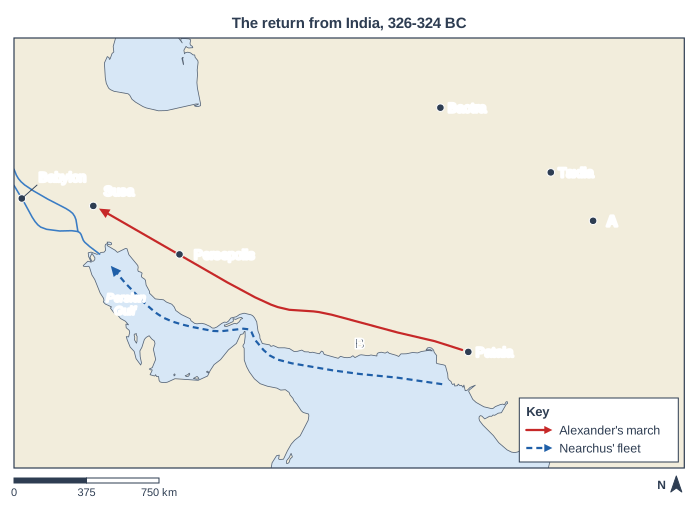
The case for it is strong. For the first time, the army refused to follow Alexander. After eight years of fighting and weeks of monsoon rain, and frightened by reports of huge armies with elephants beyond the river, the soldiers would go no further. Alexander sulked in his tent for three days but had to give way. His conquests in the east ended, and the return led to the march through Gedrosia, whose 'disasters' Arrian admits in 7.4. Arrian also shows that the governors left behind had assumed he would never return from 'beyond the Indus ... and the Hyphasis', and that on his return he had to execute several of them. After this, Alexander's aims turned to ruling and uniting his empire, seen in the Susa marriages, and his relationship with his army never fully recovered, as the mutiny at Opis in 324 BC showed.
However, we must be careful with the evidence. Arrian's sources, Ptolemy, Aristobulus and Nearchus, were Alexander's officers, and they presented the retreat as the king's decision, so they may have played down how serious the mutiny was. Arrian himself writes as an admirer.
Other turning points seem more important. Gaugamela in 331 BC decided the war: Arrian has Alexander tell his officers they were fighting 'for the whole of Asia', and the Babylonian diary, written at the time, records the heavy defeat of Darius' troops and the approach to Babylon. This contemporary, independent evidence shows the battle was seen as decisive straight away. In 330 BC the burning of Persepolis ended the war of revenge, and the death of Darius made Alexander the king of Asia, leading to his adoption of Persian customs. That change caused the tensions that led to the killing of Cleitus and the proskynesis affair, described by both Arrian and Plutarch, which changed Alexander's relationships with his companions more than the Hyphasis did.
Moreover, the Hyphasis did not end the fighting: Alexander campaigned down the Indus and was nearly killed attacking a town of the Malli. India was not remembered as a defeat either. Ptolemy's coin, minted about 306 BC, shows Alexander in an elephant-scalp headdress celebrating his Indian conquests, although as propaganda for Ptolemy it is not neutral evidence.
Overall, the Hyphasis was a genuine turning point in the sense that Alexander's will was overruled for the first time: it marked the turning point in his relationship with his army and the end of his expansion. But Gaugamela and the events of 330 BC changed the nature of his campaigns far more.
Explanation
Strong answers compare the Hyphasis with other possible turning points (Gaugamela, 330 BC, Hephaestion's death) and use the sources critically, for example the officers behind Arrian's account and the contemporary Babylonian diary. Candidates may use sources beyond the set ones. Answers without source evaluation are capped at 8.