Level:
Correct: 0
Incorrect: 0
Marks: 0/0
Exam Practice
Course:
Topics:
OCR GCSE Ancient History (Greece and Persia) Smart practice A mixed round aimed at your weak spots
Unit 1
The Persian Empire, 559-465 BC (period study)
Unit 2
From Tyranny to Democracy, 546-483 BC (depth study)
Unit 3
Athens in the Age of Pericles, 462-429 BC (depth study)
Unit 4
Alexander the Great, 356-323 BC (depth study)
Avg
score:
–
Topics
done:
0/45

The expedition against Persia and the battles against Darius

Practise 12 exam-style questions on The expedition against Persia and the battles against Darius for OCR GCSE Ancient History (Greece and Persia). Write your answer as you would in the exam and get it marked in seconds against the mark scheme, point by point, with the Study Helper on hand if you get stuck.

  • 12 questions
  • 1–20 marks each
  • Instant marking
  • No sign-up needed
12 questions, marked as you go

Sample questions with model answers

Here are 4 of the questions in this topic, each with a model answer, an explanation of why it earns the marks and the mark scheme an examiner would use.

Question 1

2 marks

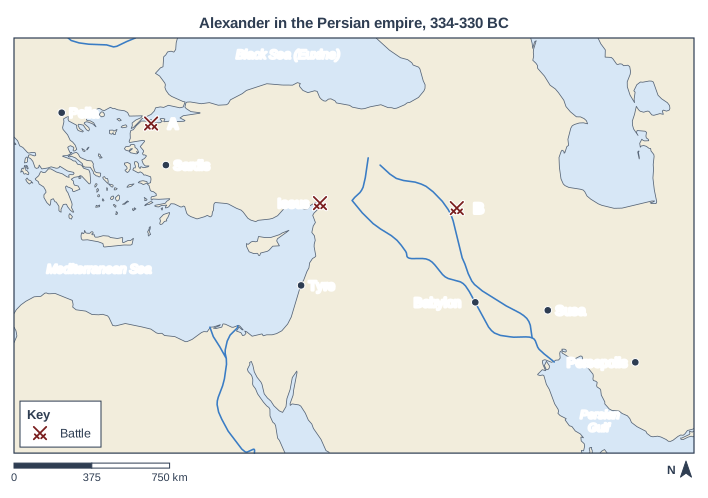
The map shows places in the Persian empire, with some battle sites marked by crossed swords.

Name the battles fought at the sites labelled A and B.

Map of the area from 20°E to 56°E and 26°N to 44°N, titled "Alexander in the Persian empire, 334-330 BC", drawn with real coastlines (land pale buff, sea pale blue) and no modern borders; a north arrow shows north at the top; the scale bar is 750 km long. Sea names printed in blue italics: Mediterranean Sea, Black Sea (Euxine) and Persian Gulf. Blue lines show rivers. Points: a dot labelled "Pella" (inland); a crossed-swords symbol (battle) labelled A on the coast, in the top left of the map (about 20% of the way across and 20% of the way down), about 210 km north of the point labelled "Sardis"; a dot labelled "Sardis" (inland); a crossed-swords symbol (battle) labelled "Issus" (on the coast); a dot labelled "Tyre" (on the coast); a crossed-swords symbol (battle) labelled B inland, near the centre of the map (about 65% of the way across and 40% of the way down), about 460 km north of the point labelled "Babylon"; a dot labelled "Babylon" (inland); a dot labelled "Susa" (inland); a dot labelled "Persepolis" (inland). The key (in a box on the map) shows: "Battle".

Model answer

A is the Battle of the Granicus (334 BC) and B is the Battle of Gaugamela (331 BC).

Explanation

The Granicus, a river in north-west Asia Minor near the Hellespont, was Alexander's first victory in Asia (334 BC); Gaugamela, east of the Tigris near Arbela, was his decisive victory over Darius III (331 BC). Plutarch notes that most writers wrongly placed it at Arbela, so Arbela is accepted.

Mark scheme
  1. 2 marks

    A: (the Battle of) the Granicus (334 BC). B: (the Battle of) Gaugamela (331 BC) / Arbela.

    1 mark for each correct answer, max 2. Allow recognisable spellings (Granikos, Gaugamala). Accept Arbela for B, as many ancient writers named the battle after the nearby town. Do not credit Issus for either letter (Issus is labelled on the map) or Marathon, Thermopylae or Salamis.

Question 2

5 marks

Passage D

Diodorus describes events in 336 BC, shortly before Philip's death.

'In this year King Philip, who had been appointed leader by the Greeks, began the war against Persia by sending Attalus and Parmenio ahead into Asia with part of his forces, ordering them to free the Greek cities. He himself, wanting to begin the war with the approval of the gods, asked the Pythia [the priestess of Apollo at Delphi] whether he would defeat the king of the Persians. Her answer was this: "The bull is garlanded. All is done. There is the one who will strike him." Philip found the reply unclear, but took it in the way that suited him, as foretelling that, like a sacrificial victim, the Persian king would be slaughtered. ... In any case, he believed that the gods were on his side, and he was delighted at the thought that Asia would be made captive by the Macedonians.'

Diodorus Siculus, Library of History 16.91 (adapted)

What can we learn from Passage D about the reasons for the war against Persia?

Model answer

The passage shows that the war was presented as a Greek war: Philip had been 'appointed leader by the Greeks', so Macedon led a Panhellenic campaign. It was also Philip's plan and had already started, since he sent 'Attalus and Parmenio ahead into Asia', which helps explain why Alexander invaded in 334 BC. One stated aim was to 'free the Greek cities' of Asia Minor. Philip's question to the Pythia, whether he 'would defeat the king of the Persians', shows the aim was to defeat the Great King himself, and that he wanted the gods' approval to justify it. However, the end of the passage suggests a less idealistic motive: Philip was 'delighted at the thought that Asia would be made captive by the Macedonians', so conquest and plunder for Macedon, and Philip's own ambition, also mattered. The mixture of Greek freedom and Macedonian conquest is the key lesson.

Explanation

Good answers explain several reasons from the start, middle and end of the passage: Panhellenic leadership, Philip's existing plan, freeing the Greek cities, divine approval and Macedonian conquest. Own knowledge alone, without the passage, scores 1 at most.

Mark scheme
  1. 5 marks

    Levels of response (5 marks, AO3).
    Level 3 (4-5 marks): Response uses a range of fully appropriate details from the passage, which are analysed to draw out relevant characteristics and features and give a detailed and sophisticated evaluation of what we can learn from the source about the specified issue in the question.
    Level 2 (2-3 marks): Response uses some appropriate details from the passage, which are analysed to draw out some of the characteristics and features and evaluate what we can learn from the source about the specified issue in the question.
    Level 1 (1 mark): Response uses few details from the passage and makes a very basic attempt to draw out any of the characteristics and features in relation to the question.
    0 marks: No response or no response worthy of credit.

    Max 1 if the answer makes no use of the passage (own knowledge alone does not answer this question). Details must be explained, not just copied: credit what each detail tells us about the issue. Candidates are likely to pick out and explain: 'appointed leader by the Greeks': the war was presented as a Panhellenic (all-Greek) war led by Macedon through the League of Corinth; 'began the war ... sending Attalus and Parmenio ahead': the war was Philip's plan and had already begun, so Alexander inherited it; 'ordering them to free the Greek cities': one stated aim was to free the Greeks of Asia Minor from Persian rule; 'asked the Pythia ... whether he would defeat the king of the Persians': the aim was nothing less than defeating the Great King; Philip wanted religious approval to justify it; 'like a sacrificial victim, the Persian king would be slaughtered': Philip hoped for the death or defeat of the Persian king himself; 'the gods were on his side': belief in divine support encouraged the war; 'Asia would be made captive by the Macedonians': a more selfish aim, conquest and plunder for Macedon, beyond freeing Greeks; 'he was delighted': Philip's personal ambition and confidence drove the plan. Credit answers that point out the irony that the oracle in fact foretold Philip's own death, but this is not required.

Question 3

5 marks

Source D

A clay tablet from Babylon, now in the British Museum. It is part of an 'astronomical diary' written in cuneiform (wedge-shaped writing) by Babylonian scholars, who recorded the moon, the planets and the weather night by night, together with prices and important events. The entries for September and October 331 BC record an eclipse of the moon, during which 'deaths and plague' are said to have occurred, and panic in the camp of 'the king' (Darius III). They say that on the 24th day of the month (1 October 331 BC), in the morning, 'the king of the world' (Alexander) set up his standard and the two sides fought, and the king's troops suffered a heavy defeat. The king's troops deserted him and went back to their cities, fleeing to the land of the Guti [the hill country north-east of Babylon]. Later lines, badly damaged, mention the approach to Babylon and its great temple, Esagila. Parts of the tablet are broken.

How reliable is the Babylonian tablet as evidence for the Battle of Gaugamela?

Model answer

The tablet is very reliable for the fact and date of the battle, but less useful for its details. It was written at the time by Babylonian scholars, not by Alexander's historians, and its purpose was to record the sky and events, so it had no reason to glorify Alexander. It agrees with Plutarch, who puts the battle eleven nights after an eclipse of the moon, and it confirms that Darius' troops 'suffered a heavy defeat' on 1 October 331 BC. However, it is very short and does not name Gaugamela or describe any tactics, and Babylon was far from the battlefield, so the scribes relied on reports. Calling Alexander 'the king of the world' may show them flattering a conqueror who was about to enter their city. Its claim that the troops 'deserted' Darius is a useful different view from the Greek sources, though parts of the tablet are broken.

Explanation

Top answers balance the tablet's strengths (contemporary, independent, matching the eclipse date) against its limits (brevity, distance from the battle, damage, a possible wish to please the new king) and reach a judgement. Answers that only say 'it is reliable because it is archaeological' stay in Level 1.

Mark scheme
  1. 5 marks

    Levels of response (5 marks, AO3).
    Level 3 (4-5 marks): Response analyses the source by using relevant detail from the source content or historical context to give a more detailed evaluation of the source within its historical context. It draws a thorough and convincing conclusion about its accuracy or reliability based on how the context in which it was created impacts on how it portrays issues or events.
    Level 2 (2-3 marks): Response analyses the source by using relevant detail from the source content or historical context to give a basic evaluation of the source within its historical context. It draws a basic conclusion about its accuracy or reliability based on how the context in which it was created impacts on how it portrays issues or events.
    Level 1 (1 mark): Response analyses the source in a basic way by selecting relevant detail from the source content or historical context.
    0 marks: No response or no response worthy of credit.

    Max 1 if the answer reaches no conclusion at all about how accurate or reliable the source is. Full marks need the evaluation to be related to the particular details of the object, not only general comments about the maker or the type of object. Candidates might comment on: it was written at the time (331 BC), unlike Arrian and Plutarch, who wrote over 400 years later; it comes from Babylonian scholars, not Greeks or Macedonians, so it is independent of Alexander's propaganda and his historians; its purpose was to record astronomical observations and events, not to glorify Alexander, so it has little reason to distort; its dating agrees with the Greek sources: Plutarch (31) puts the battle on the eleventh night after an eclipse of the moon, which matches the tablet; but it is very brief: it does not name Gaugamela or describe tactics, numbers or Alexander's role; Babylon was far from the battlefield, so the scribes relied on reports and rumours; calling Alexander 'the king of the world' may show the scribes adapting quickly to the new ruler, whose favour Babylon needed; it presents events through Babylonian ideas of omens (the eclipse as a bad sign); the statement that Darius' troops deserted him gives a different emphasis from the Greek sources, which say Darius was the first to flee; the tablet is damaged, so some readings are uncertain.

Question 4

20 marks

'Alexander's victories over the Persians were due more to Persian mistakes than to his own skill.'

How far do you agree with this view?

You must use and analyse the ancient sources you have studied as well as supporting your answer with your own knowledge.

Model answer

Persian mistakes certainly helped Alexander, but I would argue that his own skill was more important, because he created and exploited their mistakes.

There is good evidence of Persian errors. Arrian says that at the Granicus the satraps rejected Memnon's advice to destroy the crops and avoid battle, and then lined the river bank with cavalry, leaving their Greek mercenary infantry behind where they could not help. At Gaugamela, Darius kept his army standing in arms all night for fear of a night attack, so that, as Arrian says, fear 'thoroughly cowed their spirits'. During the battle the Persian cavalry rode out to surround Alexander's wing and opened a gap in their own line, and Darius was 'the first to turn and flee'. Plutarch also describes Darius abandoning his chariot.

However, we must be careful with these sources. Arrian's account comes mainly from Ptolemy and Aristobulus, Macedonian officers who admired Alexander and liked to show the Persians as frightened. The claim that Darius fled first may be propaganda; the Babylonian diary, written at the time by Babylonian scholars, says instead that his troops deserted him. The Alexander Mosaic, which shows Darius turning in his chariot as Alexander charges, is a later copy, probably of a Greek painting made to celebrate Alexander, so it is not independent evidence of cowardice.

Moreover, many 'mistakes' were caused by Alexander. The Persians stood in arms all night because Alexander had chosen not to attack at night, and the gap opened because his oblique advance to the right forced Darius to send cavalry round his wing. Arrian describes Alexander's preparation in detail: he reconnoitred the ground, placed a second line to deal with encirclement and posted light troops to defeat the scythed chariots. At the Persian Gates, after a failed frontal attack, he led a night march round the Persian position while Craterus attacked from the front. Arrian had been a general himself, and this military detail is convincing.

The Persians were also dangerous enemies. At the Granicus the first Macedonians to cross 'suffered badly', and at Gaugamela the armoured Scythian and Bactrian cavalry pressed Alexander's right hard while Persian horsemen broke through to the baggage. Victory needed discipline and quick decisions, such as Alexander turning back from the pursuit of Darius to help Parmenio, which Arrian says led to the fiercest cavalry fight of the day, in which about sixty Companions were killed. An army that won only because of enemy mistakes would not have needed to fight so hard.

Overall, Persian mistakes made Alexander's victories easier, and the sources may exaggerate Persian fear, but it was Alexander's planning, tactics and leadership that turned those mistakes into decisive victories.

Explanation

Level 5 answers weigh Persian errors against Alexander's skill across more than one battle and evaluate the evidence, for example the pro-Macedonian bias of Arrian's sources, the independent Babylonian diary and the purpose of the mosaic. Answers that narrate battles without source analysis are capped at 8.

Mark scheme
  1. 20 marks

    Levels of response (20 marks: AO3 10, AO1 5, AO2 5).
    Level 5 (17-20 marks): Detailed evaluation of the ancient sources in their historical context, with thorough analysis of their reliability and accuracy in terms of the context in which they were created, used to make developed, supported judgements and fully convincing conclusions (AO3). A range of detailed, accurate knowledge and a developed understanding (AO1). Thorough, convincing analysis with substantiated, developed judgements (AO2). A sustained, coherent and logically structured line of reasoning.
    Level 4 (13-16 marks): Detailed evaluation of the ancient sources in their context, with some analysis of their reliability and accuracy, used to make supported judgements and reasonable conclusions (AO3). Accurate knowledge and a developed understanding (AO1). A full analysis; judgements are substantiated but not consistently well developed (AO2). A clear, logically structured line of reasoning.
    Level 3 (9-12 marks): Analyses examples from the ancient sources, with a basic analysis of the reliability and accuracy of at least one source in terms of its context, used to make basic judgements and simple conclusions (AO3). Accurate knowledge and some understanding (AO1). Analysis and explanation; judgements may not be explicit (AO2). A mostly relevant line of reasoning with some structure.
    Level 2 (5-8 marks): Uses examples from the ancient sources, with a very basic attempt to consider a source's reliability or accuracy that may border on assertion; no source analysis is used to reach judgements (AO3). Basic knowledge and some understanding (AO1). A basic explanation (AO2). Some relevance; limited structure.
    Level 1 (1-4 marks): Basic use of the sources, with no attempt to consider their reliability or accuracy (AO3). Basic knowledge (AO1). Little or no explanation, close to assertion (AO2). Basic, unstructured communication.
    0 marks: No response or no response worthy of credit.

    Max 8 if the answer makes no use of the ancient sources (it never names, quotes or discusses any ancient writer, work, inscription, coin or other object, and knowing the events is not using the sources). Max 8 if the answer never considers how reliable or accurate any ancient source is. Max 12 if the answer considers only one side of the statement and never addresses the other (the issue of extent). No set answer is expected. It is possible to reach the highest mark either by agreeing or disagreeing with the statement (providing the issue of extent is addressed by refuting the counter-argument), or anywhere between. To access Level 3 and above, answers discuss the ancient sources; at lower levels they may only retell stories from the sources or name them. Candidates do not have to quote directly or give precise references. Grounds for agreeing include: at the Granicus the satraps rejected Memnon's scorched-earth advice (Arrian 1.12) and placed their cavalry on the river bank with the infantry behind, where it was useless (Arrian 1.14); at Gaugamela the Persians stood in arms all night, exhausted and afraid (Arrian 3.11); the Persian cavalry rode out to outflank Alexander and opened a gap in their own line (Arrian 3.14); Darius fled before the battle was decided (Arrian 3.14; Plutarch 33), and his army collapsed; at Issus Darius chose to fight in a narrow coastal plain where his numbers counted for little; at the Persian Gates the mountain path round the wall was only lightly guarded (Arrian 3.18). Grounds for disagreeing include: Alexander's reconnaissance and planning at Gaugamela (Arrian 3.9) and his refusal of a night attack (Arrian 3.10); tactical skill: the oblique advance, the second line, the light troops against chariots (Arrian 3.12-3.13), the wedge at the gap (Arrian 3.14); personal leadership in the front line at the Granicus (Arrian 1.15) and Gaugamela (Plutarch 33); flexibility: turning back from the pursuit to help Parmenio (Arrian 3.15); the flanking march at the Persian Gates (Arrian 3.18); the Persians were not incompetent: their armoured Scythian and Bactrian cavalry pressed Alexander hard, and they broke through to the baggage (Arrian 3.13-3.14); at the Granicus the first Macedonian attack suffered badly (Arrian 1.15); the quality of the Macedonian army, built by Philip, mattered as well as Alexander's skill. Likely sources to be included: Arrian 1.12-1.16 (Granicus), 3.9-3.15 (Gaugamela), 3.18 (Persian Gates); Plutarch 31-33 (Gaugamela); the Babylonian Astronomical Diary (Gaugamela); the Alexander Mosaic (Darius turning to flee). The source analysis is likely to address: Arrian relied on Ptolemy and Aristobulus, Macedonian officers who admired Alexander and stressed his genius and Persian fear; Arrian, a former Roman general, writes knowledgeably about tactics; Plutarch's dramatic details (Darius' chariot trapped by bodies) may come from writers such as Callisthenes, Alexander's official historian, whom he cites for Alexander's prayer; the Diary is contemporary and independent, and says Darius' troops deserted him; the Mosaic is a much later copy, probably of a Greek painting, celebrating Alexander and showing Darius in flight.

Ready to try the rest? Every answer you write is marked against the mark scheme, so you can see exactly where the marks are.

Study Helper Hints first, answers after you try

Stuck on this one? Ask for a hint and I’ll point you in the right direction, without giving the answer away. Once you’ve checked your answer, I’ll show you how the marks are awarded.