Level:
Correct: 0
Incorrect: 0
Marks: 0/0
Exam Practice
Course:
Topics:
OCR GCSE Ancient History (Greece and Persia) Smart practice A mixed round aimed at your weak spots
Unit 1
The Persian Empire, 559-465 BC (period study)
Unit 2
From Tyranny to Democracy, 546-483 BC (depth study)
Unit 3
Athens in the Age of Pericles, 462-429 BC (depth study)
Unit 4
Alexander the Great, 356-323 BC (depth study)
Avg
score:
–
Topics
done:
0/45

The Macedonian army: troops, weapons and tactics

Practise 12 exam-style questions on The Macedonian army: troops, weapons and tactics for OCR GCSE Ancient History (Greece and Persia). Write your answer as you would in the exam and get it marked in seconds against the mark scheme, point by point, with the Study Helper on hand if you get stuck.

  • 12 questions
  • 1–20 marks each
  • Instant marking
  • No sign-up needed
12 questions, marked as you go

Sample questions with model answers

Here are 4 of the questions in this topic, each with a model answer, an explanation of why it earns the marks and the mark scheme an examiner would use.

Question 1

2 marks

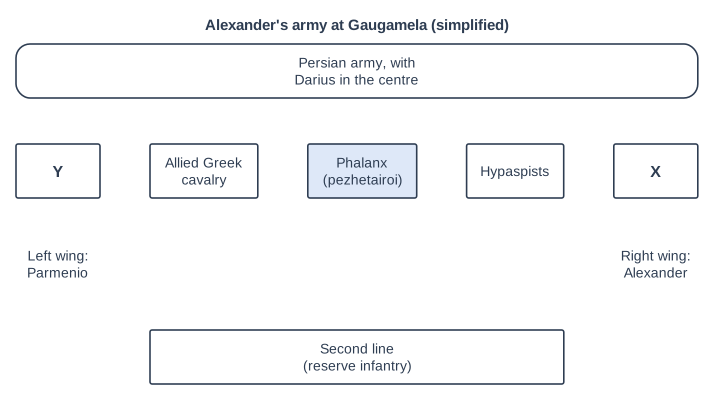
The diagram shows, in simplified form, how Alexander's army was drawn up at the Battle of Gaugamela (331 BC), according to Arrian.

Name the troops labelled X and Y.

Alexander's army at Gaugamela (simplified). Block diagram with nine parts in four rows. Top row: a rounded box "Persian army, with Darius in the centre" (wide, across the diagram). Second row, left to right: a box labelled Y, a box "Allied Greek cavalry", a box "Phalanx (pezhetairoi)" (shaded), a box "Hypaspists" and a box labelled X. Third row, left to right: the text "Left wing: Parmenio" and the text "Right wing: Alexander". Bottom row: a box "Second line (reserve infantry)" (wide).

Model answer

X is the Companion cavalry, led by Alexander on the right wing; Y is the Thessalian cavalry on the left wing under Parmenio.

Explanation

Arrian (3.11) says the Companion cavalry, with the royal squadron in front, held the right wing next to the hypaspists, while Parmenio commanded the left wing, where the Thessalian cavalry fought. This arrangement, with the phalanx in the centre and a second line behind, is typical of Alexander's battles.

Mark scheme
  1. 2 marks

    X: the Companion cavalry / Companions / hetairoi. Y: the Thessalian cavalry / Thessalians.

    1 mark for each correct answer, max 2. Allow recognisable spellings (Hetairoi, Thessalyan). For X accept 'the Companions' or 'the royal squadron and Companion cavalry'; do not credit 'hypaspists' or 'the phalanx' (both shown by name). For Y do not credit 'Greek allied cavalry' (shown by name) or 'Persian cavalry'.

Question 2

5 marks

Passage D

Plutarch describes Alexander at the Battle of Gaugamela (331 BC).

'He put on his helmet; the rest of his armour he was already wearing when he came out of his tent: a belted tunic made in Sicily, and over it a breastplate of linen folded double, taken from the spoils at Issus. His helmet was of iron but shone like polished silver, the work of Theophilus, and to it was fitted a neck-guard, also of iron, set with precious stones. He had a sword of amazing strength and lightness, a gift from the king of Citium [in Cyprus], and he had trained himself to use a sword for most of his fighting. ... As long as he was riding about drawing up part of the phalanx, encouraging, instructing or inspecting his men, he spared Bucephalas, who was now past his prime, and used another horse; but whenever he was going into action, Bucephalas was led up, and he mounted him and at once began the attack.'

Plutarch, Life of Alexander 32 (adapted)

What can we learn from Passage D about how Alexander equipped himself for battle?

Model answer

The passage suggests Alexander's equipment was practical but also designed to make him stand out. He wore 'a breastplate of linen folded double', a light, flexible armour suited to fighting on horseback, and it was 'taken from the spoils at Issus', a trophy of an earlier victory. His iron helmet 'shone like polished silver' and was made by a named craftsman, Theophilus, so it was of the finest quality and made him easy for his own men to see, while the jewels on his neck-guard showed his royal status. His sword was a gift from the king of Citium, prized for its 'strength and lightness', and he had 'trained himself to use a sword', so he expected to fight hand to hand. Finally, he saved Bucephalas, now 'past his prime', for the attack itself, using another horse while he drew up and encouraged his troops.

Explanation

Top answers explain what each detail shows about his equipment and how he fought (light linen armour, a conspicuous helmet, a fine sword for close combat, a fresh warhorse for the charge) using the start, middle and end of the passage. Copying the list of armour without comment earns Level 1.

Mark scheme
  1. 5 marks

    Levels of response (5 marks, AO3).
    Level 3 (4-5 marks): Response uses a range of fully appropriate details from the passage, which are analysed to draw out relevant characteristics and features and give a detailed and sophisticated evaluation of what we can learn from the source about the specified issue in the question.
    Level 2 (2-3 marks): Response uses some appropriate details from the passage, which are analysed to draw out some of the characteristics and features and evaluate what we can learn from the source about the specified issue in the question.
    Level 1 (1 mark): Response uses few details from the passage and makes a very basic attempt to draw out any of the characteristics and features in relation to the question.
    0 marks: No response or no response worthy of credit.

    Max 1 if the answer makes no use of the passage (own knowledge alone does not answer this question). Details must be explained, not just copied: credit what each detail tells us about the issue. Candidates are likely to pick out and explain: 'a breastplate of linen folded double': he wore light, flexible linen armour (a linothorax) rather than heavy bronze, suited to a cavalryman; 'taken from the spoils at Issus': he used captured equipment, a trophy of victory; 'iron but shone like polished silver, the work of Theophilus': his helmet was of the highest quality, made by a named craftsman, and conspicuous so that his men could see him; 'neck-guard ... set with precious stones': his equipment showed his wealth and royal status; 'a sword ... a gift from the king of Citium': gifts from allied rulers; the quality ('strength and lightness') mattered; 'trained himself to use a sword for most of his fighting': he expected to fight hand to hand at close quarters; 'spared Bucephalas ... another horse ... whenever he was going into action, Bucephalas was led up': he used more than one horse and saved his famous warhorse for the charge; 'drawing up ... encouraging, instructing or inspecting his men': before battle he rode along the line organising and encouraging the troops in person.

Question 3

5 marks

Passage D

Arrian describes the start of the Battle of the Granicus (334 BC). The Persians were waiting on the far bank of the river.

'The Persian cavalry numbered about 20,000, and their infantry, who were Greek mercenaries, were a little fewer. They had drawn up their cavalry in a long line along the river bank, with the infantry behind, because the ground above the bank was steep and high. Where they saw Alexander himself advancing against their left wing, they placed dense squadrons of cavalry, for he was easy to see because of the brightness of his armour and the eager attention of those around him. ... He ordered Amyntas, son of Arrhabaeus, to lead the first charge into the river with the scouting cavalry, the Paeonians and one battalion of infantry. ... He himself led the right wing to the sound of trumpets and the war-cry to Enyalius [the war god], and entered the river, keeping his line slanting in the direction of the current, so that the Persians could not attack him in the flank as he came out of the water.'

Arrian, The Campaigns of Alexander 1.14 (adapted)

Using details from Passage D, how accurate do you think Arrian's account of the tactics used at the Battle of the Granicus is?

Model answer

Arrian's account of the tactics is detailed and largely convincing. The plan he describes, a first attack by 'Amyntas, son of Arrhabaeus' and Alexander leading the right wing 'slanting in the direction of the current' so the Persians could not hit his flank, is sensible and probably comes from an eyewitness such as Ptolemy. It also fits the next part of his account, where the first attackers suffer badly before Alexander arrives. Alexander being 'easy to see because of the brightness of his armour' matches Plutarch's description of his shining helmet. However, the Persian numbers, 'about 20,000' cavalry and almost as many infantry, are rounded and may be exaggerated, and Arrian's sources admired Alexander and stress his personal leadership. Most importantly, Diodorus says Alexander crossed unopposed at dawn, so the sources disagree. Overall, Arrian's version is the more convincing, but it is not certain.

Explanation

Top answers use particular details (the diversion, the slanting line, the bright armour, the numbers) and compare them with other evidence (Plutarch's description of his armour, Diodorus' different version) to reach a judgement. Comments only about Arrian's date and sources stay at Level 1-2.

Mark scheme
  1. 5 marks

    Levels of response (5 marks, AO3).
    Level 3 (4-5 marks): Response analyses the source by using relevant detail from the source content or historical context to give a more detailed evaluation of the source within its historical context. It draws a thorough and convincing conclusion about its accuracy or reliability based on how the context in which it was created impacts on how it portrays issues or events.
    Level 2 (2-3 marks): Response analyses the source by using relevant detail from the source content or historical context to give a basic evaluation of the source within its historical context. It draws a basic conclusion about its accuracy or reliability based on how the context in which it was created impacts on how it portrays issues or events.
    Level 1 (1 mark): Response analyses the source in a basic way by selecting relevant detail from the source content or historical context.
    0 marks: No response or no response worthy of credit.

    Max 1 if the answer reaches no conclusion at all about how accurate or reliable the passage is. Full marks need the evaluation to be related to the particular events in the passage, not only general comments about the author. Candidates might comment on: the tactical detail (a first attack by Amyntas, the line 'slanting in the direction of the current' to protect the flank) suggests a well-informed eyewitness source such as Ptolemy; the plan is militarily sensible and fits Arrian's next chapter, where the first attackers suffer heavily before Alexander's wing arrives; Alexander being 'easy to see because of the brightness of his armour' fits Plutarch's description of his shining helmet (32) and his habit of leading from the front; the Persian deployment (cavalry in front, infantry behind) seems strange, but Arrian explains it by the steep ground, which makes it believable; the numbers (about 20,000 cavalry and almost as many mercenaries) are rounded and may be exaggerated, though they are smaller than in some other accounts; Diodorus (in his account of Alexander) says Alexander crossed the river at dawn without opposition and fought on the plain, so the ancient accounts of the battle disagree; Arrian's sources admired Alexander and may stress his heroism ('He himself led the right wing'); Arrian wrote in the 2nd century AD, but he was an experienced commander interested in tactics.

Question 4

20 marks

'The phalanx, not the cavalry, was the key to Alexander's success in battle.'

How far do you agree with this view?

You must use and analyse the ancient sources you have studied as well as supporting your answer with your own knowledge.

Model answer

The phalanx was essential to Alexander's success, but I do not think it was more important than the cavalry: the key was how the two worked together.

There is a strong case for the phalanx. At Gaugamela Alexander had about 40,000 infantry and only 7,000 cavalry, according to Arrian, so the phalanx was the bulk of his army. Its role was to hold the enemy's centre: Arrian describes it 'packed close and bristling with long pikes', and he says it was the attack of both the cavalry and the phalanx that made Darius flee. Plutarch adds that after the cavalry charged, 'the phalanx rolled on after them like a flood'. Alexander also gave the phalanx a second line, which turned round to rescue the baggage when Persian cavalry broke through. At the Granicus, once the Persian cavalry had fled, it was the phalanx that destroyed the Greek mercenaries.

However, the sources also show that the cavalry usually decided the battle. Arrian describes the Granicus as a cavalry battle in which the Persians gave way first where Alexander charged. At Gaugamela the decisive moment came when Alexander formed a wedge of the Companion cavalry and charged through the gap towards Darius. Cavalry also won the struggles on the flanks: Menidas and Aretes fought off the outflanking Persian horsemen, and the Thessalians held the left wing under Parmenio. Arrian says the fiercest fighting of the day was a cavalry battle, in which sixty Companions died. Plutarch, too, says that at Gaugamela 'the cavalry charged at full speed upon the enemy' before the phalanx followed, so in his account the cavalry led the way.

The sources may exaggerate the cavalry's role. Arrian's main source, Ptolemy, was a cavalry officer close to Alexander, and Plutarch writes biography, so both focus on Alexander, who fought on horseback. The visual sources do the same: the Alexander sarcophagus and the Alexander Mosaic show Alexander as a rider, because that was how a hero was portrayed, and neither shows the phalanx in action. Arrian, however, was a Roman general who recorded the infantry dispositions carefully, so his account is more balanced than it first appears.

Overall, neither arm was the key on its own, and the sources, for all their bias, show this clearly. The phalanx fixed the enemy and protected the army, while the cavalry, led by Alexander, delivered the decisive blow; light troops and Alexander's leadership tied them together. If one must be chosen, the cavalry was the arm that turned holding actions into victories, so I disagree with the statement, while accepting that without the phalanx the cavalry's charge could never have succeeded.

Explanation

Level 5 answers weigh evidence for both the phalanx and the cavalry from more than one battle, and evaluate the sources' focus (Ptolemy's cavalry perspective, Plutarch's biography, the conventions of the visual sources). One-sided answers are capped at 12.

Mark scheme
  1. 20 marks

    Levels of response (20 marks: AO3 10, AO1 5, AO2 5).
    Level 5 (17-20 marks): Detailed evaluation of the ancient sources in their historical context, with thorough analysis of their reliability and accuracy in terms of the context in which they were created, used to make developed, supported judgements and fully convincing conclusions (AO3). A range of detailed, accurate knowledge and a developed understanding (AO1). Thorough, convincing analysis with substantiated, developed judgements (AO2). A sustained, coherent and logically structured line of reasoning.
    Level 4 (13-16 marks): Detailed evaluation of the ancient sources in their context, with some analysis of their reliability and accuracy, used to make supported judgements and reasonable conclusions (AO3). Accurate knowledge and a developed understanding (AO1). A full analysis; judgements are substantiated but not consistently well developed (AO2). A clear, logically structured line of reasoning.
    Level 3 (9-12 marks): Analyses examples from the ancient sources, with a basic analysis of the reliability and accuracy of at least one source in terms of its context, used to make basic judgements and simple conclusions (AO3). Accurate knowledge and some understanding (AO1). Analysis and explanation; judgements may not be explicit (AO2). A mostly relevant line of reasoning with some structure.
    Level 2 (5-8 marks): Uses examples from the ancient sources, with a very basic attempt to consider a source's reliability or accuracy that may border on assertion; no source analysis is used to reach judgements (AO3). Basic knowledge and some understanding (AO1). A basic explanation (AO2). Some relevance; limited structure.
    Level 1 (1-4 marks): Basic use of the sources, with no attempt to consider their reliability or accuracy (AO3). Basic knowledge (AO1). Little or no explanation, close to assertion (AO2). Basic, unstructured communication.
    0 marks: No response or no response worthy of credit.

    Max 8 if the answer makes no use of the ancient sources (it never names, quotes or discusses any ancient writer, work, inscription, coin or other object, and knowing the events is not using the sources). Max 8 if the answer never considers how reliable or accurate any ancient source is. Max 12 if the answer considers only one side of the statement and never addresses the other (the issue of extent). No set answer is expected. It is possible to reach the highest mark either by agreeing or disagreeing with the statement (providing the issue of extent is addressed by refuting the counter-argument), or anywhere between. To access Level 3 and above, answers discuss the ancient sources; at lower levels they may only retell stories from the sources or name them. Candidates do not have to quote directly or give precise references. Grounds for agreeing include: the phalanx held the enemy centre so that the cavalry could strike (the 'anvil' for the cavalry 'hammer'); at Gaugamela the phalanx, 'packed close and bristling with long pikes', attacked alongside the cavalry and helped terrify Darius into flight (Arrian 3.14); Plutarch (33) says it 'rolled on ... like a flood'; the double phalanx (second line) protected the army against encirclement and rescued the baggage (Arrian 3.12, 3.14); at the Granicus the phalanx destroyed the Greek mercenaries after the cavalry battle (Arrian 1.16); the phalanx made up most of the army (about 40,000 infantry to 7,000 cavalry at Gaugamela, Arrian 3.12) and was the core of Philip's reformed army. Grounds for disagreeing include: the Granicus was mainly a cavalry battle, won where Alexander charged with the Companions (Arrian 1.15-1.16); at Gaugamela the decisive moment was the Companion cavalry's wedge through the gap towards Darius (Arrian 3.14); the cavalry also pursued Darius (3.15); the Thessalian cavalry held the left wing under Parmenio (Arrian 3.15), and cavalry under Menidas and Aretes defeated the outflanking Persian horsemen (Arrian 3.13-3.14); the hardest fighting at Gaugamela was a cavalry fight (Arrian 3.15); light troops were vital: the Agrianians and javelin-men defeated the scythed chariots (Arrian 3.13); success came from combined arms and Alexander's leadership, not one arm alone. Likely sources to be included: Arrian 1.13-1.16 (Granicus), 3.11-3.15 (Gaugamela), 3.18 (Persian Gates); Plutarch 32-33 (Gaugamela); the Alexander sarcophagus (Alexander as a cavalryman); the Alexander Mosaic (Alexander on horseback). The source analysis is likely to address: Arrian's main source Ptolemy was a cavalry officer and royal bodyguard, so the narrative focuses on Alexander's cavalry charges; Arrian, a Roman commander, records the dispositions of the infantry carefully, which gives balance; Plutarch is interested in Alexander's personal heroism, so he concentrates on Alexander and the cavalry; the visual sources follow the convention of showing the hero on horseback, so they under-represent the infantry.

Ready to try the rest? Every answer you write is marked against the mark scheme, so you can see exactly where the marks are.

Study Helper Hints first, answers after you try

Stuck on this one? Ask for a hint and I’ll point you in the right direction, without giving the answer away. Once you’ve checked your answer, I’ll show you how the marks are awarded.