Level:
Correct: 0
Incorrect: 0
Marks: 0/0
Exam Practice
Course:
Topics:
OCR GCSE Ancient History (Greece and Persia) Smart practice A mixed round aimed at your weak spots
Unit 1
The Persian Empire, 559-465 BC (period study)
Unit 2
From Tyranny to Democracy, 546-483 BC (depth study)
Unit 3
Athens in the Age of Pericles, 462-429 BC (depth study)
Unit 4
Alexander the Great, 356-323 BC (depth study)
Avg
score:
–
Topics
done:
0/45

Pericles' war strategy and the plague

Practise 12 exam-style questions on Pericles' war strategy and the plague for OCR GCSE Ancient History (Greece and Persia). Write your answer as you would in the exam and get it marked in seconds against the mark scheme, point by point, with the Study Helper on hand if you get stuck.

  • 12 questions
  • 1–20 marks each
  • Instant marking
  • No sign-up needed
12 questions, marked as you go

Sample questions with model answers

Here are 4 of the questions in this topic, each with a model answer, an explanation of why it earns the marks and the mark scheme an examiner would use.

Question 1

2 marks

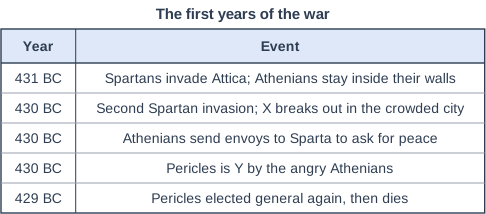
The table shows events in Athens during the first years of the Peloponnesian War.

What should replace X and Y in the table?

The first years of the war. Table with columns "Year", "Event". Year: 431 BC; Event: Spartans invade Attica; Athenians stay inside their walls | Year: 430 BC; Event: Second Spartan invasion; X breaks out in the crowded city | Year: 430 BC; Event: Athenians send envoys to Sparta to ask for peace | Year: 430 BC; Event: Pericles is Y by the angry Athenians | Year: 429 BC; Event: Pericles elected general again, then dies.

Model answer

X is the plague. Y: Pericles was removed from his command and fined.

Explanation

The plague broke out in 430 BC, soon after the second Spartan invasion, among the crowds sheltering inside the walls. The angry Athenians then deposed Pericles and fined him (Plutarch gives 15 to 50 talents), but re-elected him in 429 BC. 'Ostracised' is wrong: Pericles was never ostracised.

Mark scheme
  1. 2 marks

    X: the plague / the epidemic (1). Y: removed from his command (deposed) and fined / fined (1)

    1 mark for each correct answer, max 2. X: accept 'a disease / an epidemic / pestilence'; do not credit 'a fire', 'a revolt' or 'famine'. Y: accept 'deposed', 'removed from office as general', 'fined', 'put on trial and fined'; do not credit 'ostracised' or 'executed'.

Question 2

5 marks

Passage C

In 431 BC, as the Spartans prepared to invade, Pericles advised the Athenians.

'He also gave them advice about their present situation. They were to prepare for war and bring in their property from the countryside. They were not to go out to battle, but to come into the city and guard it, and to get their fleet ready, since that was where their strength lay. They were also to keep a firm hold on the allies, because the city's strength came from the money they paid, and wars were mostly won by good judgement and plenty of money. He told them to be confident: on average six hundred talents of tribute came in from the allies each year, and there were still six thousand talents of coined silver on the Acropolis... And if they were ever cut off from everything else, they could even use the gold on the goddess herself: the statue had forty talents of pure gold on it, all removable. But if they used it to save themselves, they must put it all back afterwards.'

Thucydides, History of the Peloponnesian War 2.13.2-2.13.5 (adapted)

What can we learn from Passage C about Pericles' strategy for the war?

Model answer

The passage shows that Pericles planned a defensive war based on sea power and money. The Athenians were to 'bring in their property from the countryside' and 'not... go out to battle', so Attica would be abandoned rather than risk a land battle against Sparta's stronger army. Instead they should 'get their fleet ready, since that was where their strength lay'. The empire was central: they had to 'keep a firm hold on the allies' because 'the city's strength came from the money they paid'. Pericles expected a long war won by 'good judgement and plenty of money', and the figures of 'six hundred talents' a year and 'six thousand talents' in reserve show why he was confident. He was even willing to use the 'forty talents' of gold on Athena's statue in an emergency.

Explanation

Top answers explain each element of the strategy (abandoning Attica, no land battle, the fleet, the allies' money, financial reserves) and what it shows about Pericles' expectations of a long war. Simply listing the sums of money without explaining why they mattered stays at Level 1-2.

Mark scheme
  1. 5 marks

    Levels of response (5 marks, AO3).
    Level 3 (4-5 marks): Response uses a range of fully appropriate details from the passage, which are analysed to draw out relevant characteristics and features and give a detailed and sophisticated evaluation of what we can learn from the source about the specified issue in the question.
    Level 2 (2-3 marks): Response uses some appropriate details from the passage, which are analysed to draw out some of the characteristics and features and evaluate what we can learn from the source about the specified issue in the question.
    Level 1 (1 mark): Response uses few details from the passage and makes a very basic attempt to draw out any of the characteristics and features in relation to the question.
    0 marks: No response or no response worthy of credit.

    Max 1 if the answer makes no use of the passage (own knowledge alone does not answer this question). Details must be explained, not just copied: credit what each detail tells us about the issue. Candidates are likely to pick out and explain: 'bring in their property from the countryside': Attica was to be abandoned to the enemy and its people moved inside the walls; 'not to go out to battle, but to come into the city and guard it': Pericles would not risk a land battle against Sparta's stronger army; 'get their fleet ready, since that was where their strength lay': Athens would rely on its navy; 'keep a firm hold on the allies, because the city's strength came from the money they paid': the empire's tribute was the basis of the strategy; 'wars were mostly won by good judgement and plenty of money': Pericles planned a long war of endurance, not a quick victory; 'six hundred talents of tribute... six thousand talents of coined silver': Athens had huge financial reserves; 'the gold on the goddess herself... forty talents... all removable': even sacred wealth could be used in an emergency, which shows how seriously he planned; 'they must put it all back afterwards': he respected the gods and expected to win. A paraphrase of the passage with no explanation of what it shows is typically no higher than the bottom of Level 2.

Question 3

5 marks

Passage C

Thucydides describes the effects of the plague on Athens in 430 BC, when the people of Attica were crowded inside the walls.

'The sacred places where they had been lodging were full of the bodies of those who had died there... All the funeral customs they had used before were thrown into confusion, and they buried their dead however they could. Many, lacking what they needed because so many of their family had already died, turned to shameless methods of burial: some placed their own dead on a pyre others had built and lit it first; others threw the body they were carrying on top of one that was already burning and went away. The plague also began a wider lawlessness in the city... People decided to spend quickly and enjoy themselves, thinking that their lives and their wealth alike would last only a day... No fear of the gods or law of men held them back. They judged it made no difference whether they worshipped them or not, since they saw everyone dying alike; and no one expected to live long enough to be brought to trial for his crimes.'

Thucydides, History of the Peloponnesian War 2.52.3-2.53.4 (adapted)

Using details from Passage C, how accurate do you think Thucydides' account of the effects of the plague is?

Model answer

Thucydides' account is largely accurate, though some of his generalisations may be exaggerated. He was in Athens during the plague and caught it himself, so he was an eyewitness, and he wrote so that the disease could be recognised in future, which suggests a careful aim. His specific details, such as bodies lying in 'sacred places' and people placing their dead on 'a pyre others had built', fit the overcrowding when the people of Attica came inside the walls, and a mass grave of about 430 BC found in the Kerameikos shows hurried burials, which supports him. However, statements such as 'No fear of the gods or law of men held them back' are sweeping; Thucydides was interested in how disaster reveals human nature and may have overstated the collapse. Overall, his account of the plague's effects is reliable, especially on burials, but his moral conclusions should be treated with some care.

Explanation

The best answers use Thucydides' position as an eyewitness (and sufferer) and his stated purpose, test particular details against other evidence such as the Kerameikos mass grave, and question his sweeping generalisations. 'Thucydides was there, so it is true' is only Level 1-2.

Mark scheme
  1. 5 marks

    Levels of response (5 marks, AO3).
    Level 3 (4-5 marks): Response analyses the source by using relevant detail from the source content or historical context to give a more detailed evaluation of the source within its historical context. It draws a thorough and convincing conclusion about its accuracy or reliability based on how the context in which it was created impacts on how it portrays issues or events.
    Level 2 (2-3 marks): Response analyses the source by using relevant detail from the source content or historical context to give a basic evaluation of the source within its historical context. It draws a basic conclusion about its accuracy or reliability based on how the context in which it was created impacts on how it portrays issues or events.
    Level 1 (1 mark): Response analyses the source in a basic way by selecting relevant detail from the source content or historical context.
    0 marks: No response or no response worthy of credit.

    Max 1 if the answer reaches no conclusion at all about how accurate or reliable the passage is. Full marks need the evaluation to be related to the particular events in the passage, not only general comments about the author. Candidates might comment on: Thucydides lived through the plague in Athens and caught it himself (2.48.3), so he describes what he saw; he says he wrote about it so that it could be recognised if it returned, which suggests a careful, factual aim; the descriptions of bodies in 'sacred places' and of burial on others' pyres are specific and fit the overcrowding of people from Attica in the city; a mass grave found in the Kerameikos in Athens, dated to about 430-426 BC, with many bodies buried hurriedly, supports his picture of the breakdown of burial customs; the generalisations ('No fear of the gods or law of men held them back', 'no one expected to live') may exaggerate; they reflect Thucydides' interest in how disaster reveals human nature; he was a supporter of order and of Pericles, and his picture of lawlessness may be coloured by his own views; no other contemporary historian describes the plague in detail, so his account is hard to check.

Question 4

20 marks

'Pericles' strategy for the Archidamian War was a failure.'

How far do you agree with this view?

You must use and analyse the ancient sources you have studied as well as supporting your answer with your own knowledge.

Model answer

Whether Pericles' strategy was a failure depends on what it was meant to achieve. Judged by its aims, it was largely successful, but in the short term it caused great suffering and nearly destroyed Pericles himself.

There is strong evidence of failure in 431-429 BC. Pericles abandoned the countryside, and Plutarch describes how the Spartans ravaged Attica as far as Acharnae while choruses mocked his generalship as 'cowardly'. Worse, crowding the population inside the walls helped the plague spread, and Plutarch says his enemies blamed him for penning people up 'like cattle'. Thucydides says that after the second invasion 'war and pestilence' pressed heavily on the Athenians, who sent envoys to Sparta against his advice, and then deposed him and fined him. The raids on the Peloponnese and the attack on Epidaurus achieved little, and the strategy was steadily using up the reserve of money on which it depended.

On the other hand, the strategy achieved its main aims. Pericles never intended to defeat Sparta in battle but to survive a long war with the empire intact. He avoided a battle against sixty thousand hoplites, kept the fleet and the allies under control and made the Spartans' invasions pointless. Plutarch says the enemy suffered at sea and would soon have given up if a 'terrible visitation from heaven' - the plague - had not upset his calculations. Thucydides argues that Pericles judged Athens' power correctly and that the city lost the war because his successors abandoned his advice to attempt no new conquests. In fact the Archidamian War ended with the Peace of Nicias in 421 BC, largely restoring the situation before the war. Pericles also defended the strategy in his last speech, as Thucydides reports it: the city's survival mattered more than any one man's losses, because a flourishing state can rescue unlucky citizens but ruined citizens cannot save a ruined state (2.60.2-4), and it was the Athenians who had changed, not he (2.61.2).

The sources affect this judgement. Thucydides admired Pericles and wrote after Athens' final defeat, so he had reasons to praise Pericles and blame his successors; Pericles' speeches defending the strategy are Thucydides' compositions. However, Thucydides also honestly records the anger, the envoys and the fine. Plutarch wrote much later and used comic poets and other hostile writers, which explains the mockery he reports, but he too largely follows Thucydides' favourable judgement.

Overall, I disagree with the statement. The strategy was painful and unpopular, and it did not allow for the plague, but the plague was not a predictable result of military planning. Measured against its aim of preserving Athens and its empire, Pericles' strategy worked, and the city's later disasters came from abandoning it.

Explanation

High-level answers judge success against Pericles' aims (survival, preserving the empire, avoiding a land battle) as well as the suffering it caused, use Thucydides 2.13 and 2.65 and Plutarch 33-35, and evaluate Thucydides' admiration and hindsight. One-sided answers are capped at 12.

Mark scheme
  1. 20 marks

    Levels of response (20 marks: AO3 10, AO1 5, AO2 5).
    Level 5 (17-20 marks): Detailed evaluation of the ancient sources in their historical context, with thorough analysis of their reliability and accuracy in terms of the context in which they were created, used to make developed, supported judgements and fully convincing conclusions (AO3). A range of detailed, accurate knowledge and a developed understanding (AO1). Thorough, convincing analysis with substantiated, developed judgements (AO2). A sustained, coherent and logically structured line of reasoning.
    Level 4 (13-16 marks): Detailed evaluation of the ancient sources in their context, with some analysis of their reliability and accuracy, used to make supported judgements and reasonable conclusions (AO3). Accurate knowledge and a developed understanding (AO1). A full analysis; judgements are substantiated but not consistently well developed (AO2). A clear, logically structured line of reasoning.
    Level 3 (9-12 marks): Analyses examples from the ancient sources, with a basic analysis of the reliability and accuracy of at least one source in terms of its context, used to make basic judgements and simple conclusions (AO3). Accurate knowledge and some understanding (AO1). Analysis and explanation; judgements may not be explicit (AO2). A mostly relevant line of reasoning with some structure.
    Level 2 (5-8 marks): Uses examples from the ancient sources, with a very basic attempt to consider a source's reliability or accuracy that may border on assertion; no source analysis is used to reach judgements (AO3). Basic knowledge and some understanding (AO1). A basic explanation (AO2). Some relevance; limited structure.
    Level 1 (1-4 marks): Basic use of the sources, with no attempt to consider their reliability or accuracy (AO3). Basic knowledge (AO1). Little or no explanation, close to assertion (AO2). Basic, unstructured communication.
    0 marks: No response or no response worthy of credit.

    Max 8 if the answer makes no use of the ancient sources (it never names, quotes or discusses any ancient writer, work, inscription, coin or other object, and knowing the events is not using the sources). Max 8 if the answer never considers how reliable or accurate any ancient source is. Max 12 if the answer considers only one side of the statement and never addresses the other (the issue of extent). No set answer is expected. It is possible to reach the highest mark either by agreeing or disagreeing with the statement (providing the issue of extent is addressed by refuting the counter-argument), or anywhere between. To access Level 3 and above, answers discuss the ancient sources; at lower levels they may only retell stories from the sources or name them. Candidates do not have to quote directly or give precise references. Grounds for agreeing include: Crowding the people of Attica into the city helped the plague spread, and Pericles was blamed (Plutarch 34.3-34.4); Attica was ravaged year after year; farmers lost their land and the Athenians were furious (Plutarch 33.3-33.6; Thucydides 2.59.1); By 430 the Athenians had sent envoys to Sparta and had deposed and fined Pericles (Thucydides 2.65.3; Plutarch 35.4); Naval raids and the Epidaurus expedition achieved little (Plutarch 35.3); The strategy drained the reserves of money it relied on (Thucydides 2.13.3; the siege of Potidaea alone cost 2,000 talents, 2.70.2). Grounds for disagreeing include: Thucydides says Pericles judged Athens' power correctly and that his plan would have won if his successors had followed it (2.65.5-2.65.7, 2.65.13); Athens avoided the catastrophic land battle Sparta wanted (Plutarch 33.4) and kept its fleet and empire intact; Plutarch says the enemy suffered badly from the raids and would have given up but for the plague, which no one could foresee (34.2); The war of 431-421 ended with the Peace of Nicias largely on pre-war terms, so Athens achieved Pericles' aim of preserving the empire; The Athenians themselves re-elected Pericles in 429 because they knew he was the best man (Thucydides 2.65.4). Likely sources to be included: Thucydides 2.13.2-5, 2.59.1, 2.60.2-4, 2.61.2, 2.65; Plutarch, Life of Pericles 33.3-33.6, 34, 35.3-35.4. The source analysis is likely to address: Thucydides was a contemporary and general, but an admirer of Pericles who wrote with hindsight after Athens' defeat in 404 and blamed later leaders; Pericles' speeches (2.60-2.64) are Thucydides' versions and naturally defend his policy; Plutarch wrote about AD 100, using Thucydides and hostile sources such as the comic poets (the mocking choruses, Hermippus) and Idomeneus. A top answer judges success against Pericles' own aims and the unforeseeable plague.

Ready to try the rest? Every answer you write is marked against the mark scheme, so you can see exactly where the marks are.

Study Helper Hints first, answers after you try

Stuck on this one? Ask for a hint and I’ll point you in the right direction, without giving the answer away. Once you’ve checked your answer, I’ll show you how the marks are awarded.