Level:
Correct: 0
Incorrect: 0
Marks: 0/0
Exam Practice
Course:
Topics:
OCR GCSE Ancient History (Greece and Persia) Smart practice A mixed round aimed at your weak spots
Unit 1
The Persian Empire, 559-465 BC (period study)
Unit 2
From Tyranny to Democracy, 546-483 BC (depth study)
Unit 3
Athens in the Age of Pericles, 462-429 BC (depth study)
Unit 4
Alexander the Great, 356-323 BC (depth study)
Avg
score:
–
Topics
done:
0/45

Ostracism: Miltiades, Themistocles and Aristides

Practise 12 exam-style questions on Ostracism: Miltiades, Themistocles and Aristides for OCR GCSE Ancient History (Greece and Persia). Write your answer as you would in the exam and get it marked in seconds against the mark scheme, point by point, with the Study Helper on hand if you get stuck.

  • 12 questions
  • 1–20 marks each
  • Instant marking
  • No sign-up needed
12 questions, marked as you go

Sample questions with model answers

Here are 4 of the questions in this topic, each with a model answer, an explanation of why it earns the marks and the mark scheme an examiner would use.

Question 1

2 marks

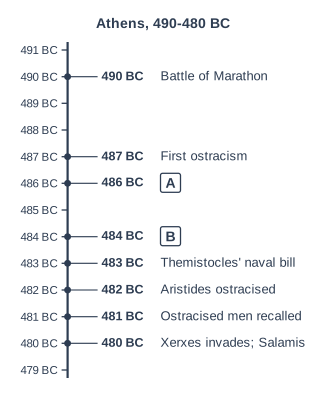
The timeline shows events in Athens between 490 and 480 BC.

Name the men who were ostracised at the dates labelled A and B.

Vertical timeline titled "Athens, 490-480 BC", running from 491 BC at the top to 479 BC at the bottom, with the years marked every year (491 BC to 479 BC). Events marked by dots on the line, in date order: 490 BC: Battle of Marathon; 487 BC: First ostracism; 486 BC: label A; 484 BC: label B; 483 BC: Themistocles' naval bill; 482 BC: Aristides ostracised; 481 BC: Ostracised men recalled; 480 BC: Xerxes invades; Salamis.

Model answer

A is Megacles son of Hippocrates and B is Xanthippus son of Ariphron.

Explanation

The Athenian Constitution (22.5-22.6) says Megacles, an Alcmaeonid, was ostracised the year after Hipparchus son of Charmus, and that Xanthippus, the father of Pericles, was the first man ostracised who had no connection with the tyrants. Ostraka with both names have been found in Athens.

Mark scheme
  1. 2 marks

    A: Megacles (son of Hippocrates); B: Xanthippus (son of Ariphron)

    1 mark for each different correct answer, max 2. Allow recognisable spellings. One mark for each. Do not accept Aristides or Themistocles. For A accept 'Megacles the Alcmaeonid'.

Question 2

5 marks

Passage B

Cornelius Nepos, a Roman writer, explains why the Athenians condemned Miltiades after his failed attack on the island of Paros in 489 BC.

'Although he was tried on the charge about Paros, there was another reason for his condemnation. Because of the tyranny of Peisistratus a few years before, the Athenians feared that any of their citizens might become too powerful. Miltiades had held many military commands and offices, and it seemed he could not live as a private citizen, especially as habit might seem to lead him towards a desire for power. For he had held unbroken power in the Chersonese for all the years he had lived there, and had been called a tyrant, though a just one, since he had gained his power not by force but with the consent of his people... In Miltiades there was great kindness and remarkable friendliness, so that no one was too humble to approach him; he had great influence with all the Greek states, a famous name and the highest military reputation. With all this in mind, the people preferred that he should be punished, although innocent, rather than go on being afraid.'

Cornelius Nepos, Miltiades 8 (adapted)

What can we learn from Passage B about why the Athenians turned against Miltiades?

Model answer

The passage suggests that the Athenians turned against Miltiades out of fear rather than because of the Paros failure. Nepos says there was 'another reason for his condemnation': because of 'the tyranny of Peisistratus', they feared that any citizen 'might become too powerful'. Miltiades seemed especially dangerous because he had held 'many military commands and offices' and might not be content as a 'private citizen'. His past made things worse: he had held 'unbroken power in the Chersonese' and had been 'called a tyrant', even though a just one. Even his good qualities, his 'kindness', his 'influence with all the Greek states' and his 'military reputation', made him more of a threat. Nepos concludes that the people preferred him to be 'punished, although innocent, rather than go on being afraid', so he sees the condemnation as unjust.

Explanation

Good answers explain the link between fear of tyranny and the treatment of Miltiades, and notice the paradox that his popularity counted against him. Nepos' final judgement ('although innocent') should be explained, not just quoted.

Mark scheme
  1. 5 marks

    Levels of response (5 marks, AO3).
    Level 3 (4-5 marks): Response uses a range of fully appropriate details from the passage, which are analysed to draw out relevant characteristics and features and give a detailed and sophisticated evaluation of what we can learn from the source about the specified issue in the question.
    Level 2 (2-3 marks): Response uses some appropriate details from the passage, which are analysed to draw out some of the characteristics and features and evaluate what we can learn from the source about the specified issue in the question.
    Level 1 (1 mark): Response uses few details from the passage and makes a very basic attempt to draw out any of the characteristics and features in relation to the question.
    0 marks: No response or no response worthy of credit.

    Max 1 if the answer makes no use of the passage (own knowledge alone does not answer this question). Details must be explained, not just copied: credit what each detail tells us about the issue. Candidates are likely to pick out and explain: 'another reason for his condemnation': the Paros charge was not the real reason; 'Because of the tyranny of Peisistratus': memories of tyranny made the Athenians suspicious of powerful men; 'feared that any of their citizens might become too powerful': the democracy's fear of one man's power, the same fear behind ostracism; 'held many military commands and offices ... could not live as a private citizen': his long career made him seem dangerous; 'unbroken power in the Chersonese ... called a tyrant': his past as a ruler abroad made him look like a potential tyrant; 'kindness ... friendliness ... influence with all the Greek states ... military reputation': his popularity and fame made him more, not less, of a threat; 'punished, although innocent, rather than go on being afraid': Nepos believed the Athenians acted out of fear, not justice. Credit any other valid point drawn from the passage.

Question 3

5 marks

Passage B

Cornelius Nepos, a Roman writer, describes the ostracism of Aristides.

'Aristides son of Lysimachus was almost the same age as Themistocles, and so competed with him for first place. In them it was seen how far eloquence could overcome honesty. For although Aristides was so outstanding in his integrity that he is the only man, as far as I have heard, to be given the surname 'the Just', he was brought down by Themistocles and sentenced by ostracism to ten years' exile. When Aristides saw that the excited crowd could not be calmed, he noticed, as he gave way, a man writing that he should be banished. He is said to have asked him why he was doing this, and what wrong Aristides had done. The man replied that he did not know Aristides, but was annoyed that he had worked so hard to be called 'the Just' above everyone else. Aristides did not serve the full ten years: when Xerxes invaded Greece, he was recalled by a decree of the people, about six years after he had been banished.'

Cornelius Nepos, Aristides 1 (adapted)

Using details from Passage B, how accurate do you think Nepos' account of the ostracism of Aristides is?

Model answer

Nepos' account is accurate in its basic facts but unreliable in its details. It is true that Aristides was a rival of Themistocles, was ostracised and was recalled when Xerxes invaded: the Athenian Constitution and Plutarch confirm this, and ostraka with Aristides' name have been found in Athens. However, Nepos was a Roman writing about 450 years later, and he admits he is relying on hearsay ('as far as I have heard', 'is said to have'). His date is wrong: Aristides was recalled two or three years after his ostracism, not 'about six years'. The famous story of the voter is told differently by Plutarch, in whose version the voter cannot write and asks Aristides himself to write the name, which suggests a popular anecdote rather than a fact. Nepos also shapes the story into a moral lesson about eloquence beating honesty. Overall, the outline is reliable, but the details should not be trusted.

Explanation

Top answers test specific claims against other sources: the date of recall (Athenian Constitution 22.8), the anecdote (Plutarch's different version) and the ostraka. A clear judgement separating the reliable outline from the doubtful details reaches Level 3.

Mark scheme
  1. 5 marks

    Levels of response (5 marks, AO3).
    Level 3 (4-5 marks): Response analyses the source by using relevant detail from the source content or historical context to give a more detailed evaluation of the source within its historical context. It draws a thorough and convincing conclusion about its accuracy or reliability based on how the context in which it was created impacts on how it portrays issues or events.
    Level 2 (2-3 marks): Response analyses the source by using relevant detail from the source content or historical context to give a basic evaluation of the source within its historical context. It draws a basic conclusion about its accuracy or reliability based on how the context in which it was created impacts on how it portrays issues or events.
    Level 1 (1 mark): Response analyses the source in a basic way by selecting relevant detail from the source content or historical context.
    0 marks: No response or no response worthy of credit.

    Max 1 if the answer reaches no conclusion at all about how accurate or reliable the passage is. Full marks need the evaluation to be related to the particular events in the passage, not only general comments about the author. Candidates might comment on: Nepos was a Roman writing in the first century BC, about 450 years later, and names no sources ('as far as I have heard', 'is said to have'); 'about six years' is wrong: Aristides was ostracised about 482 BC and recalled in 481/0 BC (Athenian Constitution 22.7-22.8), two or three years later; the story of the voter is told differently by Plutarch (Aristides 7.5-7.6), where an illiterate man asks Aristides to write his own name and Aristides does so; a neat anecdote told in different versions may not be true; Nepos' moral contrast between 'eloquence' and 'honesty' reflects his purpose as a biographer writing moral lessons; the basic facts are supported: Themistocles' rivalry (Plutarch, Aristides 2-3), the ten-year sentence and the recall when Xerxes invaded (Athenian Constitution 22.8); ostraka inscribed with Aristides' name have been found in Athens, confirming that votes were cast against him. Credit any other valid evaluation; a conclusion either way can reach Level 3 if it is supported.

Question 4

10 marks

Explain the differences between the treatment of Miltiades and the treatment of Aristides by the Athenian democracy.

Model answer

The Athenian democracy treated both Miltiades and Aristides with suspicion, but the way it dealt with them, and the results, were very different.

The most important difference was in the method. Miltiades was put on trial in a law court. Nepos says that after he failed to take Paros he was accused of treason, of having been bribed by the Persian king to give up the siege. Aristides, by contrast, was removed by ostracism, a vote of the whole people that needed no accusation of a crime; Plutarch stresses that ostracism was not a punishment for wrongdoing.

The punishments were also different. Miltiades was fined fifty talents, the cost of the fleet; since he could not pay, Nepos says, he was imprisoned and died there. Aristides was simply exiled for ten years and kept his property.

The outcomes differed too. Miltiades died in disgrace soon after the trial. Aristides served less than three years of his exile: when Xerxes invaded, the Athenians recalled all the ostracised men, and Aristides returned to serve the city again.

The treatment of the two men also differed in the honours they had received. Nepos complains that Miltiades, who had saved Greece at Marathon, was given only the honour of being painted first among the ten generals in the picture of the battle in the Stoa Poikile, whereas Aristides, a general at Marathon, was made archon the following year.

There was, however, an important similarity in the underlying reason. Nepos says the real reason for Miltiades' condemnation was the fear that he had become too powerful, after his long rule in the Chersonese. Plutarch says the Athenians called their envy of Aristides 'fear of tyranny'. In both cases a rival helped turn the people against them, Themistocles in the case of Aristides.

Overall, both men suffered because the democracy feared powerful individuals, but Miltiades was treated as a criminal while Aristides was removed by a milder political procedure that allowed him to return.

Explanation

A 'differences' question needs both men: an answer describing only Miltiades or only Aristides is capped at 4 marks. The best answers compare in several areas (method, charge, punishment, outcome) and note the shared underlying reason.

Mark scheme
  1. 10 marks

    Levels of response (10 marks: AO1 5, AO2 5).
    Level 5 (9-10 marks): The response demonstrates a range of detailed and accurate knowledge and a developed understanding that is fully relevant to the question (AO1). Response has a full explanation and thorough, convincing analysis of the issue in the question, arriving at substantiated and developed judgements (AO2).
    Level 4 (7-8 marks): The response demonstrates accurate knowledge and a developed understanding that is fully relevant to the question (AO1). Response has a full explanation and analysis of the issue in the question arriving at substantiated judgements, but these are not consistently well developed (AO2).
    Level 3 (5-6 marks): The response demonstrates accurate knowledge and some understanding that is relevant to the question (AO1). This is linked to an analysis and explanation of the issue in the question but judgements may not always be made explicit (AO2).
    Level 2 (3-4 marks): The response demonstrates basic knowledge and some understanding that is relevant to the question (AO1). There is a basic explanation of the issue in the question (AO2).
    Level 1 (1-2 marks): Response demonstrates basic knowledge that is relevant to the topic of the question (AO1). There is little or no attempt at a very basic explanation of the issue in the question, which may be close to assertion (AO2).
    0 marks: No response or no response worthy of credit.

    Max 4 if the answer describes only one of the two. A Level 3 response might cover two areas of comparison. Explanations may include: honours: Miltiades was given only the honour of being shown first among the ten generals in the painting of Marathon in the Stoa Poikile (Nepos, Miltiades 6); Aristides was general at Marathon and (own knowledge) archon the following year; method: Miltiades was put on trial in a law court after the failure at Paros (Nepos, Miltiades 7); Aristides was removed by ostracism, which was not a trial and required no crime (Plutarch, Aristides 7); charges: Miltiades was accused of treason, of being bribed by the Persian king (Nepos); Aristides was accused of nothing, though Themistocles claimed he was making himself a monarch (Plutarch, Aristides 7); punishment: Miltiades was fined fifty talents, imprisoned and died (Nepos, Miltiades 7); Aristides was exiled for ten years but kept his property; underlying reason: in both cases fear of an over-powerful citizen (Nepos, Miltiades 8; Plutarch's 'fear of tyranny'), though Plutarch says envy of Aristides' reputation; role of rivals: Themistocles stirred up feeling against Aristides; (own knowledge) Xanthippus prosecuted Miltiades (Herodotus); outcome: Miltiades died disgraced; Aristides was recalled when Xerxes invaded (Athenian Constitution 22.8) and served Athens again.

Ready to try the rest? Every answer you write is marked against the mark scheme, so you can see exactly where the marks are.

Study Helper Hints first, answers after you try

Stuck on this one? Ask for a hint and I’ll point you in the right direction, without giving the answer away. Once you’ve checked your answer, I’ll show you how the marks are awarded.