
Level:
Correct: 0
Incorrect: 0
Marks: 0/0
Exam Practice
Course:
Topics:
OCR GCSE Ancient History (Greece and Persia) Smart practice A mixed round aimed at your weak spots
Unit 1
The Persian Empire, 559-465 BC (period study)
Unit 2
From Tyranny to Democracy, 546-483 BC (depth study)
Unit 3
Athens in the Age of Pericles, 462-429 BC (depth study)
Unit 4
Alexander the Great, 356-323 BC (depth study)
Avg
score:
–
Topics
done:
0/45

Athens and Sparta: the rising tensions

Practise 12 exam-style questions on Athens and Sparta: the rising tensions for OCR GCSE Ancient History (Greece and Persia). Write your answer as you would in the exam and get it marked in seconds against the mark scheme, point by point, with the Study Helper on hand if you get stuck.

  • 12 questions
  • 1–20 marks each
  • Instant marking
  • No sign-up needed
12 questions, marked as you go

Sample questions with model answers

Here are 4 of the questions in this topic, each with a model answer, an explanation of why it earns the marks and the mark scheme an examiner would use.

Question 1

2 marks

The plan shows Athens and its harbour town in the time of Pericles.

Name the structures labelled A and give one reason why they increased Spartan fears of Athens.
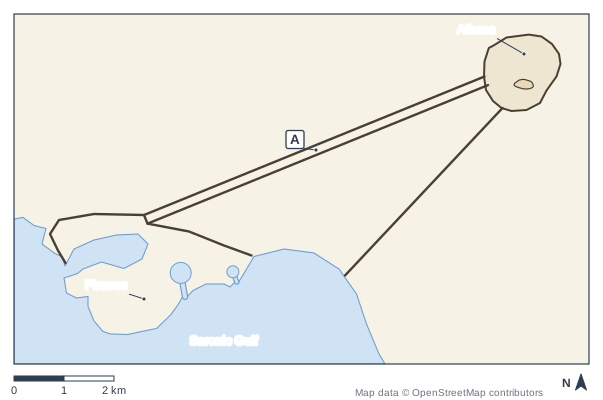
Plan of a walled city joined to the sea by long walls, north at the top, with a scale bar of 2 km. A walled city with a rock in the middle is in the north-east. Two long parallel walls run south-west from it to the walls of a town on a rocky peninsula, and a single wall runs south-west from the city to the eastern end of a bay. The peninsula has a large harbour on its west side, a round harbour on its south-east side and a small round harbour to the east of that. The sea fills the south and west. The label "Athens" points to the walled city at the north-east end of the long parallel walls; label A points to the two long parallel walls running south-west from the walled city to the harbour town; the label "Piraeus" points to the rocky peninsula with three harbours at the south-west end of the long walls; the label "Saronic Gulf" is written on the sea at the bottom of the plan.

Model answer

A shows the Long Walls. They worried Sparta because they joined Athens to Piraeus, so Athens could always be supplied by sea and could not be defeated by a Spartan army besieging it on land.

Explanation

The Long Walls (begun about 461-458 BC, with a third 'Middle Wall' added under Pericles in the 440s) made Athens and Piraeus one fortress. Sparta's power was its army on land; with the walls and its fleet Athens could ignore Spartan invasions, which is exactly Pericles' strategy in 431 BC.

Mark scheme
  1. 2 marks

    Naming: the Long Walls (1). Reason (1), any one of: they joined Athens to its harbour at Piraeus, so the city could not be starved out by a siege on land; Athens could be supplied by sea, where its fleet was strongest; they made Sparta's main strength, its hoplite army, much less effective against Athens; they showed Athens' growing power and independence

    1 mark for naming the Long Walls and 1 mark for a valid reason, max 2. Accept 'the walls to Piraeus', 'the North and Middle Walls', 'the Long Walls to the sea'. Do not credit 'the city walls' or 'the Phaleric Wall' alone for the name. For the reason, credit any other historically valid answer; 'they were big' alone does not explain Spartan fears.

Question 2

5 marks

Passage C

In Aristophanes' comedy the Acharnians (425 BC), the farmer Dicaeopolis tells the audience how the war with Sparta began.

'Some men of ours - I do not say the city, I do not say the city - worthless little men, kept denouncing the Megarians' cloaks as smuggled goods. If they saw a cucumber, a hare, a piglet, garlic or lumps of salt, it was 'Megarian' and was sold off that same day... But then some young men, drunk from their drinking games, went to Megara and stole a courtesan called Simaetha; and the Megarians, stung with fury, stole two of Aspasia's courtesans in return. And from this the war broke out for all the Greeks - over three courtesans. Then Pericles the Olympian, in his anger, lightened and thundered and stirred up Greece, and he passed laws written like drinking songs: 'No Megarian shall stay on land, or in the market, or on the sea, or on the mainland.' Then the Megarians, as they slowly starved, begged the Spartans to get the decree reversed... and we refused, though they asked many times. And then came the clash of shields.'

Aristophanes, Acharnians 515-539 (adapted)

What can we learn from Passage C about the Megarian decree?

Model answer

The passage shows that Aristophanes made the Megarian decree the trigger of the war. Even before it, Athenian informers were denouncing Megarian goods, which shows hostility already existed. He gives a comic cause, the theft of 'two of Aspasia's courtesans', which links the decree personally to Pericles. Pericles is shown acting in anger, 'the Olympian' who 'lightened and thundered', so the decree is presented as his personal decision. Its terms are shown as harsh: no Megarian could stay 'on land, or in the market, or on the sea', and the Megarians 'slowly starved', which suggests real economic damage. Finally, Athens refused to reverse it although Megara and Sparta 'asked many times', and 'then came the clash of shields', so Aristophanes treats refusing to cancel the decree as the direct cause of war.

Explanation

Credit explanation of what each detail shows: the decree's terms (exclusion from markets and harbours), its effect (starvation), the appeals to Sparta and Athens' refusal, and the comic blame placed on Pericles and Aspasia. Do not treat the courtesan story as fact; it is comic exaggeration.

Mark scheme
  1. 5 marks

    Levels of response (5 marks, AO3).
    Level 3 (4-5 marks): Response uses a range of fully appropriate details from the passage, which are analysed to draw out relevant characteristics and features and give a detailed and sophisticated evaluation of what we can learn from the source about the specified issue in the question.
    Level 2 (2-3 marks): Response uses some appropriate details from the passage, which are analysed to draw out some of the characteristics and features and evaluate what we can learn from the source about the specified issue in the question.
    Level 1 (1 mark): Response uses few details from the passage and makes a very basic attempt to draw out any of the characteristics and features in relation to the question.
    0 marks: No response or no response worthy of credit.

    Max 1 if the answer makes no use of the passage (own knowledge alone does not answer this question). Details must be explained, not just copied: credit what each detail tells us about the issue. Candidates are likely to pick out and explain: 'denouncing the Megarians' cloaks as smuggled goods... sold off that same day': before the decree there was already petty hostility, with Megarian goods confiscated by informers; 'stole a courtesan called Simaetha... two of Aspasia's courtesans': Aristophanes gives a ridiculous personal cause, linking the decree to Pericles' partner Aspasia; 'Pericles the Olympian, in his anger, lightened and thundered': the decree is presented as Pericles' own personal act, driven by anger; 'laws written like drinking songs': the decree is mocked as absurd and over the top; 'No Megarian shall stay on land, or in the market, or on the sea': the decree shut the Megarians out of Athenian markets and harbours; 'as they slowly starved': the decree caused real economic hardship to Megara; 'begged the Spartans to get the decree reversed... we refused, though they asked many times': Megara appealed to Sparta and Athens' refusal to cancel the decree led to war; 'then came the clash of shields': Aristophanes presents the decree as the direct trigger of the war. A paraphrase of the passage with no explanation of what it shows is typically no higher than the bottom of Level 2.

Question 3

5 marks

Passage C

Plutarch describes events after Athens sent ships to help Corcyra against Corinth in 433 BC.

'The Corinthians were furious at this and denounced the Athenians at Sparta. The Megarians joined them, complaining that they were shut out and driven away from every market and from all the harbours that the Athenians controlled, against the common law and the sworn agreements of the Greeks... At this point Potidaea, a city subject to Athens although a colony of Corinth, revolted, and the siege of it hurried on the war even more. Even so, since embassies were sent to Athens again and again... it does not seem likely that the war would have fallen on the Athenians for any other reason, if only they could have been persuaded to cancel their decree against the Megarians and make peace with them. And so, since it was Pericles who opposed this most strongly and urged the people to keep up their quarrel with the Megarians, he alone was held responsible for the war.'

Plutarch, Life of Pericles 29.4-29.5 (adapted)

Using details from Passage C, how accurate do you think Plutarch's account of Pericles' responsibility for the war is?

Model answer

Plutarch's account of the events is accurate, but his view of Pericles' responsibility is more doubtful. Writing about AD 100, he clearly used Thucydides: the complaints of the Corinthians, the Megarians 'shut out... from every market and... harbours' and the revolt of Potidaea all match Thucydides' account. However, his conclusion that the war would not have happened 'if only they could have been persuaded to cancel their decree' is his own opinion, and Thucydides, a contemporary, thought the decree was only a pretext and that the truest cause was Spartan fear of Athenian power. The phrase 'he alone was held responsible' reports what people said, such as the jokes of the comic poets, rather than what happened. As a biographer, Plutarch puts Pericles at the centre of events. Overall, the facts are reliable, but the judgement that Pericles alone caused the war is too simple.

Explanation

The best answers separate the factual details (confirmed by Thucydides) from Plutarch's opinion about responsibility, and explain how his date, sources and biographical purpose affect that judgement. General remarks that Plutarch lived later, not linked to the passage, are Level 1.

Mark scheme
  1. 5 marks

    Levels of response (5 marks, AO3).
    Level 3 (4-5 marks): Response analyses the source by using relevant detail from the source content or historical context to give a more detailed evaluation of the source within its historical context. It draws a thorough and convincing conclusion about its accuracy or reliability based on how the context in which it was created impacts on how it portrays issues or events.
    Level 2 (2-3 marks): Response analyses the source by using relevant detail from the source content or historical context to give a basic evaluation of the source within its historical context. It draws a basic conclusion about its accuracy or reliability based on how the context in which it was created impacts on how it portrays issues or events.
    Level 1 (1 mark): Response analyses the source in a basic way by selecting relevant detail from the source content or historical context.
    0 marks: No response or no response worthy of credit.

    Max 1 if the answer reaches no conclusion at all about how accurate or reliable the passage is. Full marks need the evaluation to be related to the particular events in the passage, not only general comments about the author. Candidates might comment on: Plutarch wrote about AD 100, over 500 years later; for these events he relies on Thucydides (book 1), whose account of the complaints of Corinth, Megara and Potidaea he follows closely; the details of the Megarians being 'shut out... from every market and from all the harbours' and of Potidaea's revolt are confirmed by Thucydides (1.67, 1.139); 'it does not seem likely that the war would have fallen... for any other reason' is Plutarch's own opinion, and it disagrees with Thucydides, who says the truest cause was Spartan fear of Athens' growing power (1.23.6); 'he alone was held responsible' reports what people said (the comic poets, Aristophanes' Acharnians and Peace) rather than Plutarch's proof; Plutarch the biographer focuses on one man's character, so he tends to make Pericles the centre of events; elsewhere (31-32) he records hostile claims that Pericles started the war to escape trials, while saying 'the truth about it is not clear'; 'embassies were sent to Athens again and again' fits Thucydides' account of the Spartan embassies of 432-431 BC (1.126, 1.139).

Question 4

20 marks

'The growth of Athenian power was the main cause of the tension between Athens and Sparta.'

How far do you agree with this view?

You must use and analyse the ancient sources you have studied as well as supporting your answer with your own knowledge.

Model answer

The growth of Athenian power was the main cause of tension between Athens and Sparta, but particular events and individuals turned that tension into open conflict.

The strongest support comes from Thucydides, who wrote that the truest cause of the war, 'formally most kept out of sight', was the growth of Athens' power and the fear it caused in Sparta. His account of the period supports this. After the Persian Wars the Delian League gave Athens tribute of 460 talents a year and a great fleet. When Cimon's force went to Ithome, the Spartans grew afraid of the Athenians' 'daring and revolutionary spirit' and sent them home. Athens then began the Long Walls to Piraeus, which made it safe from Spartan land power. By 432 BC Sparta's allies were complaining that Athens was crushing Potidaea, denying Aegina its independence and excluding Megara from its markets: all signs of Athenian power being used aggressively.

However, other factors mattered. Aristophanes makes the Megarian decree the trigger of the war: in the Acharnians, Pericles 'the Olympian' thunders out a decree that starves the Megarians, and Athens refuses to cancel it; in Peace the decree is the 'spark' that sets Greece alight. Plutarch agrees that the war would probably not have happened if the decree had been withdrawn and says Pericles alone was held responsible. The Spartans' demand that Athens drive out 'the curse of the goddess' was aimed at Pericles' family. Corinth's quarrel with Athens over Corcyra and Potidaea also pushed Sparta towards war. Differences of character played a part as well: Thucydides says that at Ithome the Spartans saw the Athenians as 'men of a different race', and a Spartan oligarchy that depended on controlling the helots naturally distrusted a restless democracy, whatever its size.

The value of these sources differs. Thucydides was a contemporary and a general who tried to find deeper causes, but he admired Pericles and may have played down the decree that Pericles refused to cancel. Aristophanes wrote comedies during the war to make audiences laugh and to argue for peace, so his stories of stolen courtesans are not literally true, although they show that Athenians linked the war with Pericles and the decree. Plutarch, writing over 500 years later, mainly followed Thucydides for events but, as a biographer, put Pericles at the centre and repeated gossip while admitting the truth was unclear.

Overall, I agree with the statement to a large extent. The Megarian decree, Corinth's complaints and Pericles' stubbornness explain why tension became war in 431 BC, but they mattered only because Sparta already feared Athens' growing power. Without that fear, these disputes could have been settled by arbitration under the Thirty Years Peace.

Explanation

The best answers distinguish the long-term cause (Athenian power and Spartan fear) from triggers (Ithome, the Megarian decree, Corinth, Pericles' role), support both with named sources and evaluate Thucydides, Aristophanes and Plutarch. Narrative of events from 462 to 431 BC without judgement stays at Level 2-3.

Mark scheme
  1. 20 marks

    Levels of response (20 marks: AO3 10, AO1 5, AO2 5).
    Level 5 (17-20 marks): Detailed evaluation of the ancient sources in their historical context, with thorough analysis of their reliability and accuracy in terms of the context in which they were created, used to make developed, supported judgements and fully convincing conclusions (AO3). A range of detailed, accurate knowledge and a developed understanding (AO1). Thorough, convincing analysis with substantiated, developed judgements (AO2). A sustained, coherent and logically structured line of reasoning.
    Level 4 (13-16 marks): Detailed evaluation of the ancient sources in their context, with some analysis of their reliability and accuracy, used to make supported judgements and reasonable conclusions (AO3). Accurate knowledge and a developed understanding (AO1). A full analysis; judgements are substantiated but not consistently well developed (AO2). A clear, logically structured line of reasoning.
    Level 3 (9-12 marks): Analyses examples from the ancient sources, with a basic analysis of the reliability and accuracy of at least one source in terms of its context, used to make basic judgements and simple conclusions (AO3). Accurate knowledge and some understanding (AO1). Analysis and explanation; judgements may not be explicit (AO2). A mostly relevant line of reasoning with some structure.
    Level 2 (5-8 marks): Uses examples from the ancient sources, with a very basic attempt to consider a source's reliability or accuracy that may border on assertion; no source analysis is used to reach judgements (AO3). Basic knowledge and some understanding (AO1). A basic explanation (AO2). Some relevance; limited structure.
    Level 1 (1-4 marks): Basic use of the sources, with no attempt to consider their reliability or accuracy (AO3). Basic knowledge (AO1). Little or no explanation, close to assertion (AO2). Basic, unstructured communication.
    0 marks: No response or no response worthy of credit.

    Max 8 if the answer makes no use of the ancient sources (it never names, quotes or discusses any ancient writer, work, inscription, coin or other object, and knowing the events is not using the sources). Max 8 if the answer never considers how reliable or accurate any ancient source is. Max 12 if the answer considers only one side of the statement and never addresses the other (the issue of extent). No set answer is expected. It is possible to reach the highest mark either by agreeing or disagreeing with the statement (providing the issue of extent is addressed by refuting the counter-argument), or anywhere between. To access Level 3 and above, answers discuss the ancient sources; at lower levels they may only retell stories from the sources or name them. Candidates do not have to quote directly or give precise references. Grounds for agreeing include: Thucydides says the truest cause of the war was the growth of Athenian power and the fear it caused in Sparta (1.23.6); The Delian League became an empire with large tribute (Thucydides 1.96), giving Athens wealth and a great fleet; The Long Walls made Athens impossible to defeat by land (Thucydides 1.107.1); Sparta's dismissal of the Athenians at Ithome showed fear of Athens' daring and revolutionary character (Thucydides 1.102.3); Sparta's allies complained of Athenian aggression in 432 - Potidaea, Aegina's independence, Megara's exclusion (Thucydides 1.67). Grounds for disagreeing include: Particular incidents caused tension: the dismissal at Ithome was a personal insult (Thucydides 1.102.4); The Megarian decree: Aristophanes makes it the trigger of the war (Acharnians 515-539; Peace 605-609) and Plutarch thinks the war would not have happened without it (29.5); Pericles' personal role: Plutarch says he was held responsible and records claims that he started the war to escape trials (29.5, 31-32); Sparta's demand to drive out the 'curse' targeted his family (Thucydides 1.126); Corinth's quarrels with Athens over Corcyra and Potidaea pushed Sparta into war; Differences of character and politics: Spartan oligarchy against Athenian democracy; Dorians and Ionians ('men of a different race'). Likely sources to be included: Thucydides 1.23.6, 1.67, 1.96, 1.101-1.102, 1.107.1, 1.126, 1.139; Aristophanes, Acharnians 515-539; Peace 605-609; Plutarch, Life of Pericles 29-32. The source analysis is likely to address: Thucydides was a contemporary and an Athenian general who aimed at an accurate, lasting history, but he wrote with hindsight and admired Pericles, so he may play down the decree that Pericles defended; Aristophanes wrote comedy during the war to entertain and to argue for peace; his causes are deliberately absurd, but show what the audience believed; Plutarch wrote about AD 100, followed Thucydides for events but focuses on Pericles' character and repeats hostile stories while admitting 'the truth about it is not clear'. A top answer weighs Athenian power as a long-term cause against particular triggers and decides which mattered most.

Ready to try the rest? Every answer you write is marked against the mark scheme, so you can see exactly where the marks are.

Study Helper Hints first, answers after you try

Stuck on this one? Ask for a hint and I’ll point you in the right direction, without giving the answer away. Once you’ve checked your answer, I’ll show you how the marks are awarded.