
Level:
Correct: 0
Incorrect: 0
Marks: 0/0
Exam Practice
Course:
Topics:
OCR GCSE Ancient History (Greece and Persia) Smart practice A mixed round aimed at your weak spots
Unit 1
The Persian Empire, 559-465 BC (period study)
Unit 2
From Tyranny to Democracy, 546-483 BC (depth study)
Unit 3
Athens in the Age of Pericles, 462-429 BC (depth study)
Unit 4
Alexander the Great, 356-323 BC (depth study)
Avg
score:
–
Topics
done:
0/45

Polycrates of Samos

Practise 12 exam-style questions on Polycrates of Samos for OCR GCSE Ancient History (Greece and Persia). Write your answer as you would in the exam and get it marked in seconds against the mark scheme, point by point, with the Study Helper on hand if you get stuck.

  • 12 questions
  • 1–20 marks each
  • Instant marking
  • No sign-up needed
12 questions, marked as you go

Sample questions with model answers

Here are 4 of the questions in this topic, each with a model answer, an explanation of why it earns the marks and the mark scheme an examiner would use.

Question 1

2 marks

The table summarises what Herodotus says about three great works on Samos from the time of Polycrates.

Name the works labelled A and B.
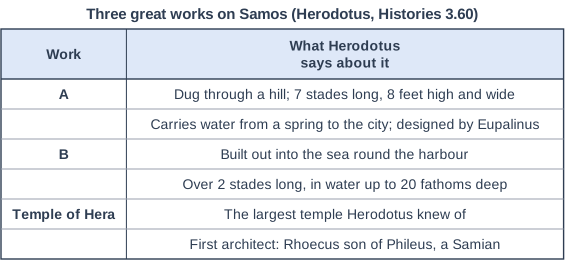
Three great works on Samos (Herodotus, Histories 3.60). Table with columns "Work", "What Herodotus says about it". Work: A; What Herodotus says about it: Dug through a hill; 7 stades long, 8 feet high and wide | Work: (blank); What Herodotus says about it: Carries water from a spring to the city; designed by Eupalinus | Work: B; What Herodotus says about it: Built out into the sea round the harbour | Work: (blank); What Herodotus says about it: Over 2 stades long, in water up to 20 fathoms deep | Work: Temple of Hera; What Herodotus says about it: The largest temple Herodotus knew of | Work: (blank); What Herodotus says about it: First architect: Rhoecus son of Phileus, a Samian.

Model answer

A is the tunnel of Eupalinus, which carried water through the mountain to the city. B is the mole or breakwater built out into the sea round the harbour.

Explanation

Herodotus (3.60) says he wrote at length about the Samians because of these three works, the greatest built by any Greeks: the tunnel, the harbour mole and the Temple of Hera. Answers that say only 'the harbour' do not identify the mole itself.

Mark scheme
  1. 2 marks

    A: the tunnel (of Eupalinus) / the water tunnel or aqueduct bringing water to the city; B: the harbour mole / breakwater (the sea wall round the harbour)

    1 mark for each different correct answer, max 2. Allow recognisable spellings. One mark for each work. For A accept 'tunnel through the mountain', 'aqueduct', 'Eupalinian tunnel'. For B accept 'harbour wall', 'jetty', 'pier'. Do not accept 'harbour' alone for B.

Question 2

5 marks

Passage B

Herodotus describes how Polycrates dealt with Samians he did not trust, in about 525 BC.

'Polycrates had sent a messenger to Cambyses son of Cyrus, without the Samians knowing, while Cambyses was gathering an army against Egypt, asking him to send to Samos and ask for troops. When Cambyses heard this, he was glad to send to Samos asking Polycrates to send a fleet with him against Egypt. Polycrates chose the citizens he most suspected of planning a rising against him and sent them off in forty triremes, telling Cambyses not to send them back... As these men were sailing back to Samos, Polycrates met them with his ships and fought them. The returning men won and landed on the island, but they were beaten in a battle on land and so sailed off to Sparta... Then Polycrates gathered the wives and children of the citizens and shut them in the ship-sheds, ready to burn them, sheds and all, if the citizens went over to the returning exiles.'

Herodotus, Histories 3.44.1-3.45.4 (adapted)

What can we learn from Passage B about Polycrates' treatment of his opponents?

Model answer

The passage shows that Polycrates dealt with opponents ruthlessly and cunningly. He contacted Cambyses 'without the Samians knowing', so he acted secretly, and he used Cambyses' war as a way to get rid of 'the citizens he most suspected', telling Cambyses 'not to send them back' - in effect, exile without a trial. He was also willing to work with Persia against his own people. When the exiles returned, he 'met them with his ships', and although they won at sea they were 'beaten in a battle on land', which suggests he had strong forces on the island. Most strikingly, he shut 'the wives and children of the citizens' in the ship-sheds, 'ready to burn them' if the citizens joined the exiles. He ruled by fear and hostage-taking, which shows how little he trusted his own people.

Explanation

Good answers explain what each action reveals (secrecy, removing suspects without trial, using hostages). The threat to the women and children is the most striking detail, but a Level 3 answer uses details from the beginning, middle and end of the passage.

Mark scheme
  1. 5 marks

    Levels of response (5 marks, AO3).
    Level 3 (4-5 marks): Response uses a range of fully appropriate details from the passage, which are analysed to draw out relevant characteristics and features and give a detailed and sophisticated evaluation of what we can learn from the source about the specified issue in the question.
    Level 2 (2-3 marks): Response uses some appropriate details from the passage, which are analysed to draw out some of the characteristics and features and evaluate what we can learn from the source about the specified issue in the question.
    Level 1 (1 mark): Response uses few details from the passage and makes a very basic attempt to draw out any of the characteristics and features in relation to the question.
    0 marks: No response or no response worthy of credit.

    Max 1 if the answer makes no use of the passage (own knowledge alone does not answer this question). Details must be explained, not just copied: credit what each detail tells us about the issue. Candidates are likely to pick out and explain: 'without the Samians knowing': he acted secretly, behind his own people's backs; 'asking him to send to Samos and ask for troops': he arranged for Cambyses to make the request, so the plan would not look like his; 'the citizens he most suspected of planning a rising': he watched for possible opponents and acted before they rebelled; 'telling Cambyses not to send them back': he used a foreign war to get rid of opponents without a trial - exile by trickery; he was willing to work with Persia, the rising power, against his own citizens (and against his former friend Egypt); 'met them with his ships ... beaten in a battle on land': he fought the returning exiles and had the forces to defeat them; 'shut them in the ship-sheds, ready to burn them': he ruled by fear and took hostages, using the citizens' families to stop them joining the exiles. Credit any other valid point drawn from the passage.

Question 3

5 marks

Passage B

Herodotus explains how Oroetes, the Persian satrap of Sardis, set a trap for Polycrates in about 522 BC.

'Oroetes was living at Magnesia on the river Maeander. He sent Myrsus son of Gyges, a Lydian, to Samos with a message, since he knew what Polycrates had in mind. For Polycrates was the first of the Greeks we know of who planned to rule the sea, apart from Minos of Knossos and anyone before him who may have ruled the sea; of what is called the human age, Polycrates was the first, and he had high hopes of ruling Ionia and the islands. Knowing his plans, Oroetes sent this message: 'Oroetes says this to Polycrates. I hear that you are planning great things, but that you do not have money to match your ambitions. If you do as I say, you will do well for yourself and save me too, for King Cambyses is planning to kill me... So take me and my money away to safety. Keep part of it yourself and let me have the rest, and with this money you will rule all Greece.''

Herodotus, Histories 3.122 (adapted)

Using details from Passage B, how accurate do you think Herodotus' account of Polycrates' plans is?

Model answer

This account is partly reliable. Herodotus is careful to separate legend from history when he says Polycrates was the first to plan to rule the sea 'of what is called the human age', excluding Minos, and Thucydides independently confirms that Polycrates had a powerful navy and took many islands, including Rheneia. The statement about his ambitions is therefore plausible. However, much of the passage could not have been known to Herodotus. Oroetes' message is in direct speech, which Herodotus must have composed himself, and secret plans of this kind were hardly written down. Herodotus also gives two different versions of why Oroetes wanted Polycrates dead, which shows his informants did not agree, and the trick that follows sounds like a folk tale about a greedy tyrant. So the outline - an ambitious naval ruler lured to his death by a Persian satrap - is credible, but the details are Herodotus' reconstruction.

Explanation

High marks come from separating the well-supported claim (Polycrates' naval ambition, confirmed by Thucydides) from the parts Herodotus could not know (the private message in direct speech). A clear final judgement is needed for Level 3.

Mark scheme
  1. 5 marks

    Levels of response (5 marks, AO3).
    Level 3 (4-5 marks): Response analyses the source by using relevant detail from the source content or historical context to give a more detailed evaluation of the source within its historical context. It draws a thorough and convincing conclusion about its accuracy or reliability based on how the context in which it was created impacts on how it portrays issues or events.
    Level 2 (2-3 marks): Response analyses the source by using relevant detail from the source content or historical context to give a basic evaluation of the source within its historical context. It draws a basic conclusion about its accuracy or reliability based on how the context in which it was created impacts on how it portrays issues or events.
    Level 1 (1 mark): Response analyses the source in a basic way by selecting relevant detail from the source content or historical context.
    0 marks: No response or no response worthy of credit.

    Max 1 if the answer reaches no conclusion at all about how accurate or reliable the passage is. Full marks need the evaluation to be related to the particular events in the passage, not only general comments about the author. Candidates might comment on: Herodotus separates history from legend: 'of what is called the human age' excludes Minos, showing a critical approach; Thucydides (1.13) independently confirms that Polycrates had a strong navy and took many islands, including Rheneia, so his naval ambition is well supported; Herodotus also says (3.39) that Polycrates had a hundred penteconters and conquered islands and mainland cities, which fits the claim; the message is in direct speech, which Herodotus must have composed; a private message between Oroetes and Polycrates is unlikely to have been recorded; Herodotus gives two different explanations for why Oroetes wanted Polycrates dead (3.120-3.121), showing that his informants did not agree; the trick that follows (chests of stones covered with gold) sounds like a folk tale about a greedy tyrant, part of Herodotus' moral pattern of great good fortune followed by disaster; Herodotus wrote some eighty to ninety years later, but Samian memories of Polycrates' death were probably still strong. Credit any other valid evaluation; a conclusion either way can reach Level 3 if it is supported.

Question 4

10 marks

Explain why the Spartan and Corinthian attack on Samos failed to remove Polycrates.

Model answer

The Spartan and Corinthian attack on Samos failed mainly because Polycrates was too strong and Samos too well defended, but the attackers' half-hearted commitment also mattered.

Polycrates' military strength was the first reason. Herodotus says he had foreign mercenaries and very many native archers, and he had already defeated the returning exiles on land. The city was walled and surrounded by a ditch dug by Lesbian prisoners. When the Spartans attacked, they seized a tower by the sea, but Polycrates came up with a large force and drove them out. At the upper tower the mercenaries and Samians held their ground for a while before falling back.

Secondly, the city could survive a siege. The Spartans besieged Samos for forty days without making progress. If the tunnel of Eupalinus, which brought water from a spring outside the walls, was already complete, it would have made Samos very hard to force into surrender.

Thirdly, the attackers lacked commitment. Herodotus says that if all the Spartans had fought like Archias and Lycopas, who chased the Samians inside the walls and were killed, Samos would have fallen; this suggests that the rest did not press home the attack. Their motives were also mixed: the exiles' appeal, revenge for the stolen bowl and corselet, and the Corinthians' old grudge over the Corcyraean boys, rather than a principled campaign against tyranny. It was also the first expedition of the Dorian Spartans into Asia, far from home. Herodotus reports, but does not believe, a story that Polycrates bribed them with gilded lead coins.

Overall, Polycrates' strength was the decisive factor: with mercenaries, walls and a secure water supply, he could outlast a force whose leaders had no deep reason to stay.

Explanation

The strongest answers combine Polycrates' strengths (mercenaries, defences, water supply) with the attackers' weaknesses (mixed motives, distance, lack of commitment) and decide which mattered more. Repeating the bribe story as fact, when Herodotus calls it less credible, is an error.

Mark scheme
  1. 10 marks

    Levels of response (10 marks: AO1 5, AO2 5).
    Level 5 (9-10 marks): The response demonstrates a range of detailed and accurate knowledge and a developed understanding that is fully relevant to the question (AO1). Response has a full explanation and thorough, convincing analysis of the issue in the question, arriving at substantiated and developed judgements (AO2).
    Level 4 (7-8 marks): The response demonstrates accurate knowledge and a developed understanding that is fully relevant to the question (AO1). Response has a full explanation and analysis of the issue in the question arriving at substantiated judgements, but these are not consistently well developed (AO2).
    Level 3 (5-6 marks): The response demonstrates accurate knowledge and some understanding that is relevant to the question (AO1). This is linked to an analysis and explanation of the issue in the question but judgements may not always be made explicit (AO2).
    Level 2 (3-4 marks): The response demonstrates basic knowledge and some understanding that is relevant to the question (AO1). There is a basic explanation of the issue in the question (AO2).
    Level 1 (1-2 marks): Response demonstrates basic knowledge that is relevant to the topic of the question (AO1). There is little or no attempt at a very basic explanation of the issue in the question, which may be close to assertion (AO2).
    0 marks: No response or no response worthy of credit.

    Explanations may include: Samos' defences: walls with a ditch dug by Lesbian prisoners (3.39); the attackers took only a tower by the sea and were driven out when Polycrates arrived with a large force (3.54); Polycrates' forces: foreign mercenaries and many native archers (3.45), who fought from the upper tower on the ridge; the Spartans lacked determination: only Archias and Lycopas pursued the fleeing defenders into the city, where they were killed (3.55); the siege made no progress after forty days and the Spartans went home (3.56); a secure water supply (the tunnel of Eupalinus, own knowledge of its purpose) meant the city could hold out; Herodotus reports, but calls less credible, a story that Polycrates bribed the Spartans with gilded lead coins (3.56); the attackers' motives were mixed (revenge for the bowl and corselet, the Corinthian grudge, the exiles' appeal), not a firm commitment to end tyranny; distance: this was the first expedition of the Dorian Spartans into Asia; the Samian exiles were few, and later left to raid Siphnos and settle in Crete (3.57-3.59). A Level 5 answer reaches a judgement, for example that Polycrates' military strength and defences mattered more than any Spartan weakness.

Ready to try the rest? Every answer you write is marked against the mark scheme, so you can see exactly where the marks are.

Study Helper Hints first, answers after you try

Stuck on this one? Ask for a hint and I’ll point you in the right direction, without giving the answer away. Once you’ve checked your answer, I’ll show you how the marks are awarded.