Level:
Correct: 0
Incorrect: 0
Marks: 0/0
Exam Practice
Course:
Topics:
OCR GCSE Ancient History (Greece and Persia) Smart practice A mixed round aimed at your weak spots
Unit 1
The Persian Empire, 559-465 BC (period study)
Unit 2
From Tyranny to Democracy, 546-483 BC (depth study)
Unit 3
Athens in the Age of Pericles, 462-429 BC (depth study)
Unit 4
Alexander the Great, 356-323 BC (depth study)
Avg
score:
–
Topics
done:
0/45

The sources for Periclean Athens

Practise 12 exam-style questions on The sources for Periclean Athens for OCR GCSE Ancient History (Greece and Persia). Write your answer as you would in the exam and get it marked in seconds against the mark scheme, point by point, with the Study Helper on hand if you get stuck.

  • 12 questions
  • 1–20 marks each
  • Instant marking
  • No sign-up needed
12 questions, marked as you go

Sample questions with model answers

Here are 4 of the questions in this topic, each with a model answer, an explanation of why it earns the marks and the mark scheme an examiner would use.

Question 1

2 marks

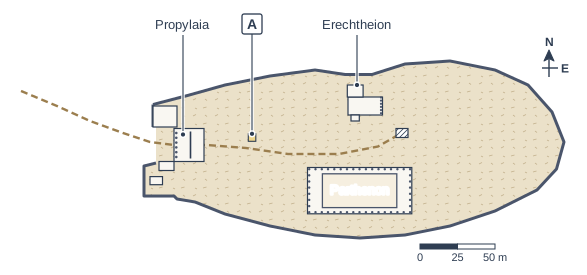
The plan shows the buildings on the Acropolis. Pausanias says that the point of the spear and the crest of the helmet of the statue labelled A could be seen by sailors as soon as they had passed Cape Sunium.

Name the statue labelled A and the sculptor who made it.

Plan of a fortified hilltop sanctuary. Plan of a rocky hilltop surrounded by a wall, with north at the top. The only way in is at the west end, through a large building, with a small building on a projecting corner south-west of it. Just east of the large building is a small square base. The largest building, a temple surrounded by columns, stands on the south side of the rock; opposite it, near the north wall, is a smaller, irregular building with porches. A small hatched block lies east of the irregular building. A dashed route comes up the slope from the west, through the large building at the west end and east between the two temples to the hatched block. A compass shows north (up) and east (right); there is a 50 m scale bar. Label A points to the small square base just east of the building at the west end; the label "Propylaia" points to the building across the west end of the rock, where the dashed route enters; the label "Parthenon" points to the large temple surrounded by columns on the south side of the rock; the label "Erechtheion" points to the irregular building with porches near the north wall.

Model answer

A is the bronze statue of Athena Promachos, made by Pheidias.

Explanation

Pausanias (1.28.2) says this bronze Athena was paid for from the spoils of the Persians who landed at Marathon and was the work of Pheidias, with the reliefs on its shield by Mys. It stood just inside the Propylaia, and Pausanias says its spear point and helmet crest could be seen from the sea. It was set up before the Parthenon, probably completed in the 450s BC. It is often confused with the gold and ivory Athena Parthenos inside the Parthenon.

Mark scheme
  1. 2 marks

    Statue: Athena Promachos / the great bronze Athena (paid for from the spoils of Marathon) (1). Sculptor: Pheidias (1)

    1 mark for each correct answer, max 2. Allow recognisable spellings (Phidias). For the statue accept 'bronze Athena', 'Athena Promachos', 'Athena who fights in the front line'; do not credit 'Athena Parthenos' (inside the Parthenon) or 'Athena Nike'. For the sculptor do not credit Mys (who carved the reliefs on its shield) or Ictinus.

Question 2

5 marks

Passage C

Quintilian, a Roman teacher of public speaking writing about AD 95, compares the great Greek sculptors.

'Pheidias, on the other hand, is considered to have been more skilful at making images of gods than of men, and in working ivory he was far beyond any rival - as he would be even if he had made nothing except his Minerva [Athena] at Athens and his Olympian Jupiter [Zeus] at Elis. The beauty of that statue is said to have added something even to the religion that people already had, so completely did the majesty of the work match the greatness of the god.'

Quintilian, Oratorical Education 12.10.9 (adapted)

What can we learn from Passage C about Pheidias' reputation as a sculptor?

Model answer

The passage shows that Pheidias had an outstanding reputation that lasted more than five hundred years, since a Roman writer of about AD 95 still praises him. He was thought best at making 'images of gods' rather than men, and he was 'far beyond any rival' in ivory work, which refers to his gold and ivory statues. His Athena Parthenos ('his Minerva at Athens') and his Zeus at Olympia were seen as his masterpieces. Most strikingly, his Zeus was said to have 'added something even to the religion that people already had', so his statues were believed to make people feel the gods' greatness more strongly. However, the words 'is considered' and 'is said' suggest Quintilian is repeating common opinion rather than his own observation.

Explanation

Good answers explain what each detail shows about Pheidias' reputation (gods rather than men, ivory and gold, the Athena and Zeus, religious effect) and notice that this is a later Roman judgement reporting common opinion. Remember 'Minerva' and 'Jupiter' are the Roman names for Athena and Zeus.

Mark scheme
  1. 5 marks

    Levels of response (5 marks, AO3).
    Level 3 (4-5 marks): Response uses a range of fully appropriate details from the passage, which are analysed to draw out relevant characteristics and features and give a detailed and sophisticated evaluation of what we can learn from the source about the specified issue in the question.
    Level 2 (2-3 marks): Response uses some appropriate details from the passage, which are analysed to draw out some of the characteristics and features and evaluate what we can learn from the source about the specified issue in the question.
    Level 1 (1 mark): Response uses few details from the passage and makes a very basic attempt to draw out any of the characteristics and features in relation to the question.
    0 marks: No response or no response worthy of credit.

    Max 1 if the answer makes no use of the passage (own knowledge alone does not answer this question). Details must be explained, not just copied: credit what each detail tells us about the issue. Candidates are likely to pick out and explain: 'more skilful at making images of gods than of men': Pheidias was famous above all for statues of the gods; 'in working ivory he was far beyond any rival': he was the master of gold and ivory (chryselephantine) statues; 'his Minerva at Athens': the Athena Parthenos was counted among his greatest works; 'his Olympian Jupiter at Elis': his statue of Zeus at Olympia was equally famous; 'added something even to the religion that people already had': the beauty of his Zeus was believed to increase people's reverence for the god; 'the majesty of the work match[ed] the greatness of the god': his work was admired for its grandeur and dignity; 'is considered... is said': Quintilian reports a common opinion, perhaps without having seen the statues himself; a Roman writer about AD 95 still praising him shows that his reputation lasted over 500 years. A paraphrase of the passage with no explanation of what it shows is typically no higher than the bottom of Level 2.

Question 3

5 marks

Passage C

Plutarch describes the end of the revolt of Samos against Athens (440-439 BC).

'After eight months the Samians surrendered, and Pericles pulled down their walls, took away their warships and imposed a heavy fine on them, part of which they paid at once, while for the rest they agreed to pay by a fixed date and gave hostages. Duris of Samos makes a tragedy out of this, accusing the Athenians and Pericles of great cruelty, which is not recorded by Thucydides, Ephorus or Aristotle. He does not seem to be telling the truth when he claims that Pericles had the Samian ship-captains and marines brought into the market-place of Miletus and put to death there... Since Duris does not usually keep his story to the truth even when he has no personal interest, he is all the more likely in this case to have exaggerated the sufferings of his own country in order to slander the Athenians.'

Plutarch, Life of Pericles 28.1-28.3 (adapted)

Using details from Passage C, how accurate do you think Plutarch's account of the end of the Samian revolt is?

Model answer

Plutarch's account is probably accurate, mainly because here he shows how he weighed his sources. Writing over 500 years later, he names Duris, who claimed Pericles was very cruel, and checks him against Thucydides, Ephorus and Aristotle, who do not mention it. The terms he gives - walls pulled down, warships taken, a fine and hostages - match Thucydides, a contemporary, so they are reliable. His reasons for rejecting Duris are sensible: Duris was a Samian writing about the sufferings of 'his own country' and was known for turning history into 'tragedy'. However, Plutarch admired Pericles, and the fact that Thucydides does not mention cruelty does not prove it never happened, so he may have dismissed Duris too easily. Overall, the terms of surrender are accurate, and his rejection of the cruelty story is reasonable but not certain.

Explanation

Top answers recognise Plutarch's method in this passage (comparing named sources and explaining a source's bias) and also its limits (his own admiration for Pericles; an argument from silence). They relate these to the particular details of the surrender.

Mark scheme
  1. 5 marks

    Levels of response (5 marks, AO3).
    Level 3 (4-5 marks): Response analyses the source by using relevant detail from the source content or historical context to give a more detailed evaluation of the source within its historical context. It draws a thorough and convincing conclusion about its accuracy or reliability based on how the context in which it was created impacts on how it portrays issues or events.
    Level 2 (2-3 marks): Response analyses the source by using relevant detail from the source content or historical context to give a basic evaluation of the source within its historical context. It draws a basic conclusion about its accuracy or reliability based on how the context in which it was created impacts on how it portrays issues or events.
    Level 1 (1 mark): Response analyses the source in a basic way by selecting relevant detail from the source content or historical context.
    0 marks: No response or no response worthy of credit.

    Max 1 if the answer reaches no conclusion at all about how accurate or reliable the passage is. Full marks need the evaluation to be related to the particular events in the passage, not only general comments about the author. Candidates might comment on: Plutarch wrote about AD 100, over 500 years later, but here he names and compares his sources: Duris against Thucydides, Ephorus and Aristotle; the terms of surrender (walls pulled down, warships taken, a fine paid partly at once and partly later, hostages) agree with Thucydides' account, a contemporary, so they are probably accurate; he rejects Duris' claim of cruelty because the more reliable writers do not record it, a reasonable method; he explains Duris' bias: Duris was a Samian, writing about 'his own country', and was known for dramatic 'tragedy' rather than truth; but Plutarch admired Pericles and may have been too quick to dismiss evidence of Athenian harshness; the silence of Thucydides does not prove nothing happened; 'After eight months' fits other evidence for a long siege (Plutarch also reports Ion's claim of nine months), so the length is roughly right; Plutarch's own judgement ('does not seem to be telling the truth') is an opinion, not proof.

Question 4

20 marks

'Thucydides' admiration for Pericles makes him an unreliable source for Periclean Athens.'

How far do you agree with this view?

You must use and analyse the ancient sources you have studied as well as supporting your answer with your own knowledge.

Model answer

Thucydides clearly admired Pericles, and this affects his judgements, but I do not think it makes him an unreliable source overall. His facts are usually trustworthy, even where his opinions are favourable.

There is evidence that his admiration shapes his account. His final verdict on Pericles praises him for leading Athens 'with moderation', for his 'foresight' and for being incorruptible, and blames his successors, whose rivalry handed affairs to the 'whims of the people'. This was written after Pericles' death and probably after Athens' defeat in 404 BC, so hindsight may have made Pericles look wiser than he was. The Funeral Oration presents an idealised Athens in Thucydides' own words. He also says little about the criticisms that other sources record: Aristophanes blames Pericles' anger and the Megarian decree for the war, and Plutarch says Pericles alone was held responsible and reports the attacks on his friends Pheidias and Aspasia. Thucydides, by contrast, makes Spartan fear of Athenian power the 'truest cause', which takes attention away from Pericles' role.

On the other hand, Thucydides does not hide Pericles' difficulties. He records that the Athenians, suffering from war and plague, turned against Pericles, sent envoys to Sparta and fined him, and he describes the plague's horrors frankly. He also includes the Megarian decree and the Spartan demand that it be withdrawn. Many of his facts are confirmed by other evidence: the tribute and building records inscribed at the time broadly support his picture of Athens' wealth, and Plutarch confirms that the gold on Athena's statue was removable. As a contemporary and a former general, he knew events at first hand, and he explains his careful method of checking reports. He also had no need to flatter Pericles: he wrote long after Pericles' death, in exile, with nothing to gain from praising him, which suggests his admiration was a genuine judgement rather than bias for profit.

The other sources have weaknesses too. Aristophanes was writing comedy to make his audience laugh and to argue for peace, so his blame of Pericles is exaggerated. Plutarch wrote more than five hundred years later and relied partly on comic poets and hostile writers, although he admits how hard it is to find the truth and often follows Thucydides himself. Thucydides' admiration, therefore, should be weighed against their hostility.

Overall, I disagree with the statement to a large extent. Thucydides' admiration makes his judgements of Pericles too favourable and leads him to say little about some criticisms, so his opinions must be read with care. But his factual account of politics and war is generally reliable and is confirmed by other sources, which makes him the most valuable source we have for Periclean Athens, even if he is not a complete one.

Explanation

High-level answers distinguish Thucydides' judgements of Pericles (affected by admiration and hindsight) from his factual reporting (generally confirmed), test both against Plutarch, Aristophanes and inscriptions, and evaluate those sources too. Answers that simply call Thucydides 'biased' or 'reliable' without analysis stay at Level 2.

Mark scheme
  1. 20 marks

    Levels of response (20 marks: AO3 10, AO1 5, AO2 5).
    Level 5 (17-20 marks): Detailed evaluation of the ancient sources in their historical context, with thorough analysis of their reliability and accuracy in terms of the context in which they were created, used to make developed, supported judgements and fully convincing conclusions (AO3). A range of detailed, accurate knowledge and a developed understanding (AO1). Thorough, convincing analysis with substantiated, developed judgements (AO2). A sustained, coherent and logically structured line of reasoning.
    Level 4 (13-16 marks): Detailed evaluation of the ancient sources in their context, with some analysis of their reliability and accuracy, used to make supported judgements and reasonable conclusions (AO3). Accurate knowledge and a developed understanding (AO1). A full analysis; judgements are substantiated but not consistently well developed (AO2). A clear, logically structured line of reasoning.
    Level 3 (9-12 marks): Analyses examples from the ancient sources, with a basic analysis of the reliability and accuracy of at least one source in terms of its context, used to make basic judgements and simple conclusions (AO3). Accurate knowledge and some understanding (AO1). Analysis and explanation; judgements may not be explicit (AO2). A mostly relevant line of reasoning with some structure.
    Level 2 (5-8 marks): Uses examples from the ancient sources, with a very basic attempt to consider a source's reliability or accuracy that may border on assertion; no source analysis is used to reach judgements (AO3). Basic knowledge and some understanding (AO1). A basic explanation (AO2). Some relevance; limited structure.
    Level 1 (1-4 marks): Basic use of the sources, with no attempt to consider their reliability or accuracy (AO3). Basic knowledge (AO1). Little or no explanation, close to assertion (AO2). Basic, unstructured communication.
    0 marks: No response or no response worthy of credit.

    Max 8 if the answer makes no use of the ancient sources (it never names, quotes or discusses any ancient writer, work, inscription, coin or other object, and knowing the events is not using the sources). Max 8 if the answer never considers how reliable or accurate any ancient source is. Max 12 if the answer considers only one side of the statement and never addresses the other (the issue of extent). No set answer is expected. It is possible to reach the highest mark either by agreeing or disagreeing with the statement (providing the issue of extent is addressed by refuting the counter-argument), or anywhere between. To access Level 3 and above, answers discuss the ancient sources; at lower levels they may only retell stories from the sources or name them. Candidates do not have to quote directly or give precise references. Grounds for agreeing include: He praises Pericles' integrity, foresight and moderation and blames his successors for Athens' failures (2.65.5-2.65.13), written with hindsight after the defeat; He calls the democracy 'government by the first citizen' (2.65.9), which may exaggerate Pericles' control in order to praise him; His version of the Funeral Oration (2.35-2.46) is an idealised picture in his own words (1.22); He gives little space to criticisms of Pericles that others record: the Megarian decree's role (Aristophanes, Acharnians, Peace; Plutarch 29-32), the attacks on Pheidias and Aspasia; He plays down the decree as a cause, preferring Spartan fear of Athenian power (1.23.6), which takes blame away from Pericles. Grounds for disagreeing include: He was a contemporary, an Athenian and a general, who knew events at first hand and had no personal reason to flatter a dead man; He records Pericles' failures honestly: the anger of the people, the envoys sent to Sparta and the fine (2.59.1-2.59.2, 2.65.3), and the horrors of the plague (2.52.3-2.53.4); His figures and facts are confirmed elsewhere: the treasury (2.13.3-5; inscriptions), the gold on the statue (Plutarch 31.3), the citizenship law and the Long Walls; His account of the causes of the war still includes the Megarian decree and Spartan demands (1.67, 1.139); His admiration affects his judgements, not his facts; for subjects he ignores (culture, women, buildings) we have other sources. Likely sources to be included: Thucydides 1.23.6, 1.67, 1.139, 2.13, 2.35-2.46, 2.52-2.53, 2.59-2.65; Plutarch, Life of Pericles 13.12, 29-35, 39; Aristophanes, Acharnians 515-539; Peace 605-609. The source analysis is likely to address: Thucydides' aim was an accurate history, 'a possession for all time', and he describes his methods (1.22), but his speeches are reconstructions and his judgements were formed after the war was lost; Plutarch, writing about AD 100, used Thucydides heavily and also hostile writers; he sometimes corrects Thucydides' picture with other evidence; Aristophanes' comedies are contemporary but exaggerated and hostile to Pericles. A top answer distinguishes Thucydides' judgements (affected by admiration) from his factual reporting (generally reliable) and tests both against other sources.

Ready to try the rest? Every answer you write is marked against the mark scheme, so you can see exactly where the marks are.

Study Helper Hints first, answers after you try

Stuck on this one? Ask for a hint and I’ll point you in the right direction, without giving the answer away. Once you’ve checked your answer, I’ll show you how the marks are awarded.