Level:
Correct: 0
Incorrect: 0
Marks: 0/0
Exam Practice
Course:
Topics:
OCR GCSE Ancient History (Greece and Persia) Smart practice A mixed round aimed at your weak spots
Unit 1
The Persian Empire, 559-465 BC (period study)
Unit 2
From Tyranny to Democracy, 546-483 BC (depth study)
Unit 3
Athens in the Age of Pericles, 462-429 BC (depth study)
Unit 4
Alexander the Great, 356-323 BC (depth study)
Avg
score:
–
Topics
done:
0/45

The Persian kings compared: expansion, cultures and priorities

Practise 14 exam-style questions on The Persian kings compared: expansion, cultures and priorities for OCR GCSE Ancient History (Greece and Persia). Write your answer as you would in the exam and get it marked in seconds against the mark scheme, point by point, with the Study Helper on hand if you get stuck.

  • 14 questions
  • 2–25 marks each
  • Instant marking
  • No sign-up needed
14 questions, marked as you go

Sample questions with model answers

Here are 4 of the questions in this topic, each with a model answer, an explanation of why it earns the marks and the mark scheme an examiner would use.

Question 1

3 marks

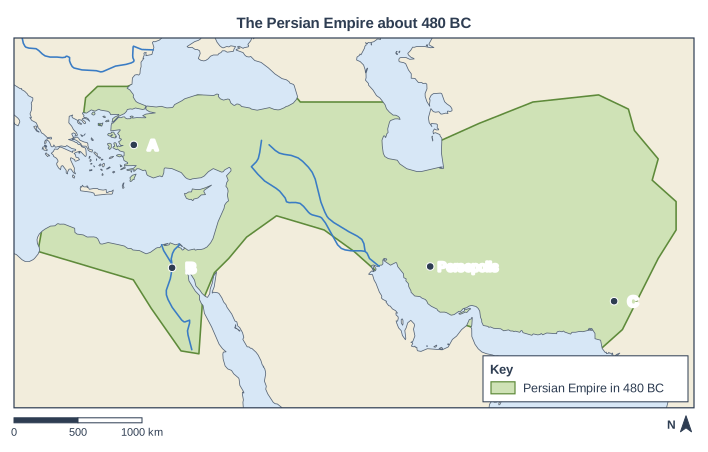
The map shows the Persian Empire about 480 BC.

Name the king who added to the empire the region containing each of the places marked A, B and C.

Map of the area from 18°E to 75°E and 20°N to 46°N, titled "The Persian Empire about 480 BC", drawn with real coastlines (land pale buff, sea pale blue) and no modern borders; a north arrow shows north at the top; the scale bar is 1000 km long. An area of land shaded pale green with a darker outline shows the Persian Empire under Xerxes (480 BC) (key: "Persian Empire in 480 BC"). Blue lines show rivers. Points: a dot labelled "Persepolis" (inland); a dot labelled A inland, in the top left of the map (about 20% of the way across and 30% of the way down); a dot labelled B inland, towards the left of the map (about 25% of the way across and 60% of the way down); a dot labelled C inland, in the bottom right of the map (about 90% of the way across and 70% of the way down), about 1550 km east of the point labelled "Persepolis". The key (in a box on the map) shows: "Persian Empire in 480 BC".

Model answer

A was added by Cyrus, B by Cambyses and C by Darius.

Explanation

Sardis, capital of Lydia, was taken by Cyrus about 547/546 BC; Egypt, with Memphis, was conquered by Cambyses in 525 BC; and the Indus valley was added by Darius about 518-515 BC. This shows each king adding new territory, the expansion that Xerxes said was a Persian custom.

Mark scheme
  1. 3 marks

    A (Sardis, in Lydia): Cyrus; B (Memphis, in Egypt): Cambyses; C (the Indus valley, in India): Darius

    1 mark for each correct king, max 3. The kings must be matched to the right letters. The place names are not required, but credit an answer that names the region and the right king (e.g. 'A is Lydia, conquered by Cyrus'). Do not accept Xerxes for any letter.

Question 2

10 marks

Passage A

In Aeschylus' play The Persians (472 BC), the ghost of Darius speaks to the Persian elders after hearing that Xerxes has been defeated at Salamis. Aeschylus was an Athenian who had fought against the Persians. He calls the man Darius overthrew 'Mardus' (Herodotus' false Smerdis) and names the noble who killed him 'Artaphrenes'.

'Never has such a disaster fallen on this city of Susa since Lord Zeus first granted that one man should rule all Asia with its flocks and hold the sceptre of command. Medus was the first leader of its army; his son finished his work, for good sense guided his mind. Third came Cyrus, a fortunate man, who ruled and brought peace to all his people. He won the Lydians and Phrygians and conquered all Ionia by force; the god did not hate him, for he was wise. Fourth, the son of Cyrus led the army. Fifth, Mardus ruled, a disgrace to his country and to the ancient throne; noble Artaphrenes killed him in his palace by a trick ... And I too gained the rule I wanted, and led many campaigns with a great army, but I never brought such a disaster on the city. Yet Xerxes my son is young and thinks young thoughts, and does not remember my advice.'

Aeschylus, The Persians, lines 759-783 (adapted)

Using details from Passage A and your own knowledge, what can we learn about the achievements of the Persian kings from Cyrus to Darius?

Model answer

Passage A shows how the achievements of the Persian kings were remembered, though through the eyes of an Athenian playwright writing after Xerxes' defeat.

At the start, Darius' ghost says that 'Lord Zeus first granted that one man should rule all Asia'. This reflects the Persian idea that kingship came from the god; in their own inscriptions the kings thank Ahuramazda. The kings also saw themselves as heirs of the Medes, whose leaders come first in the list.

Cyrus is praised most. He 'brought peace to all his people' and 'won the Lydians and Phrygians and conquered all Ionia by force'. Own knowledge confirms this: Cyrus defeated Croesus and took Lydia in about 547/546 BC, and his general Harpagus conquered the Ionian Greeks. He also overthrew Astyages and captured Babylon in 539 BC, where the Cyrus Cylinder presents him as a liberator. Aeschylus adds that 'the god did not hate him, for he was wise', which suggests that even Greeks admired him.

In the middle, Cambyses gets only one line: 'the son of Cyrus led the army'. Surprisingly, his conquest of Egypt in 525 BC is not mentioned, perhaps because of his bad reputation among Greeks. 'Mardus', the false Smerdis, is called 'a disgrace' and was killed 'by a trick' in 522 BC.

At the end, Darius claims he 'led many campaigns with a great army' without bringing disaster. Own knowledge shows real achievements: he crushed the revolts of 522-521 BC, conquered the Indus valley and Thrace and organised the empire into satrapies. But the claim ignores his failures in Scythia and at Marathon. Aeschylus praises Darius to make Xerxes, who 'does not remember my advice', look worse, so the passage tells us as much about Greek views of Xerxes as about the earlier kings.

Explanation

Top answers explain what the passage shows about each king (Cyrus' conquests and wisdom, Cambyses' silence, the coup of 522 BC, Darius' campaigns) and add own knowledge such as Babylon, Egypt and Darius' organisation. Credit evaluation that Aeschylus omits Cambyses' Egypt and Darius' Marathon in order to contrast them with Xerxes.

Mark scheme
  1. 10 marks

    Levels of response (10 marks: AO1 5, AO3 5).
    Level 5 (9-10 marks): A range of detailed and accurate knowledge and a developed understanding that is fully relevant to the question (AO1). Uses a range of fully appropriate details from the passage, which are analysed to draw out relevant characteristics and features and give a detailed and sophisticated evaluation of what we can learn from the source about the specified issue (AO3).
    Level 4 (7-8 marks): Accurate knowledge and a developed understanding that is fully relevant to the question (AO1). Uses a range of fully appropriate details from the passage, which are analysed to draw out most of the relevant characteristics and features and evaluate what we can learn from the source about the specified issue (AO3).
    Level 3 (5-6 marks): Accurate knowledge and some understanding that is relevant to the question (AO1). Uses some appropriate details from the passage, which are analysed to draw out some of the characteristics and features and evaluate what we can learn from the source about the specified issue (AO3).
    Level 2 (3-4 marks): Basic knowledge and some understanding that is relevant to the question (AO1). Uses some appropriate details from the passage, which are analysed to draw out a few of the characteristics and features (AO3).
    Level 1 (1-2 marks): Basic knowledge that is relevant to the topic of the question (AO1). Uses few details from the passage and makes a very basic attempt to draw out any of the characteristics and features (AO3).
    0 marks: No response or no response worthy of credit.

    Max 6 if the answer uses only the passage, with no own knowledge. Max 6 if the answer makes no use of the passage.
    Quotations from the passage are credited only when linked to the question. A Level 4 or 5 answer typically uses details from the start, middle and end of the passage. There is no requirement to judge the passage's reliability, but relevant evaluation can be credited under AO3.
    Valid features the answer could identify from the passage: 'Lord Zeus first granted that one man should rule all Asia' - kingship was seen as given by the god, with one king ruling all Asia; 'Medus ... his son finished his work' - the Persian kings saw themselves as heirs of the Median empire; Cyrus 'brought peace to all his people' - he united Medes and Persians and gave stability; he 'won the Lydians and Phrygians and conquered all Ionia by force' - Cyrus' great conquests in Asia Minor (Croesus and Lydia, about 547/546 BC; Ionia under Harpagus); 'the god did not hate him, for he was wise' - Cyrus' wisdom and good fortune were remembered even by Greeks; 'the son of Cyrus led the army' - Cambyses is given no achievements; his conquest of Egypt is not even mentioned; 'Mardus ... a disgrace' was killed 'by a trick' - the overthrow of the false Smerdis in 522 BC; Darius 'led many campaigns with a great army' and 'never brought such a disaster on the city' - Darius remembered as a successful conqueror; his defeat at Marathon is not mentioned; evaluation: Aeschylus was an Athenian writing for Athenians in 472 BC; he praises Darius and Cyrus to contrast them with Xerxes.
    Other valid features from own knowledge: Cyrus also overthrew Astyages and took Media (about 550 BC) and captured Babylon (539 BC); the Cyrus Cylinder and the return of the Jews show his tolerance; he built Pasargadae; Cambyses conquered Egypt at Pelusium (525 BC), and the Libyans and Cyrene submitted; Darius crushed the revolts of 522-521 BC (the Behistun inscription), organised satrapies and tribute, introduced the daric, built the Royal Road, Susa, Persepolis and the Nile canal; Darius conquered the Indus valley, Thrace and Samos, but his Scythian campaign failed and his expedition of 490 BC was defeated at Marathon; Herodotus says the Persians called Darius a shopkeeper, Cambyses a master and Cyrus a father; Aeschylus' list of kings (beginning with two Median rulers, Medus and his son, and counting 'Mardus' as a king) does not match Persian records, which trace Darius' descent from Achaemenes.

Question 3

15 marks

Passage A

In Aeschylus' play The Persians (472 BC), the ghost of Darius and Queen Atossa, Xerxes' mother, discuss why Xerxes was defeated in Greece.

'DARIUS: My son, in his ignorance, brought this about through his youthful rashness. He hoped to stop the flow of the sacred Hellespont with chains, as if it were a slave, and he changed the nature of the strait, throwing hammered fetters on it and making a great road for his great army. Though only a mortal, he foolishly thought he could overpower all the gods, even Poseidon. Surely some sickness of the mind had taken hold of my son? I fear that the great wealth I won by my labour will be seized by the first man who comes. ATOSSA: Impetuous Xerxes learned this from talking with bad men. They kept telling him that you had won great wealth for your children with your spear, while he, through cowardice, only fought at home and did not add to his father's riches. After hearing these insults many times from bad advisers, he planned this expedition against Greece.'

Aeschylus, The Persians, lines 744-758 (adapted)

Using details from Passage A and your own knowledge, explain why the Persian kings found it so hard to conquer Greece.

Model answer

The Persian kings found it hard to conquer Greece because of the land and sea they had to fight on, the strength of the Greek forces, and their own mistakes. Aeschylus blames Xerxes' pride, but the problems affected Darius too.

Passage A gives a Greek, religious explanation. Darius' ghost says that Xerxes, 'in his ignorance ... through his youthful rashness', tried 'to stop the flow of the sacred Hellespont with chains' and thought he could 'overpower all the gods, even Poseidon'. To an Athenian audience in 472 BC this was hubris, which the gods punished. Atossa adds that Xerxes 'learned this from talking with bad men', who taunted him that he 'did not add to his father's riches'. Herodotus agrees that advisers such as Mardonius pushed Xerxes into war, and that Xerxes ignored warnings from Demaratus and Artemisia.

However, there were practical reasons. The passage mentions 'a great road for his great army'. Such an army was very hard to supply so far from the heart of the empire; Herodotus says it drank rivers dry, and on the retreat many died of hunger and disease. The weather was another enemy: Mardonius' fleet was wrecked off Athos in 492 BC, and in 480 BC storms off Magnesia and Euboea destroyed hundreds of ships.

The Greeks also had real strengths. Their mountains and narrow seas suited defenders: at Thermopylae the Persians could not use their numbers, and at Salamis the fleet was trapped in the straits by Themistocles' trick. In close combat Greek hoplites beat lightly armoured Persian infantry at Marathon, Thermopylae and Plataea. In 480 BC many Greek states united under Spartan leadership, and Athens had built a large navy.

The passage claims Darius 'never brought such a disaster', but this is misleading. Darius' expedition was defeated at Marathon in 490 BC, for some of the same reasons - hoplites fighting on ground of their choosing. Both kings were also distracted by other problems: the Ionian Revolt, and revolts in Egypt and Babylon.

Overall, the most important reason was the combination of Greek geography and Greek military strength, especially hoplites on land and the Athenian navy at sea, which turned Persian numbers into a disadvantage. Persian mistakes, which Aeschylus explains as divine punishment of pride, made defeat more likely, but the Greeks still had to win the battles.

Explanation

Top answers use the passage's explanations (Xerxes' rashness and pride, the Hellespont, bad advisers, pressure to match Darius) and test them against own knowledge of geography, weather, supply, Greek hoplites and navy, and Darius' own defeat at Marathon, reaching a judgement. Answers that only discuss Xerxes, or only retell Salamis, do not range across the kings as the question requires.

Mark scheme
  1. 15 marks

    Levels of response (15 marks: AO1 5, AO2 5, AO3 5).
    Level 5 (13-15 marks): Uses a range of fully appropriate examples from the passage and analyses them to make developed, supported judgements and draw fully convincing conclusions about what the source tells us (AO3). A range of detailed and accurate knowledge and a developed understanding that is fully relevant to the question (AO1). A full explanation and thorough, convincing analysis of the issue, arriving at substantiated and developed judgements (AO2).
    Level 4 (10-12 marks): Uses a range of appropriate examples from the passage and analyses them to make supported judgements and draw reasonable conclusions (AO3). Accurate knowledge and a developed understanding that is fully relevant to the question (AO1). A full explanation and analysis of the issue, arriving at substantiated judgements, but these are not consistently well developed (AO2).
    Level 3 (7-9 marks): Uses some appropriate examples from the passage and analyses them to make simple judgements and draw basic conclusions (AO3). Accurate knowledge and some understanding that is relevant to the question (AO1). Linked to an analysis and explanation of the issue, but judgements may not always be made explicit (AO2).
    Level 2 (4-6 marks): Uses some examples from the passage, making a very basic attempt to draw conclusions (AO3). Basic knowledge and some understanding that is relevant to the question (AO1). A basic explanation of the issue (AO2).
    Level 1 (1-3 marks): Uses few examples from the passage, with no attempt to draw conclusions from it (AO3). Basic knowledge that is relevant to the topic of the question (AO1). Little or no attempt at a very basic explanation, which may be close to assertion (AO2).
    0 marks: No response or no response worthy of credit.

    Max 9 if the answer uses only the passage, with no own knowledge. Max 9 if the answer makes no use of the passage.
    A typical Level 4 or 5 answer refers to two or more reasons/factors, with evidence from the start, middle and end of the passage, and reaches a judgement. There is no requirement to judge the passage's reliability.
    Valid features the answer could identify from the passage: 'in his ignorance ... through his youthful rashness' - Aeschylus blames Xerxes' inexperience and recklessness; he tried 'to stop the flow of the sacred Hellespont with chains' and thought he could 'overpower all the gods, even Poseidon' - hubris: in the Greek view, the gods punished his pride; 'making a great road for his great army' - the enormous scale of the invasion, which was hard to supply; 'some sickness of the mind' - the defeat explained by Xerxes' state of mind; Atossa: he 'learned this from talking with bad men' - bad advice drove the invasion; they said Darius 'had won great wealth ... with your spear' while Xerxes 'did not add to his father's riches' - pressure to match his father led to an unwise war; Darius 'never brought such a disaster' - but his own expedition of 490 BC was also defeated, which the passage ignores.
    Other valid features from own knowledge: geography: Greece's mountains, narrow passes and seas favoured defenders (Thermopylae, Salamis); the Persian cavalry needed open plains; the weather: Mardonius' fleet was wrecked off Athos (492 BC); storms off Magnesia and Euboea destroyed hundreds of ships in 480 BC; distance and supply: the armies were far from the heart of the empire; Herodotus says Xerxes' army drank rivers dry and many died of hunger on the retreat; Greek hoplites outfought lightly armoured Persian infantry at Marathon, Thermopylae and Plataea; the Athenian navy, built after 483/2 BC, and Themistocles' trick at Salamis; in 480-479 BC many Greek states united against Persia (the Hellenic League under Sparta); Persian kings had other problems: the Ionian Revolt, revolts in Egypt (486 BC) and Babylon (484 BC) delayed the invasions; Persian mistakes: Xerxes ignored Demaratus and Artemisia; Mardonius attacked at Plataea; Aeschylus was an Athenian veteran writing a play for Athenians in 472 BC; he explains the defeat in religious and moral terms.
    Second-order concepts in play: cause (Persian mistakes and Greek strengths; long-term factors such as geography); similarity and difference between Darius' and Xerxes' attempts; Aeschylus' religious explanation compared with practical reasons.

Question 4

25 marks

'The Persian kings were more interested in building than in conquest.'

To what extent do you agree with this view?

Spelling, punctuation and grammar and the use of specialist terminology will be assessed in this answer

Model answer

The Persian kings were great builders, but conquest was their first priority, and their buildings were largely celebrations of the empire that conquest had created. Only in Xerxes' later years did building perhaps become more important than war.

The evidence of building is impressive. Cyrus founded a new capital at Pasargadae, with palaces, a monumental gatehouse, formal gardens and his own tomb. Darius went much further. He built a new palace at Susa and began Persepolis, with its huge terrace and the Apadana, and he dug a canal from the Nile to the Red Sea and built the Royal Road. He had his achievements carved at Behistun and his tomb cut into the cliff at Naqsh-e Rustam. Xerxes completed the Apadana and added the Gate of All Nations, his own palace and the Hall of a Hundred Columns, and his inscriptions proudly say that 'what I built and what my father built, all of that we built'. Building also showed the unity of the empire: Darius' foundation charter at Susa lists materials and workers brought from many lands.

However, conquest came first for every king. Cyrus turned a small kingdom into a vast empire by conquering Media, Lydia and Babylon, and, according to Herodotus, died on campaign against the Massagetae. Cambyses spent his reign conquering Egypt and is not known for any major building. Darius added India, Thrace and Samos and sent expeditions against the Scythians and the Greeks; he was preparing another war when he died. Xerxes, according to Herodotus, said that the Persians had never stayed at peace since Cyrus, and that he must not fall short of earlier kings.

The two were also closely linked. The great buildings were paid for by the tribute of conquered peoples, and many of them celebrated conquest. The Behistun relief shows Darius standing over defeated rebels, and the reliefs of Persepolis show the many peoples of the empire bringing gifts to the King. Even great engineering works such as the Athos canal and the Hellespont bridges were built for conquest. According to the Greek geographer Strabo, Cyrus even built Pasargadae on the site of his victory over the Medes.

There may have been a change after 479 BC. Following his defeats in Greece, Xerxes made no new attempt at conquest and seems to have concentrated on building at Persepolis. This suggests that, once expansion had reached its limits, building became the main way to display royal power.

Overall, I disagree with the statement. Building was a major priority, especially for Darius and Xerxes, but it depended on conquest and celebrated it. For most of the period from 559 to 480 BC, conquest was the kings' main interest, and building was the way they showed off what they had won.

Explanation

The best essays cover all four kings with specific evidence of both building and conquest, show how the two were connected, and consider change over time (for example Xerxes after 479 BC). Answers that only describe Persepolis, or only list conquests, are one-sided.

Mark scheme
  1. 20 marks

    Levels of response (20 marks: AO1 10, AO2 10).
    Level 5 (17-20 marks): A wide range of fully relevant and accurate knowledge, with a good level of detail throughout, showing a thorough understanding of all the key features and characteristics discussed (AO1). A full explanation and thorough, convincing analysis of the issue in the question, arriving at substantiated and developed judgements (AO2). A well-developed and sustained line of reasoning which is coherent, relevant and logically structured.
    Level 4 (13-16 marks): A good range of fully relevant and accurate knowledge, detailed in places, showing a good understanding of most of the key features and characteristics discussed (AO1). A full explanation and analysis of the issue, arriving at substantiated judgements, but these are not consistently well developed (AO2). A well-developed line of reasoning which is clear, relevant and logically structured.
    Level 3 (9-12 marks): A wider selection of relevant, generally accurate knowledge, which lacks detail, showing some understanding of the key features and characteristics discussed (AO1). Linked to an analysis and explanation of the issue, but judgements may not always be made explicit (AO2). A line of reasoning which is mostly relevant and has some structure.
    Level 2 (5-8 marks): A limited amount of relevant knowledge, which may be inaccurate in places and lacks detail, showing limited understanding of the key features and characteristics (AO1). A basic explanation of the issue (AO2). A line of reasoning which has some relevance, presented with limited structure.
    Level 1 (1-4 marks): Very basic knowledge and basic understanding that is relevant to the topic of the question (AO1). Little or no attempt at a very basic explanation of the issue, which may be close to assertion (AO2). The information is communicated in a basic, unstructured way.
    0 marks: No response or no response worthy of credit.

    Max 12 if the answer considers only one side of the statement and never addresses the other (the issue of extent).
    No set answer is expected. It is possible to reach the highest marks either by agreeing or disagreeing with the statement (providing the issue of extent is addressed by refuting the counter-argument), or anywhere between. No reference to ancient sources is expected, but discussion of how far the events in the sources really happened can be credited under AO2.
    Grounds for agreeing include: Cyrus built a new capital at Pasargadae with palaces, gatehouse, gardens and his tomb; Darius built Persepolis (the terrace, Apadana and Tachara), a new palace at Susa, the canal from the Nile to the Red Sea, the Royal Road and his rock tomb at Naqsh-e Rustam; Xerxes completed and added to Persepolis (the Gate of All Nations, his palace, the Hall of a Hundred Columns); his inscriptions stress building with his father; great engineering works also supported campaigns: the Athos canal and Hellespont bridges; building displayed royal power and the unity of the empire: workers and materials came from many lands (the Susa foundation charter); reliefs at Persepolis show subject peoples bringing gifts; after 479 BC Xerxes seems to have concentrated on building rather than new wars.
    Grounds for disagreeing include: every king was a conqueror: Cyrus (Media, Lydia, Babylon), Cambyses (Egypt), Darius (India, Thrace, Samos, the Aegean), Xerxes (Greece); Xerxes called conquest a Persian custom and said he must not fall short of earlier kings (Herodotus 7.8); Cambyses is not known for major building; his reign was spent on the conquest of Egypt; Cyrus died on campaign (against the Massagetae, according to Herodotus); Darius was preparing a new war when he died; building was paid for by the tribute and resources of conquered lands; conquest came first; buildings often celebrated conquest: the Behistun relief shows Darius over defeated rebels; Persepolis shows the many peoples of the empire.
    A top answer covers all four kings, recognises that building and conquest were connected (conquest paid for building; building displayed the empire won by conquest), and reaches a substantiated judgement, perhaps noting change over time.

  2. 5 marks

    SPaG. Spelling, punctuation and grammar and the use of specialist terminology (5 marks).
    High performance (4-5 marks): Learners spell and punctuate with consistent accuracy. Learners use rules of grammar with effective control of meaning overall. Learners use a wide range of specialist terms as appropriate.
    Intermediate performance (2-3 marks): Learners spell and punctuate with considerable accuracy. Learners use rules of grammar with general control of meaning overall. Learners use a good range of specialist terms as appropriate.
    Threshold performance (1 mark): Learners spell and punctuate with reasonable accuracy. Learners use rules of grammar with some control of meaning and any errors do not significantly hinder meaning overall. Learners use a limited range of specialist terms as appropriate.
    0 marks: The learner writes nothing, the response does not relate to the question, or the learner's SPaG does not reach the threshold performance level, for example errors in spelling, punctuation and grammar severely hinder meaning.

    Mark the whole answer for spelling, punctuation and grammar and for the accurate use of specialist terms. Specialist terms suited to this question include: Pasargadae, Persepolis, Apadana, Susa, satrapy, tribute, Royal Road, canal, relief, inscription, expansion, Achaemenid. Names of people and places spelled in any recognisable form used in translations (e.g. Dareios/Darius, Artaphrenes/Artaphernes) count as accurate.

Ready to try the rest? Every answer you write is marked against the mark scheme, so you can see exactly where the marks are.

Study Helper Hints first, answers after you try

Stuck on this one? Ask for a hint and I’ll point you in the right direction, without giving the answer away. Once you’ve checked your answer, I’ll show you how the marks are awarded.