Level:
Correct: 0
Incorrect: 0
Marks: 0/0
Exam Practice
Course:
Topics:
OCR GCSE Ancient History (Greece and Persia) Smart practice A mixed round aimed at your weak spots
Unit 1
The Persian Empire, 559-465 BC (period study)
Unit 2
From Tyranny to Democracy, 546-483 BC (depth study)
Unit 3
Athens in the Age of Pericles, 462-429 BC (depth study)
Unit 4
Alexander the Great, 356-323 BC (depth study)
Avg
score:
–
Topics
done:
0/45

The sources for tyranny and the new democracy

Practise 12 exam-style questions on The sources for tyranny and the new democracy for OCR GCSE Ancient History (Greece and Persia). Write your answer as you would in the exam and get it marked in seconds against the mark scheme, point by point, with the Study Helper on hand if you get stuck.

  • 12 questions
  • 1–20 marks each
  • Instant marking
  • No sign-up needed
12 questions, marked as you go

Sample questions with model answers

Here are 4 of the questions in this topic, each with a model answer, an explanation of why it earns the marks and the mark scheme an examiner would use.

Question 1

2 marks

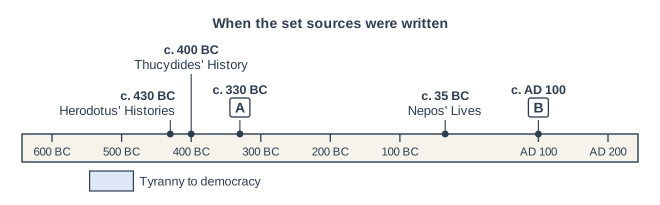
The timeline shows roughly when some of the set sources for this period were written.

Name the writers labelled A and B.

Horizontal timeline titled "When the set sources were written", running from 600 BC on the left to AD 200 on the right, with the years marked every 100 years (600 BC to AD 200). The BC dates count down towards the BC/AD boundary and the AD dates count up after it (there is no year 0). Events marked by dots on the line, in date order: c. 430 BC: Herodotus' Histories; c. 400 BC: Thucydides' History; c. 330 BC: label A; c. 35 BC: Nepos' Lives; c. AD 100: label B. Periods shown as bars below the line, each bar as long as the period: Tyranny to democracy (546 BC to 483 BC).

Model answer

A is Aristotle (the Athenian Constitution) and B is Plutarch.

Explanation

The Athenian Constitution was written about 330-322 BC by Aristotle or his pupils, and Plutarch wrote his Lives around AD 100, some six hundred years after the events. Knowing when each source was written is the starting point for judging its reliability.

Mark scheme
  1. 2 marks

    A: Aristotle / the author of the Athenian Constitution (possibly a pupil of Aristotle); B: Plutarch

    1 mark for each different correct answer, max 2. Allow recognisable spellings. One mark for each. For A accept 'Aristotle's Athenian Constitution'. Do not accept the Old Oligarch for A (written in the fifth century BC) or Nepos for B (first century BC).

Question 2

5 marks

Source B

The Temple of Hera (the Heraion) on Samos, a few kilometres from the ancient city. Excavations have found the remains of several temples on the site. A huge Ionic temple, about 52 metres wide and 105 metres long, with a double row of columns all round it, was built about 570-560 BC by the architects Rhoecus and Theodorus, but it did not stand for long. An even larger temple, about 55 metres wide and 109 metres long, planned with about 155 columns some 20 metres tall, was begun to replace it, probably in the time of Polycrates (about 530 BC). Building went on for many years and the temple was never finished. Today one column still stands, to about half its original height.

How reliable is Source B as evidence for the wealth and power of Polycrates?

Model answer

Source B is useful but limited evidence for Polycrates' wealth and power. The remains are real and measurable, and they confirm Herodotus' statement that the Samians built the largest temple he knew of. A temple planned with about 155 columns some twenty metres tall needed enormous wealth and organised labour, which fits Herodotus' picture of Polycrates as a powerful and magnificent ruler. However, the temple is only 'probably' of his time: it is dated by excavation, not by an inscription naming him. An earlier huge temple had been built about 570-560 BC, before Polycrates, so the Samians were already rich, and Herodotus himself credits 'the Samians' rather than Polycrates. The fact that it was never finished could mean that the project depended on him and stopped when he was killed, but it could also show that resources ran out. So the temple is reliable evidence for the wealth of Samos in his time, but less certain evidence for Polycrates' personal power.

Explanation

High-level answers recognise what the remains can and cannot prove: they show great wealth, but the link to Polycrates rests on dating, and the earlier temple shows Samian wealth before him. A supported conclusion is needed for Level 3.

Mark scheme
  1. 5 marks

    Levels of response (5 marks, AO3).
    Level 3 (4-5 marks): Response analyses the source by using relevant detail from the source content or historical context to give a more detailed evaluation of the source within its historical context. It draws a thorough and convincing conclusion about its accuracy or reliability based on how the context in which it was created impacts on how it portrays issues or events.
    Level 2 (2-3 marks): Response analyses the source by using relevant detail from the source content or historical context to give a basic evaluation of the source within its historical context. It draws a basic conclusion about its accuracy or reliability based on how the context in which it was created impacts on how it portrays issues or events.
    Level 1 (1 mark): Response analyses the source in a basic way by selecting relevant detail from the source content or historical context.
    0 marks: No response or no response worthy of credit.

    Max 1 if the answer reaches no conclusion at all about how accurate or reliable the source is. Full marks need the evaluation to be related to the particular features of the source, not only general comments about the type of source. Candidates might comment on: the remains are physical evidence that can be measured, and they confirm Herodotus' claim (3.60) that the Samians built the largest temple he knew; the size (about 155 columns some 20 metres tall) shows huge resources of money, materials and labour, which fits Herodotus' picture of Polycrates' wealth and power; the temple is only 'probably' of Polycrates' time: it is dated by excavation and style, not by an inscription naming him, so the link with him is an inference; an earlier huge temple was built about 570-560 BC, before Polycrates, so Samos was already rich; the temple shows the wealth of Samos as much as that of its tyrant; Herodotus credits 'the Samians', and names Rhoecus, the architect of the earlier temple, as the first architect, so he does not say Polycrates built it; the temple was never finished: perhaps Polycrates' death (522 BC) and the Persian takeover ended the money, which may show that his power drove the project, or that resources were limited; a temple shows religious devotion and civic pride, not only a tyrant's power; today mostly foundations and one column survive, so the size and number of columns come from excavators' reconstructions. Credit any other valid evaluation; a conclusion either way can reach Level 3 if it is supported.

Question 3

5 marks

Passage B

After the battle of Marathon some Athenians claimed that the Alcmaeonid family had signalled to the Persians by holding up a shield. Herodotus gives his view.

'I find it astonishing, and I do not accept the story, that the Alcmaeonids would ever have held up a shield as a signal to the Persians by agreement, wanting the Athenians to be under the barbarians and Hippias. For they clearly hated tyrants as much as Callias son of Phaenippus did, or even more... I do not accept the charge that they showed the shield, since they were in exile from the tyrants for the whole time, and it was by their scheme that the Peisistratids gave up the tyranny. In my judgement it was they who freed Athens, much more than Harmodios and Aristogeiton. For those two, by killing Hipparchus, made the rest of the Peisistratids more savage and did nothing to end their tyranny... A shield was held up; that cannot be denied, for it happened. But who held it up I cannot say any more than this.'

Herodotus, Histories 6.121.1, 6.123 and 6.124.2 (adapted)

Using details from Passage B, how accurate do you think Herodotus' defence of the Alcmaeonids is?

Model answer

Herodotus' defence of the Alcmaeonids is not very reliable, although parts of it are supported. He wrote some fifty or sixty years later, when Pericles, whose mother came from the Alcmaeonid family, led Athens, a city Herodotus knew well, so he may have absorbed the family's version. His argument rests on their character - they 'clearly hated tyrants' - rather than any evidence about who held up the shield. One of his key claims is also wrong: he says they were in exile 'for the whole time', but the archon list found in the Agora shows Cleisthenes as archon under Hippias in 525/4 BC. The Athenians themselves seem to have suspected the family, since Megacles, an Alcmaeonid, was ostracised in the 480s, when ostracism was aimed at friends of the tyrants. On the other hand, Herodotus is honest that a shield was shown and that he cannot say who showed it, and Thucydides supports his view that the Alcmaeonids, not the tyrannicides, helped end the tyranny. Overall, his defence looks biased.

Explanation

High marks come from testing Herodotus' claim of constant exile against the archon list, considering the Alcmaeonid connection and the ostracism of Megacles, and reaching a judgement while giving him credit for his honesty about the shield.

Mark scheme
  1. 5 marks

    Levels of response (5 marks, AO3).
    Level 3 (4-5 marks): Response analyses the source by using relevant detail from the source content or historical context to give a more detailed evaluation of the source within its historical context. It draws a thorough and convincing conclusion about its accuracy or reliability based on how the context in which it was created impacts on how it portrays issues or events.
    Level 2 (2-3 marks): Response analyses the source by using relevant detail from the source content or historical context to give a basic evaluation of the source within its historical context. It draws a basic conclusion about its accuracy or reliability based on how the context in which it was created impacts on how it portrays issues or events.
    Level 1 (1 mark): Response analyses the source in a basic way by selecting relevant detail from the source content or historical context.
    0 marks: No response or no response worthy of credit.

    Max 1 if the answer reaches no conclusion at all about how accurate or reliable the passage is. Full marks need the evaluation to be related to the particular events in the passage, not only general comments about the author. Candidates might comment on: Herodotus wrote some fifty or sixty years later, when Pericles, whose mother was an Alcmaeonid, led Athens, a city Herodotus knew well, so he may have been influenced by the family's own version; his argument rests on their character ('they clearly hated tyrants') rather than on evidence about the shield; 'in exile from the tyrants for the whole time' is contradicted by the archon list found in the Agora, which shows Cleisthenes as archon in 525/4 BC under Hippias; the Alcmaeonids had once been allied with Peisistratus (Megacles' daughter married him, Athenian Constitution 14.4), so they were not always his enemies; Megacles son of Hippocrates, an Alcmaeonid, was ostracised in the 480s, when ostracism was aimed at friends of the tyrants (Athenian Constitution 22.5-22.6), and ostraka with his name exist; suspicion of the family was widespread; Herodotus is honest that a shield was shown and that he does not know by whom; his claim that the Alcmaeonids, more than Harmodios and Aristogeiton, freed Athens is supported by Thucydides (6.59) and by his own account of the bribed Pythia (5.62-5.63). Credit any other valid evaluation; a conclusion either way can reach Level 3 if it is supported.

Question 4

20 marks

'The ancient sources present the tyrants of Athens and Samos only in a negative way.'

How far do you agree with this view?

You must use and analyse the ancient sources you have studied as well as supporting your answer with your own knowledge.

Model answer

The ancient sources are often hostile to tyranny, but they do not present the tyrants of Athens and Samos only in a negative way. Their picture is mixed, and the differences can be explained by when and why each source was written.

There is plenty of negative evidence. Herodotus says that after Hipparchus' murder the Athenians were ruled even more tyrannically than before, and argues that under tyrants they held back because they were working for a master. In Socles' speech he gives the strongest condemnation of tyranny, as the most unjust and bloodthirsty thing among men, illustrated by the cruelty of Cypselus and Periander. His Polycrates kills one brother, exiles another and threatens to burn the Samians' wives and children if they go over to the exiles, and after Polycrates' death Maeandrius imprisons his critics and his brother has them killed. Thucydides and the Athenian Constitution agree that Hippias became harsh after 514 BC, executing many citizens, and Herodotus shows him guiding the Persians to Marathon. The tyrannicides statue in the Agora celebrated the men who killed Hipparchus.

However, other sources are surprisingly positive. The Athenian Constitution describes Peisistratus as mild, forgiving and law-abiding, his rule remembered as the 'age of Cronus'. Thucydides says the Peisistratids aimed at goodness and good sense, took only a twentieth in tax, beautified the city and kept the existing laws. Even Herodotus admires Polycrates: no Greek tyrant except those of Syracuse matched his magnificence, and he credits Samos with the three greatest works in Greece, of which the remains of the Temple of Hera still show the scale. Thucydides also notes Polycrates' powerful navy.

The reasons for these differences lie in the sources' contexts. Herodotus knew Periclean Athens well and wrote for audiences that included Athenians, for whom tyranny was a symbol of everything the democracy rejected, and he liked to use the fall of tyrants as a moral lesson; yet he also admired greatness and recorded Samian pride in Polycrates' achievements. Thucydides deliberately set out to correct the democracy's version of its history, using inscriptions, so his positive picture is both evidence-based and part of an argument. The Athenian Constitution, written two centuries later, preserves a popular memory of Peisistratus as a golden age while contrasting him with his harsher sons. The archaeological evidence also reflects viewpoints: the Temple of Hera shows the achievements of Polycrates' time, while the tyrannicides statue was democratic propaganda.

In conclusion, I disagree with the statement. The sources are hostile to tyranny in principle and to Hippias' last years in particular, but they give credit to Peisistratus' mild rule and Polycrates' achievements. Their judgements depend on which tyrant, which period and which source we choose.

Explanation

High marks need positive and negative evidence from several sources, and an explanation of why the sources differ (Herodotus' moral purpose and democratic audience, Thucydides' corrective aim, the late Athenian Constitution, the archaeology's viewpoint). A list of what each source says, without evaluation, stays at Level 2.

Mark scheme
  1. 20 marks

    Levels of response (20 marks: AO3 10, AO1 5, AO2 5).
    Level 5 (17-20 marks): Detailed evaluation of the ancient sources in their historical context, with thorough analysis of their reliability and accuracy in terms of the context in which they were created, used to make developed, supported judgements and fully convincing conclusions (AO3). A range of detailed, accurate knowledge and a developed understanding (AO1). Thorough, convincing analysis with substantiated, developed judgements (AO2). A sustained, coherent and logically structured line of reasoning.
    Level 4 (13-16 marks): Detailed evaluation of the ancient sources in their context, with some analysis of their reliability and accuracy, used to make supported judgements and reasonable conclusions (AO3). Accurate knowledge and a developed understanding (AO1). A full analysis; judgements are substantiated but not consistently well developed (AO2). A clear, logically structured line of reasoning.
    Level 3 (9-12 marks): Analyses examples from the ancient sources, with a basic analysis of the reliability and accuracy of at least one source in terms of its context, used to make basic judgements and simple conclusions (AO3). Accurate knowledge and some understanding (AO1). Analysis and explanation; judgements may not be explicit (AO2). A mostly relevant line of reasoning with some structure.
    Level 2 (5-8 marks): Uses examples from the ancient sources, with a very basic attempt to consider a source's reliability or accuracy that may border on assertion; no source analysis is used to reach judgements (AO3). Basic knowledge and some understanding (AO1). A basic explanation (AO2). Some relevance; limited structure.
    Level 1 (1-4 marks): Basic use of the sources, with no attempt to consider their reliability or accuracy (AO3). Basic knowledge (AO1). Little or no explanation, close to assertion (AO2). Basic, unstructured communication.
    0 marks: No response or no response worthy of credit.

    Max 8 if the answer makes no use of the ancient sources (it never names, quotes or discusses any ancient writer, work, inscription, coin or other object, and knowing the events is not using the sources). Max 8 if the answer never considers how reliable or accurate any ancient source is. Max 12 if the answer considers only one side of the statement and never addresses the other (the issue of extent). No set answer is expected. It is possible to reach the highest mark either by agreeing or disagreeing with the statement (providing the issue of extent is addressed by refuting the counter-argument), or anywhere between. To access Level 3 and above, answers discuss the ancient sources; at lower levels they may only retell stories from the sources or name them. Candidates do not have to quote directly or give precise references. Grounds for agreeing include: Herodotus says Athens under Hippias was ruled even more tyrannically after 514 BC (5.55, 5.62) and that under tyrants the Athenians held back because they worked for a master (5.78); Socles' speech calls tyranny the most unjust and bloodthirsty thing among men, with stories of Cypselus and Periander (Herodotus 5.92); Polycrates killed one brother, banished the other, sent away the citizens he suspected and threatened to burn the citizens' wives and children if they joined the exiles (Herodotus 3.39, 3.44-3.45); his greed led to his death (3.122-3.125); Hippias' harsh rule after 514 BC (Thucydides 6.59; Athenian Constitution 19) and his return with the Persians (Herodotus 6.102, 6.107); Maeandrius' and Lycaretus' cruelty in Samos (Herodotus 3.143); Nepos (Miltiades 8) shows the Athenians' fear of anyone who might become a tyrant; the tyrannicides statue celebrated the men who killed Hipparchus. Grounds for disagreeing include: the Athenian Constitution (16) describes Peisistratus' rule as mild, law-abiding and a golden 'age of Cronus'; Thucydides (6.54) says the Peisistratids aimed at goodness and good sense, took only a twentieth in tax, beautified the city and kept the laws; Herodotus admires Polycrates' magnificence, unmatched among Greek tyrants except those of Syracuse (3.125), and his naval power (3.39, 3.122); Thucydides (1.13) notes his navy; the three great works of Samos (Herodotus 3.60) and the Temple of Hera show achievements of the tyrant's time; Hipparchus invited poets to Athens (Athenian Constitution 18.1); Hippias was 'easy to approach' (Thucydides 6.57); Archedice's epitaph calls Hippias the greatest man in Greece in his day (Thucydides 6.59); Periander was respected as an arbitrator (Herodotus 5.95). Likely sources to be included: Herodotus 3.39, 3.44-3.60, 3.120-3.125, 3.139-3.147, 5.55-5.56, 5.62-5.65, 5.78, 5.92; Thucydides 1.13 and 6.53.3-6.59; Aristotle, The Athenian Constitution 14-19; the Temple of Hera on Samos; the Roman copy of the tyrannicides statue. The source analysis is likely to address: Herodotus knew democratic Athens well and wrote for audiences that included Athenians; he is generally hostile to tyranny, using tyrants' falls as moral lessons, yet he admires Polycrates' magnificence; Thucydides deliberately corrects the democracy's hostile tradition, using inscriptions, so his positive view is evidence-based but also part of an argument; the Athenian Constitution, written two centuries later, preserves a popular memory of Peisistratus as a golden age while stressing his sons' harshness; the archaeological sources reflect different viewpoints: the temple shows the achievements of Polycrates' time, while the tyrannicides statue is democratic propaganda against tyranny. A top answer distinguishes between different tyrants and different sources, and explains why the sources' views differ.

Ready to try the rest? Every answer you write is marked against the mark scheme, so you can see exactly where the marks are.

Study Helper Hints first, answers after you try

Stuck on this one? Ask for a hint and I’ll point you in the right direction, without giving the answer away. Once you’ve checked your answer, I’ll show you how the marks are awarded.