Passage D
Suetonius describes what happened when the emperor Gaius (Caligula) led an army to northern Gaul in AD 40.
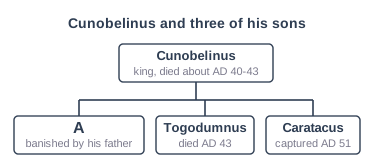
'All that he achieved was to receive the surrender of Adminius, son of Cunobelinus king of the Britons, who had been banished by his father and had deserted to the Romans with a small force. Yet, as if the whole island had been handed over to him, he sent a boastful letter to Rome, ordering the messengers to drive their carriage right into the Forum and the senate-house, and to give it to no one but the consuls, in the temple of Mars, before a full meeting of the senate ... Finally, as if he was about to finish the war, he drew up a line of battle on the shore of the Ocean and set out his catapults and other artillery. No one knew or could guess what he was going to do, when he suddenly ordered the soldiers to gather shells and fill their helmets and the folds of their clothes, calling them 'spoils of the Ocean, owed to the Capitol and the Palatine'.'
Suetonius, Caligula 44.2; 46.1 (adapted)
Using details from Passage D, how accurate do you think Suetonius' account of Caligula's attempt on Britain is?
Model answer
Suetonius' account is only partly accurate. Some details are believable: the surrender of 'Adminius, son of Cunobelinus' fits other evidence of quarrels in Cunobelinus' family, and the instructions that the letter go only to 'the consuls ... before a full meeting of the senate' are precise enough to come from senate records, which Suetonius could read as an imperial official. Tacitus also says Gaius planned an invasion that came to nothing. However, Suetonius wrote about eighty years later, and his Life of Caligula is very hostile, aiming to show the emperor was mad. Comments such as 'as if the whole island had been handed over to him' and 'No one knew or could guess' are his interpretation. The shell-gathering may be exaggerated or misunderstood; some historians think it was a punishment for troops who refused to sail. So the outline is reliable, but the details are coloured by bias.
Explanation
The best answers separate the parts of the passage that are likely to be accurate (Adminius, the letter, real preparations on the coast) from those coloured by Suetonius' hostility to Caligula (the comments on his boasting and the shells). The 2025 examiners noted that strong answers knew Suetonius' access to imperial archives as well as his liking for gossip.