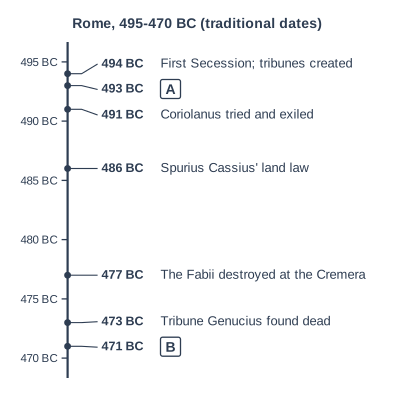
Passage A
Livy describes what happened in 494 BC, after the Senate had refused the dictator Manius Valerius' proposal to help the debtors.
'The patricians feared that if the army were sent home there would again be secret meetings and plots. So, although the levy had been held by the dictator, they held that the soldiers were still bound by their military oath, because they had sworn it to the consuls; and, using the excuse that the Aequi had renewed the war, they ordered the legions to be led out of the city. This made the revolt break out. At first, it is said, there was talk of killing the consuls so that the men would be freed from their oath; but when they were told that no religious duty can be undone by a crime, they took the advice of a certain Sicinius and, without the consuls' orders, withdrew to the Sacred Mount, across the River Anio, three miles from the city... There, without any leader, they fortified a camp and stayed quietly for several days, taking only what they needed to live... There was great panic in the city.'
Livy, The History of Rome 2.32.1-5 (adapted)
Using details from Passage A and your own knowledge, what can we learn about the First Secession of the plebeians?
Model answer
The passage shows that the First Secession grew out of distrust between the orders. The patricians 'feared that if the army were sent home there would again be secret meetings and plots', which refers to the night meetings the plebeians had held on the Esquiline and Aventine. To keep control they claimed 'the soldiers were still bound by their military oath' and used 'the excuse that the Aequi had renewed the war' to lead the legions out of the city. This tells us that the patricians used both religion and war to control the plebeians, and that their decision directly caused the revolt, since 'this made the revolt break out'. From own knowledge, this came after the Senate had refused the dictator Manius Valerius' proposal to help the debtors, so the plebeian soldiers felt betrayed.
We also learn about the plebeians' methods. Their first thought was 'killing the consuls', which shows how angry they were, but they accepted that 'no religious duty can be undone by a crime', so religion restrained them. Instead, on 'the advice of a certain Sicinius', they withdrew 'to the Sacred Mount, across the River Anio, three miles from the city'. The protest was disciplined and peaceful: 'without any leader' they 'fortified a camp' and took 'only what they needed to live'. Their power came from refusing to serve and work, and 'there was great panic in the city', because Rome could not survive without them.
From own knowledge, the Senate sent Menenius Agrippa, who told the fable of the belly and the limbs, and the plebeians returned only when they were granted their own sacrosanct tribunes, who could protect them against the consuls. Livy admits uncertainty about details, noting that Piso placed the secession on the Aventine, but the passage shows a turning point in which the plebeians learned to act together.
Explanation
High-level answers explain what details from across the passage show (the patricians' fear, the use of the oath and the war, the soldiers' restraint, the peaceful withdrawal and the panic in Rome) and add own knowledge of the causes and the outcome, the tribunes. Retelling the passage without explaining it limits AO3 marks.