
Level:
Correct: 0
Incorrect: 0
Marks: 0/0
Exam Practice
Course:
Topics:
OCR GCSE Ancient History (Rome and its neighbours) Smart practice A mixed round aimed at your weak spots
Unit 1
The foundations of Rome: from kingship to republic, 753-440 BC (longer period study)
Unit 2
Hannibal and the Second Punic War, 218-201 BC (depth study)
Unit 3
Cleopatra: Rome and Egypt, 69-30 BC (depth study)
Unit 4
Britannia: from conquest to province, AD 43-c.84 (depth study)
Avg
score:
–
Topics
done:
0/45

The deaths of Antony and Cleopatra

Practise 12 exam-style questions on The deaths of Antony and Cleopatra for OCR GCSE Ancient History (Rome and its neighbours). Write your answer as you would in the exam and get it marked in seconds against the mark scheme, point by point, with the Study Helper on hand if you get stuck.

  • 12 questions
  • 1–20 marks each
  • Instant marking
  • No sign-up needed
12 questions, marked as you go

Sample questions with model answers

Here are 4 of the questions in this topic, each with a model answer, an explanation of why it earns the marks and the mark scheme an examiner would use.

Question 1

2 marks

The timeline shows events from the Battle of Actium to Octavian's return to Rome.

What happened at the dates labelled A and B?
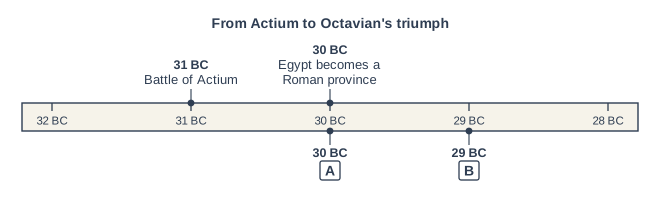
Horizontal timeline titled "From Actium to Octavian's triumph", running from 32 BC on the left to 28 BC on the right, with the years marked every year (32 BC to 28 BC). Events marked by dots on the line, in date order: 31 BC: Battle of Actium; 30 BC: label A; 30 BC: Egypt becomes a Roman province; 29 BC: label B.

Model answer

A: Octavian captured Alexandria and Antony and Cleopatra killed themselves. B: Octavian celebrated his triple triumph in Rome.

Explanation

Octavian took Alexandria on 1 August 30 BC; Antony killed himself that day and Cleopatra died about ten days later. In August 29 BC Octavian held a triple triumph in Rome (for Illyricum, Actium and Egypt), in which an image of Cleopatra with the asp was carried.

Mark scheme
  1. 2 marks

    A: Antony and Cleopatra killed themselves / Octavian captured Alexandria (August 30 BC) (1); B: Octavian celebrated his (triple) triumph in Rome (August 29 BC) (1)

    1 mark for each different correct answer, max 2. Allow recognisable spellings. One mark for each. For A accept 'Antony's suicide', 'Cleopatra's death', 'Octavian took Alexandria'. For B accept 'Octavian's triumph over Egypt / for Actium', 'Octavian returned to Rome in triumph'. Do not credit 'Battle of Actium' or 'Egypt becomes a Roman province' (both shown on the timeline).

Question 2

5 marks

Passage C

Plutarch describes events at Alexandria on 1 August 30 BC. Antony had sent his fleet out against Octavian's ships, but his crews saluted the enemy with their oars and went over to them.

'As soon as Antony saw this, he was deserted by his cavalry, which went over to the enemy, and after his infantry was defeated he went back into the city, crying out that he had been betrayed by Cleopatra to the men he was fighting for her sake. She, afraid of his anger and his madness, fled into her tomb, let down the doors, which were strengthened with bolts and bars, and sent messengers to tell Antony that she was dead. Antony believed it, and said to himself, "Why do you still delay, Antony? Fortune has taken away the only reason you had left for clinging to life." He went into his room, and as he unfastened his breastplate and laid it aside, he said: "Cleopatra, I am not grieved to lose you, for I shall soon be with you; but I am grieved that such a great general as I has been shown to be less courageous than a woman."'

Plutarch, Life of Antony 76 (adapted)

What can we learn from Passage C about the relationship between Antony and Cleopatra in their last days?

Model answer

Passage C shows that the relationship was strained by defeat but that Antony's love for Cleopatra remained. When his fleet and cavalry deserted, Antony cried out that he had been 'betrayed by Cleopatra', so he suspected her, and he described the war as fought 'for her sake'. Cleopatra was 'afraid of his anger and his madness' and fled into her tomb, which shows that trust had broken down. She then sent word that she was dead, a deception that had fatal results. Yet Antony 'believed it', and he said that Fortune had taken away 'the only reason you had left for clinging to life', so she was still the centre of his life. His words 'I shall soon be with you' show continuing love, and his shame at being 'less courageous than a woman' shows that he admired what he thought was her brave death.

Explanation

Top answers explain how the details show both the breakdown of trust (his accusation, her fear and deception) and the strength of his attachment (her 'death' removes his reason to live; his wish to join her). Answers that retell the desertions without linking them to the relationship stay at Level 1.

Mark scheme
  1. 5 marks

    Levels of response (5 marks, AO3).
    Level 3 (4-5 marks): Response uses a range of fully appropriate details from the passage, which are analysed to draw out relevant characteristics and features and give a detailed and sophisticated evaluation of what we can learn from the source about the specified issue in the question.
    Level 2 (2-3 marks): Response uses some appropriate details from the passage, which are analysed to draw out some of the characteristics and features and evaluate what we can learn from the source about the specified issue in the question.
    Level 1 (1 mark): Response uses few details from the passage and makes a very basic attempt to draw out any of the characteristics and features in relation to the question.
    0 marks: No response or no response worthy of credit.

    Max 1 if the answer makes no use of the passage (own knowledge alone does not answer this question). Details must be explained, not just copied: credit what each detail tells us about the issue. Candidates are likely to pick out and explain: 'betrayed by Cleopatra to the men he was fighting for her sake': in defeat Antony suspected her of betrayal, and saw the war as fought for her; 'afraid of his anger and his madness': trust between them had broken down; she feared him; 'fled into her tomb, let down the doors': she protected herself rather than face him; 'sent messengers to tell Antony that she was dead': she deceived him (whether to calm him or for another reason is unclear), with fatal results; 'Antony believed it': he still trusted her word, despite his suspicions; 'the only reason you had left for clinging to life': Cleopatra was the centre of his life; without her he had no reason to live; 'I shall soon be with you': his love for her remained; he expected to join her in death; 'less courageous than a woman': he admired what he thought was her brave death and felt shamed by it.

Question 3

5 marks

Passage C

Velleius Paterculus describes the end of the civil war in 30 BC. 'Caesar' is Octavian.

'The following year Caesar followed Cleopatra and Antony to Alexandria and there put the finishing touch to the civil wars. Antony quickly ended his own life, so redeeming by his death the many charges of unmanliness made against him. As for Cleopatra, she escaped the watch of her guards, had an asp brought in to her, and ended her life by its poisonous bite, untouched by a woman's fear. It was in keeping with Caesar's good fortune and his mercy that not one of those who had fought against him was put to death by him or on his orders. It was Antony's cruelty that ended the life of Decimus Brutus.'

Velleius Paterculus, The Roman History 2.87 (adapted)

Using details from Passage C, how accurate do you think Velleius' account of the end of the war is?

Model answer

Velleius' account is accurate on the basic facts but strongly biased towards Octavian. It is true that Octavian went to Alexandria in 30 BC and that Antony and Cleopatra killed themselves there. However, his claim that 'not one of those who had fought against him was put to death' is misleading: Velleius himself later mentions the deaths of Canidius and Cassius of Parma, whom other writers say Octavian had executed, and Plutarch says Octavian had Antyllus and Caesarion killed. This reflects the Augustan theme of 'mercy', which Velleius, writing under Tiberius, was keen to praise. He blames 'Antony's cruelty' instead. He states as fact that Cleopatra died from an asp, although Plutarch says 'no one knows the truth'; this was Octavian's official version. Even his praise of her courage, 'untouched by a woman's fear', makes Octavian's victory seem greater. So the outline is accurate, but the judgements are propaganda.

Explanation

Top answers test specific claims against other evidence (the killing of Antyllus and Caesarion, the uncertainty about the asp) and explain them through Velleius' date and loyalties. Spotting that his claim about Octavian's mercy is contradicted by other evidence, and even by his own next sentences, is a strong point.

Mark scheme
  1. 5 marks

    Levels of response (5 marks, AO3).
    Level 3 (4-5 marks): Response analyses the source by using relevant detail from the source content or historical context to give a more detailed evaluation of the source within its historical context. It draws a thorough and convincing conclusion about its accuracy or reliability based on how the context in which it was created impacts on how it portrays issues or events.
    Level 2 (2-3 marks): Response analyses the source by using relevant detail from the source content or historical context to give a basic evaluation of the source within its historical context. It draws a basic conclusion about its accuracy or reliability based on how the context in which it was created impacts on how it portrays issues or events.
    Level 1 (1 mark): Response analyses the source in a basic way by selecting relevant detail from the source content or historical context.
    0 marks: No response or no response worthy of credit.

    Max 1 if the answer reaches no conclusion at all about how accurate or reliable the passage is. Full marks need the evaluation to be related to the particular events in the passage, not only general comments about the author. Candidates might comment on: Velleius published in AD 30 under Tiberius, Augustus' successor, and was an admirer of both, so he presents Octavian favourably; 'not one of those who had fought against him was put to death by him or on his orders' is misleading: Velleius himself goes on to mention the deaths of Canidius and Cassius of Parma, whom other writers say Octavian had executed, and Plutarch says Octavian had Antyllus and Caesarion killed, so his mercy had limits; 'Caesar's good fortune and his mercy' repeats Augustan propaganda about his clemency; 'Antony's cruelty' and 'charges of unmanliness' show hostility to Antony, while praising his suicide as a Roman death; the asp: Velleius gives only one method as fact, the version Octavian displayed in his triumph, while Plutarch says 'no one knows the truth'; 'untouched by a woman's fear': praise of her courage, as in Horace, which also makes Octavian's enemy seem worthy; 'Antony quickly ended his own life': broadly true, though Plutarch describes a slow death after he was carried to Cleopatra; brief summary history: complex events are compressed.

Question 4

10 marks

Explain why Antony killed himself.

Model answer

Antony killed himself mainly because he had lost everything and believed death was the only honourable way out, and the false news of Cleopatra's death made him act at once.

First, his military position had collapsed completely. After Actium, his allies and client kings went over to Octavian, and in Libya his troops defected, after which, Plutarch says, he tried to kill himself but was stopped by his friends. At Alexandria in August 30 BC his fleet saluted Octavian's ships and changed sides, his cavalry deserted and his infantry was defeated. He had no army left.

Secondly, there was no escape. Antony had asked to be allowed to live as a private citizen in Athens, but Octavian refused. When he challenged Octavian to single combat, Octavian replied that Antony had 'many ways of dying'. Capture would mean humiliation, perhaps death or being paraded in a triumph.

Thirdly, honour mattered. Roman nobles such as Brutus and Cassius had chosen suicide rather than capture. Plutarch says Antony was grieved to seem 'less courageous than a woman', and his slave Eros showed him the way by killing himself. His last words, that he had been 'not ignobly conquered, a Roman by a Roman', show that he wanted a dignified end, and Velleius says his death redeemed the charges of unmanliness against him.

Finally, the trigger was personal. Cleopatra, fearing his anger, sent word that she was dead, and Antony said that Fortune had taken away his 'only reason ... for clinging to life'.

Overall, defeat made death inevitable, honour made suicide the right choice, and the message about Cleopatra decided the moment.

Explanation

Top answers distinguish the underlying causes (military collapse, Octavian's refusal of terms, Roman ideas of honour) from the trigger (the false report of Cleopatra's death), with specific evidence from Plutarch and Velleius. Answers that only mention the message about Cleopatra give a single cause.

Mark scheme
  1. 10 marks

    Levels of response (10 marks: AO1 5, AO2 5).
    Level 5 (9-10 marks): The response demonstrates a range of detailed and accurate knowledge and a developed understanding that is fully relevant to the question (AO1). Response has a full explanation and thorough, convincing analysis of the issue in the question, arriving at substantiated and developed judgements (AO2).
    Level 4 (7-8 marks): The response demonstrates accurate knowledge and a developed understanding that is fully relevant to the question (AO1). Response has a full explanation and analysis of the issue in the question arriving at substantiated judgements, but these are not consistently well developed (AO2).
    Level 3 (5-6 marks): The response demonstrates accurate knowledge and some understanding that is relevant to the question (AO1). This is linked to an analysis and explanation of the issue in the question but judgements may not always be made explicit (AO2).
    Level 2 (3-4 marks): The response demonstrates basic knowledge and some understanding that is relevant to the question (AO1). There is a basic explanation of the issue in the question (AO2).
    Level 1 (1-2 marks): Response demonstrates basic knowledge that is relevant to the topic of the question (AO1). There is little or no attempt at a very basic explanation of the issue in the question, which may be close to assertion (AO2).
    0 marks: No response or no response worthy of credit.

    Explanations may include: total military collapse: his fleet changed sides, his cavalry deserted and his infantry was defeated (Plutarch, Antony 76); allies and client kings had already gone over to Octavian; no way out: Octavian rejected his request to live as a private citizen (Antony 72-73) and refused his challenge to single combat, saying Antony had 'many ways of dying' (Antony 75); he had already tried to kill himself in Libya after his troops there went over to the enemy (Antony 69); the false message that Cleopatra was dead removed his 'only reason ... for clinging to life' (Antony 76); honour: a Roman noble was expected to choose death rather than capture (as Brutus and Cassius had done); he was ashamed to seem 'less courageous than a woman' (Antony 76); capture would mean humiliation, perhaps execution or a triumph; the example of his slave Eros (Antony 76); his last words claim he was 'not ignobly conquered, a Roman by a Roman' (Antony 77); Velleius says his death redeemed the 'charges of unmanliness' against him (2.87); a judgement on the main reason.

Ready to try the rest? Every answer you write is marked against the mark scheme, so you can see exactly where the marks are.

Study Helper Hints first, answers after you try

Stuck on this one? Ask for a hint and I’ll point you in the right direction, without giving the answer away. Once you’ve checked your answer, I’ll show you how the marks are awarded.