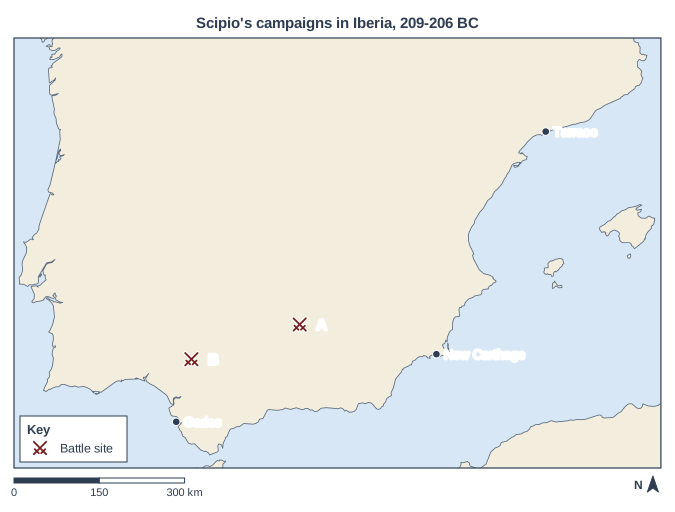
'Scipio's success in Iberia was more important than his invasion of Africa in defeating Carthage.'
How far do you agree with this view?
You must use and analyse the ancient sources you have studied as well as supporting your answer with your own knowledge.
Model answer
Scipio's conquest of Iberia was essential to Rome's victory, but the invasion of Africa was the step that actually ended the war, so I disagree with the statement, while recognising how closely the two were linked.
There are strong reasons to stress Iberia. It was Carthage's main source of silver and soldiers, and New Carthage was its arsenal and treasury. Livy's list of what Scipio captured there, catapults, 18,300 pounds of silver, sixty-three ships and the Spanish hostages, shows how much Carthage lost; he even says the city itself was the least important prize. Livy admits that his sources gave wildly different figures, so the exact numbers are doubtful, but the scale of the loss is clear. By treating the hostages generously, Scipio won over Iberian peoples, and after Ilipa in 206 BC Carthage could no longer send armies from Iberia to Hannibal. Livy's account of the earlier battle near the Ebro in 215 BC shows how much the Romans feared those reinforcements. Iberia also made Scipio: it trained his army and gave him the reputation to win the African command.
However, the loss of Iberia did not end the war. Hasdrubal had already escaped from Iberia in 208 BC, and Hannibal remained undefeated in southern Italy. Only the invasion of Africa forced him out. Livy describes Hannibal receiving the order to return, groaning and blaming the Carthaginian senate; the speech is probably Livy's composition, but the recall itself is certain. In Africa, Scipio won over Masinissa, whose Numidian cavalry proved decisive, and defeated Carthage's armies. At Zama in 202 BC, Livy shows Scipio's cavalry under Laelius and Masinissa returning to strike Hannibal's rear. Afterwards Polybius describes Hannibal himself urging the Carthaginian senate to accept the peace terms, since they had no alternative.
We must also consider the sources' attitude to Scipio. Livy admired him, and Polybius was a close friend of Scipio's adopted grandson, Scipio Aemilianus, so both present his campaigns as brilliant. Yet the outcome, the recall of Hannibal and Carthage's surrender, is not in doubt.
The timing also matters. Carthage had lost Iberia by 206 BC, yet it fought on for four more years and only sued for peace after Scipio had landed in Africa, won over Masinissa and destroyed its armies there. This suggests that Carthage could survive the loss of a province, but not the loss of its homeland's safety.
In conclusion, Iberia weakened Carthage fatally by taking away its money, men and base, and it prepared Scipio for Africa. But Carthage only gave up when it was invaded and its last army destroyed at Zama, so the invasion of Africa was the more decisive of the two.
Explanation
A top answer compares the effects of the two campaigns (resources and reinforcements versus the recall of Hannibal and Zama), uses the set sources on New Carthage, Hannibal's recall and Zama, and evaluates them, for example Livy's uncertain figures and admiration for Scipio, and Polybius' link with Scipio's family.