Level:
Correct: 0
Incorrect: 0
Marks: 0/0
Exam Practice
Course:
Topics:
OCR GCSE Ancient History (Rome and its neighbours) Smart practice A mixed round aimed at your weak spots
Unit 1
The foundations of Rome: from kingship to republic, 753-440 BC (longer period study)
Unit 2
Hannibal and the Second Punic War, 218-201 BC (depth study)
Unit 3
Cleopatra: Rome and Egypt, 69-30 BC (depth study)
Unit 4
Britannia: from conquest to province, AD 43-c.84 (depth study)
Avg
score:
–
Topics
done:
0/45

Rome and Egypt before Caesar arrived

Practise 12 exam-style questions on Rome and Egypt before Caesar arrived for OCR GCSE Ancient History (Rome and its neighbours). Write your answer as you would in the exam and get it marked in seconds against the mark scheme, point by point, with the Study Helper on hand if you get stuck.

  • 12 questions
  • 1–20 marks each
  • Instant marking
  • No sign-up needed
12 questions, marked as you go

Sample questions with model answers

Here are 4 of the questions in this topic, each with a model answer, an explanation of why it earns the marks and the mark scheme an examiner would use.

Question 1

2 marks

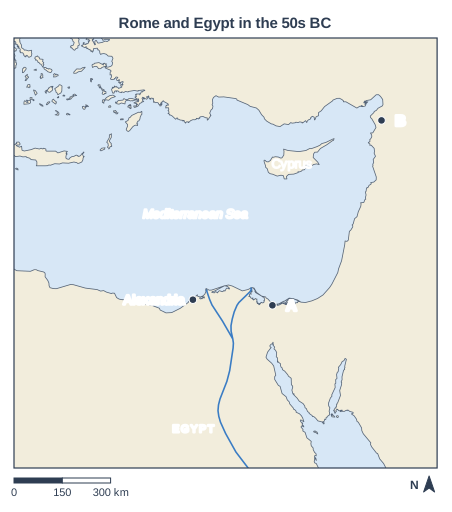
The map shows the eastern Mediterranean.

Name the fortress town labelled A, which Mark Antony captured in 55 BC when Gabinius' army entered Egypt to restore Ptolemy XII, and the city labelled B, the chief city of the Roman province from which Gabinius marched.

Map of the area from 24°E to 38°E and 26.5°N to 38.5°N, titled "Rome and Egypt in the 50s BC", drawn with real coastlines (land pale buff, sea pale blue) and no modern borders; a north arrow shows north at the top; the scale bar is 300 km long. Ancient region names printed in spaced capitals: Egypt. Sea names printed in blue italics: Mediterranean Sea. Blue lines show a river. Points: a dot labelled "Alexandria" (on the coast); a dot labelled A on the coast, near the centre of the map (about 60% of the way across and 60% of the way down), about 250 km east of the point labelled "Alexandria"; a dot labelled B inland, in the top right of the map (about 85% of the way across and 20% of the way down), about 300 km north-east of the point labelled "Cyprus"; the words "Cyprus" (on an island).

Model answer

A is Pelusium and B is Antioch.

Explanation

Pelusium guarded Egypt's eastern frontier on the road from Syria; Antony seized it for Gabinius in 55 BC, and in 48 BC Pompey was murdered there. Antioch was the chief city of the province of Syria, organised by Pompey in 64-63 BC, which Gabinius governed. The map also marks Cyprus, which Rome annexed in 58 BC.

Mark scheme
  1. 2 marks

    A: Pelusium (1); B: Antioch (1)

    1 mark for each different correct answer, max 2. Allow recognisable spellings. One mark for each. Do not credit Alexandria or Memphis for A, or Damascus, Tyre or Jerusalem for B.

Question 2

5 marks

Passage C

Caesar is in Alexandria in 48 BC. Plutarch describes how Pothinus, the chief minister of the young king Ptolemy XIII, treated him.

'For example, when Caesar's soldiers were given the oldest and worst grain, Pothinus told them to put up with it and be content, since they were eating what belonged to other people; and at state dinners he used wooden and clay dishes, saying that Caesar had taken all the gold and silver plate in payment of a debt. For the father of the present king owed Caesar seventeen and a half million drachmas. Caesar had earlier let the king's children off part of this, but now demanded ten million to support his army. When Pothinus told him to leave now and attend to his great affairs, promising that he would receive his money later with thanks, Caesar replied that he had no need at all of Egyptians as advisers, and secretly sent for Cleopatra from the country.'

Plutarch, Life of Caesar 48 (adapted)

What can we learn from Passage C about the importance of Egypt to Rome?

Model answer

Passage C shows that Egypt mattered to Rome above all for its wealth. Ptolemy XII had owed Caesar 'seventeen and a half million drachmas', which shows that Roman politicians made fortunes from Egyptian kings who needed their support. Caesar now 'demanded ten million to support his army', so Egypt's money could pay for Roman civil wars. The reference to grain for the soldiers suggests that Egypt was also expected to feed Roman troops, and the 'gold and silver plate' shows the famous riches of the court. The passage also shows the politics of the relationship. Pothinus' jibe that the Romans were 'eating what belonged to other people' reveals Egyptian resentment, while Caesar's reply that he had 'no need at all of Egyptians as advisers' and his decision to send for Cleopatra show that Rome felt entitled to decide who ruled Egypt.

Explanation

Top answers explain what the details show about Egypt's economic value (debts, money for armies, grain, royal treasure) and its political position (Roman control, Egyptian resentment). Copying the figures without explaining what they reveal is Level 1.

Mark scheme
  1. 5 marks

    Levels of response (5 marks, AO3).
    Level 3 (4-5 marks): Response uses a range of fully appropriate details from the passage, which are analysed to draw out relevant characteristics and features and give a detailed and sophisticated evaluation of what we can learn from the source about the specified issue in the question.
    Level 2 (2-3 marks): Response uses some appropriate details from the passage, which are analysed to draw out some of the characteristics and features and evaluate what we can learn from the source about the specified issue in the question.
    Level 1 (1 mark): Response uses few details from the passage and makes a very basic attempt to draw out any of the characteristics and features in relation to the question.
    0 marks: No response or no response worthy of credit.

    Max 1 if the answer makes no use of the passage (own knowledge alone does not answer this question). Details must be explained, not just copied: credit what each detail tells us about the issue. Candidates are likely to pick out and explain: 'the father of the present king owed Caesar seventeen and a half million drachmas': Ptolemy XII had paid, or promised, huge sums to Roman leaders for their support, so Egypt was a source of personal fortune for Roman politicians; 'demanded ten million to support his army': Egypt's wealth could pay for Roman armies in the civil wars; 'the oldest and worst grain': Egypt was expected to feed Roman soldiers, which shows its importance as a food supply; 'all the gold and silver plate': the Ptolemaic court's wealth was famous and attracted Roman demands; 'eating what belonged to other people': the Egyptian court resented the Romans as foreigners living off Egypt, showing tension in the relationship; 'no need at all of Egyptians as advisers': the Romans felt entitled to decide Egypt's affairs, treating it as a client state; 'secretly sent for Cleopatra': Rome, in the person of Caesar, could choose between rival Ptolemaic rulers, showing its political control.

Question 3

10 marks

Explain why Egypt was important to Rome in the 60s and 50s BC.

Model answer

Egypt was important to Rome above all because of its wealth. The Nile valley produced a huge surplus of grain, the Ptolemaic kings had enormous revenues, and Alexandria was the greatest port of the eastern Mediterranean, trading with Arabia and India through the Red Sea.

This wealth made Egypt a source of personal profit for Roman politicians. Ptolemy XII needed Roman backing to keep his throne, so in 59 BC Caesar and Pompey had him recognised as a 'friend and ally of the Roman people' in return for about 6,000 talents. When the Alexandrians drove him out, he borrowed heavily from Roman lenders, and in 55 BC Gabinius restored him for about 10,000 talents. Plutarch shows that in 48 BC the king's family still owed Caesar seventeen and a half million drachmas.

Egypt also mattered politically. Whoever controlled its wealth could become dangerously powerful, so Roman leaders blocked each other's plans to annex it, as when Crassus proposed making it pay tribute in 65 BC and when Cicero opposed Rullus' land bill in 63 BC. Strategically, Egypt bordered the new province of Syria, organised by Pompey, and lay near Cyprus, which Rome annexed in 58 BC. As a client kingdom it was expected to support Rome, and in 49 BC Pompey's son obtained ships, soldiers and grain there.

Overall, Egypt's wealth was the main reason for its importance, but it mattered so much because ambitious Roman politicians competed to profit from it while preventing any one rival from controlling it.

Explanation

Level 5 answers explain several reasons (economic, personal profit, political rivalry, strategic position, client status) with specific events from the 60s and 50s BC and reach a judgement. Answers that describe Egypt's riches in general terms, without Roman involvement in these decades, stay in Levels 2-3.

Mark scheme
  1. 10 marks

    Levels of response (10 marks: AO1 5, AO2 5).
    Level 5 (9-10 marks): The response demonstrates a range of detailed and accurate knowledge and a developed understanding that is fully relevant to the question (AO1). Response has a full explanation and thorough, convincing analysis of the issue in the question, arriving at substantiated and developed judgements (AO2).
    Level 4 (7-8 marks): The response demonstrates accurate knowledge and a developed understanding that is fully relevant to the question (AO1). Response has a full explanation and analysis of the issue in the question arriving at substantiated judgements, but these are not consistently well developed (AO2).
    Level 3 (5-6 marks): The response demonstrates accurate knowledge and some understanding that is relevant to the question (AO1). This is linked to an analysis and explanation of the issue in the question but judgements may not always be made explicit (AO2).
    Level 2 (3-4 marks): The response demonstrates basic knowledge and some understanding that is relevant to the question (AO1). There is a basic explanation of the issue in the question (AO2).
    Level 1 (1-2 marks): Response demonstrates basic knowledge that is relevant to the topic of the question (AO1). There is little or no attempt at a very basic explanation of the issue in the question, which may be close to assertion (AO2).
    0 marks: No response or no response worthy of credit.

    Explanations may include: economic: the Nile valley's huge grain surplus; the Ptolemies' famous wealth and revenues; Alexandria's trade, including Red Sea trade with Arabia and India; personal profit: Roman politicians sold recognition to Ptolemy XII (Caesar and Pompey received about 6,000 talents in 59 BC) and lent him money; Gabinius was paid about 10,000 talents to restore him; Plutarch says the king still owed Caesar seventeen and a half million drachmas (Life of Caesar 48); political: whoever controlled Egypt's wealth would have great power, so rivals blocked one another's attempts to annex it (Crassus in 65 BC, Rullus' bill in 63 BC); strategic: Egypt lay next to the new province of Syria (organised by Pompey in 64-63 BC) and near Cyprus, annexed in 58 BC; it was the last great independent Hellenistic kingdom in the east; client kingdom: Ptolemy XII was a 'friend and ally of the Roman people', so Rome expected loyalty and support; its resources mattered in Rome's civil wars: Pompey's son obtained ships, men and grain from Egypt in 49 BC; a judgement (e.g. wealth was the key, but it mattered because of Roman political rivalry).

Question 4

20 marks

'Egypt's wealth was the main reason for Rome's involvement in Egypt in the 60s and 50s BC.'

How far do you agree with this view?

You must use and analyse the ancient sources you have studied as well as supporting your answer with your own knowledge.

Model answer

Egypt's wealth was the main reason why individual Romans became involved in Egypt, but Rome's involvement was also driven by political rivalry, the client-king system and the Ptolemies' own appeals for help.

The evidence for wealth is strong. Ptolemy XII paid Caesar and Pompey about 6,000 talents in 59 BC to be recognised as king, and Gabinius was paid about 10,000 talents to restore him in 55 BC. The banker Rabirius Postumus lent him huge sums and even became his finance minister to recover them. Plutarch's Life of Caesar shows that in 48 BC the king's family still owed Caesar seventeen and a half million drachmas, and Caesar demanded ten million to pay his army. The coin of Ptolemy Auletes, a silver tetradrachm, is a reminder of the riches of the Ptolemaic kingdom, and later Cleopatra could give Antony 200 ships and 20,000 talents, according to Plutarch's Life of Antony.

However, wealth does not explain everything. Rome's politicians were as interested in stopping rivals as in gaining money: proposals by Crassus in 65 BC and by Rullus in 63 BC to take control of Egypt were blocked for fear that one man would become too powerful. Rome also normally ruled the east through client kings. Ptolemy XII became a 'friend and ally of the Roman people', the same status Dio says Caesar later gave Cleopatra and her husband, so involvement was about loyalty and control. Egypt's position next to Syria and Cyprus made it strategically important, and the Ptolemies themselves drew Rome in: Ptolemy XII begged the senate for restoration after his own people expelled him. Roman attitudes to foreign monarchs, shown later by Horace's contempt for 'a queen' and her 'degenerate men' and by Cicero's dislike of Cleopatra's arrogance, made Romans feel entitled to interfere.

The sources have limits for this question. Most set sources describe events after 48 BC, so they show patterns and attitudes rather than the 60s and 50s directly. Plutarch's precise figures suggest he used a detailed source, but he writes as Caesar's biographer and presents the debt from Caesar's side. Dio and Horace reflect Roman hostility to foreign rulers, while Cicero's letter is contemporary but full of personal resentment. The coin shows Ptolemaic wealth and kingship, not Roman motives. None of the set sources gives an Egyptian account of these decades, so we see Roman involvement almost entirely through Roman eyes, which may make it look more purposeful and profitable than it really was.

Overall, I agree that wealth was the main reason: it explains why Roman politicians competed so fiercely over Egypt. But rivalry, the client system and the Ptolemies' own weakness shaped how that involvement happened.

Explanation

Strong answers weigh wealth against politics, strategy, the client system and Ptolemaic appeals, using precise events from the 60s and 50s BC alongside the set sources, and comment on what the sources can and cannot show about this period. Answers that only describe Egypt's riches stay at Level 2-3.

Mark scheme
  1. 20 marks

    Levels of response (20 marks: AO3 10, AO1 5, AO2 5).
    Level 5 (17-20 marks): Detailed evaluation of the ancient sources in their historical context, with thorough analysis of their reliability and accuracy in terms of the context in which they were created, used to make developed, supported judgements and fully convincing conclusions (AO3). A range of detailed, accurate knowledge and a developed understanding (AO1). Thorough, convincing analysis with substantiated, developed judgements (AO2). A sustained, coherent and logically structured line of reasoning.
    Level 4 (13-16 marks): Detailed evaluation of the ancient sources in their context, with some analysis of their reliability and accuracy, used to make supported judgements and reasonable conclusions (AO3). Accurate knowledge and a developed understanding (AO1). A full analysis; judgements are substantiated but not consistently well developed (AO2). A clear, logically structured line of reasoning.
    Level 3 (9-12 marks): Analyses examples from the ancient sources, with a basic analysis of the reliability and accuracy of at least one source in terms of its context, used to make basic judgements and simple conclusions (AO3). Accurate knowledge and some understanding (AO1). Analysis and explanation; judgements may not be explicit (AO2). A mostly relevant line of reasoning with some structure.
    Level 2 (5-8 marks): Uses examples from the ancient sources, with a very basic attempt to consider a source's reliability or accuracy that may border on assertion; no source analysis is used to reach judgements (AO3). Basic knowledge and some understanding (AO1). A basic explanation (AO2). Some relevance; limited structure.
    Level 1 (1-4 marks): Basic use of the sources, with no attempt to consider their reliability or accuracy (AO3). Basic knowledge (AO1). Little or no explanation, close to assertion (AO2). Basic, unstructured communication.
    0 marks: No response or no response worthy of credit.

    Max 8 if the answer makes no use of the ancient sources (it never names, quotes or discusses any ancient writer, work, inscription, coin or other object, and knowing the events is not using the sources). Max 8 if the answer never considers how reliable or accurate any ancient source is. Max 12 if the answer considers only one side of the statement and never addresses the other (the issue of extent). No set answer is expected. It is possible to reach the highest mark either by agreeing or disagreeing with the statement (providing the issue of extent is addressed by refuting the counter-argument), or anywhere between. To access Level 3 and above, answers discuss the ancient sources; at lower levels they may only retell stories from the sources or name them. Candidates do not have to quote directly or give precise references. Grounds for agreeing include: Roman politicians profited directly: about 6,000 talents to Caesar and Pompey (59 BC); about 10,000 talents to Gabinius (55 BC); loans from Rabirius Postumus; Plutarch: the king owed Caesar seventeen and a half million drachmas, and Caesar demanded ten million for his army (Life of Caesar 48); proposals to annex Egypt (Crassus 65 BC; Rullus 63 BC) aimed at its revenues; Egypt's resources: grain, royal treasure; later Cleopatra could give Antony 200 ships and 20,000 talents (Plutarch, Antony 56). Grounds for disagreeing include: political rivalry: Roman leaders acted to stop rivals controlling Egypt as much as to gain its wealth; Rome's client system: Ptolemy XII as 'friend and ally of the Roman people' (compare Dio 43.27) - involvement was about control and loyalty; strategic position: next to Syria (64-63 BC) and Cyprus (annexed 58 BC); the last great Hellenistic kingdom; the Ptolemies drew Rome in: Ptolemy XII begged for restoration; the Alexandrian envoys appealed to the senate; Roman attitudes to foreign kings: contempt mixed with the wish to dominate (Horace, Odes 1.37; Cicero, Letter to Atticus 15.15). Likely sources to be included: Plutarch, Life of Caesar 48; Life of Antony 56; Cassius Dio 42.44 (Caesar did not make Egypt subject to Rome) and 43.27; coin of Ptolemy Auletes; Horace, Odes 1.37; Cicero, Letter to Atticus 15.15. The source analysis is likely to address: the set sources mostly describe later events, so they show attitudes and patterns rather than the 60s-50s directly; Plutarch's precise figures suggest a good source, but he writes as Caesar's biographer; Dio and Horace show Roman hostility to foreign rulers; Cicero's letter is contemporary but personal; the coin is official evidence of Ptolemaic kingship and wealth, not of Roman motives.

Ready to try the rest? Every answer you write is marked against the mark scheme, so you can see exactly where the marks are.

Study Helper Hints first, answers after you try

Stuck on this one? Ask for a hint and I’ll point you in the right direction, without giving the answer away. Once you’ve checked your answer, I’ll show you how the marks are awarded.