Passage B
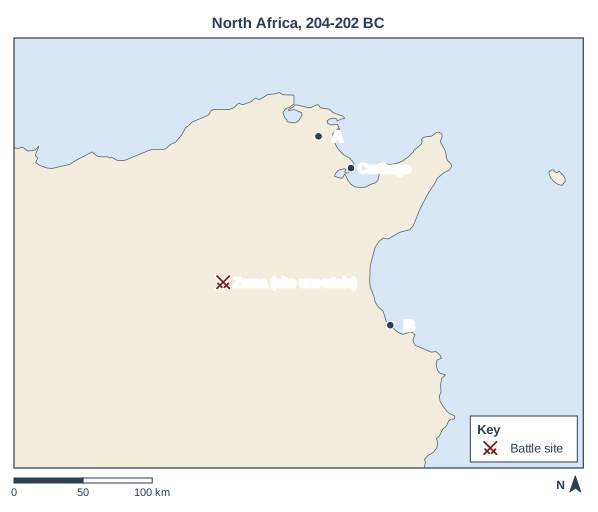
In 202 BC Hannibal, back in Africa, marches to meet Scipio's army.
'Hannibal hurried by forced marches to Zama ... His scouts were caught by the Roman outposts and brought to Scipio, who had them taken round the camp and shown whatever they wished to see, and then sent them back. Their report gave Hannibal no pleasure, for Masinissa had arrived that very day with 6,000 infantry and 4,000 cavalry, and he was most alarmed by the enemy's confidence, which he saw was well founded. So, although he had himself been the cause of the war, he thought he would win fairer terms if he asked for peace while his strength was unbroken than after a defeat, and he sent a messenger asking Scipio for a meeting. Whether he did this on his own initiative or on his government's orders, I cannot say for certain. Valerius Antias writes that he had already been beaten by Scipio in a first battle, losing 12,000 killed and 1,700 captured, and that he then came to Scipio's camp with ten other envoys.'
Livy, The History of Rome 30.29.1-7 (adapted)
Using details from Passage B, how accurate do you think Livy's account of the events before the Battle of Zama is?
Model answer
Livy's account seems careful and fairly reliable, although parts of it are interpretation. He openly admits what he does not know: 'Whether he did this on his own initiative or on his government's orders, I cannot say for certain.' He also reports another version, from Valerius Antias, that Hannibal had already lost a battle with '12,000 killed', but he does not accept it, and elsewhere Livy criticises Antias for inventing huge numbers. The figure for Masinissa's force, '6,000 infantry and 4,000 cavalry', is precise and may come from Polybius, who also tells the story of the scouts. However, the scouts being shown round the camp may be a literary motif, since a similar story is told of Xerxes, and Hannibal's thinking that he would 'win fairer terms' is Livy's own explanation. The comment that Hannibal 'had himself been the cause of the war' shows a Roman viewpoint. Overall, Livy is honest about his sources, so the account is reasonably reliable.