Level:
Correct: 0
Incorrect: 0
Marks: 0/0
Exam Practice
Course:
Topics:
OCR GCSE Ancient History (Rome and its neighbours) Smart practice A mixed round aimed at your weak spots
Unit 1
The foundations of Rome: from kingship to republic, 753-440 BC (longer period study)
Unit 2
Hannibal and the Second Punic War, 218-201 BC (depth study)
Unit 3
Cleopatra: Rome and Egypt, 69-30 BC (depth study)
Unit 4
Britannia: from conquest to province, AD 43-c.84 (depth study)
Avg
score:
–
Topics
done:
0/45

Agricola's campaigns and achievements

Practise 13 exam-style questions on Agricola's campaigns and achievements for OCR GCSE Ancient History (Rome and its neighbours). Write your answer as you would in the exam and get it marked in seconds against the mark scheme, point by point, with the Study Helper on hand if you get stuck.

  • 13 questions
  • 1–20 marks each
  • Instant marking
  • No sign-up needed
13 questions, marked as you go

Sample questions with model answers

Here are 4 of the questions in this topic, each with a model answer, an explanation of why it earns the marks and the mark scheme an examiner would use.

Question 1

2 marks

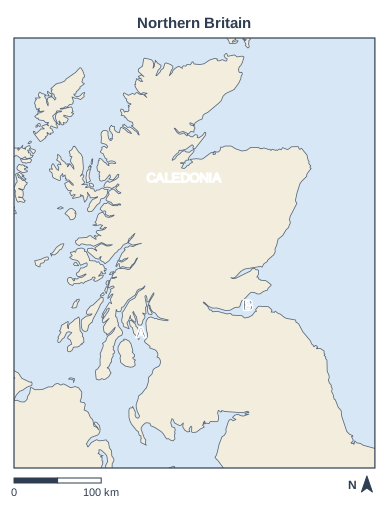
The map shows northern Britain. Tacitus says that in his fourth year Agricola held with forts the narrow neck of land between two estuaries, which are marked A and B on the map.

Name the estuaries marked A and B.

Map of the area from 7.2°W to 0.8°W and 54.4°N to 58.8°N, titled "Northern Britain", drawn with real coastlines (land pale buff, sea pale blue) and no modern borders; a north arrow shows north at the top; the scale bar is 100 km long. Points: the letter A on the coast, towards the bottom of the map (about 35% of the way across and 70% of the way down); the letter B at sea, near the centre of the map (about 65% of the way across and 60% of the way down), about 160 km south-east of the point labelled "CALEDONIA"; the words "CALEDONIA" (inland).

Model answer

A is the Clota (Firth of Clyde) and B is the Bodotria (Firth of Forth).

Explanation

Tacitus (Agricola 23) says the Clota and the Bodotria, carried far inland by the tides of opposite seas, are separated only by a narrow neck of land, which Agricola held with garrisons, 'as if the enemy had been pushed into another island'. The Antonine Wall was later built across the same line.

Mark scheme
  1. 2 marks

    A: Clota / (Firth of) Clyde; B: Bodotria / (Firth of) Forth

    1 mark for each different correct answer, max 2. Allow recognisable spellings. 1 mark for A and 1 mark for B. Accept the Latin or the modern name. Do not credit the Taus / Tay, the Solway or the Thames.

Question 2

5 marks

Passage D

Tacitus describes the first campaign of his father-in-law Agricola, who arrived in Britain as governor in the middle of summer in AD 77 or 78.

'Shortly before his arrival, the Ordovices had almost wiped out a unit of cavalry stationed in their territory ... Although the summer was over and his units were scattered, Agricola decided to face the danger. He gathered detachments from the legions and a small force of auxiliaries, and because the Ordovices did not dare to come down onto level ground, he led the line up the slope himself, at the front, so that the others would share his courage by sharing his danger. Almost the whole tribe was cut down. Knowing that his reputation must be followed up, he decided to take the island of Mona. He had no ships ... but he sent across the pick of his auxiliaries, who knew the shallows and could swim while controlling themselves, their weapons and their horses. They attacked so suddenly that the astonished enemy, who were expecting a fleet, asked for peace and surrendered the island.'

Tacitus, Agricola 18 (adapted)

What can we learn from Passage D about Agricola's tactics in his first campaign as governor?

Model answer

Passage D shows that Agricola relied on speed, surprise and personal leadership. Although 'the summer was over' and his troops were 'scattered', he 'decided to face the danger' at once, using a small force of 'detachments from the legions' and auxiliaries. When the Ordovices stayed on the high ground, he 'led the line up the slope himself, at the front', so that his men would 'share his courage by sharing his danger'. His force was ruthless: 'Almost the whole tribe was cut down', which was meant to frighten other tribes. Agricola then followed up his success at once. Lacking ships, he sent 'the pick of his auxiliaries', who could swim with their horses and weapons, across to Mona, and the surprise was so great that the enemy, 'expecting a fleet', 'surrendered the island'.

Explanation

The best answers explain several tactics: acting quickly out of season, leading from the front, ruthless force, following up success and improvising with swimming auxiliaries to achieve surprise. Simply retelling the campaign without explaining the tactics stays in the lower levels.

Mark scheme
  1. 5 marks

    Levels of response (5 marks, AO3).
    Level 3 (4-5 marks): Response uses a range of fully appropriate details from the passage, which are analysed to draw out relevant characteristics and features and give a detailed and sophisticated evaluation of what we can learn from the source about the specified issue in the question.
    Level 2 (2-3 marks): Response uses some appropriate details from the passage, which are analysed to draw out some of the characteristics and features and evaluate what we can learn from the source about the specified issue in the question.
    Level 1 (1 mark): Response uses few details from the passage and makes a very basic attempt to draw out any of the characteristics and features in relation to the question.
    0 marks: No response or no response worthy of credit.

    Max 1 if the answer makes no use of the passage (own knowledge alone does not answer this question).
    Details must be explained, not just copied: credit what each detail tells us about the issue.
    Candidates are likely to pick out and explain: 'Although the summer was over and his units were scattered, Agricola decided to face the danger': he acted at once, rather than waiting for the next campaigning season, to stop the revolt spreading; 'gathered detachments from the legions and a small force of auxiliaries': he used a small, quickly assembled force for speed; 'he led the line up the slope himself, at the front ... share his courage by sharing his danger': he led by example to raise morale, attacking the enemy on their own high ground; 'Almost the whole tribe was cut down': he used overwhelming force to make an example of the Ordovices; 'Knowing that his reputation must be followed up': he exploited his first success to build fear of Rome; 'He had no ships ... sent across the pick of his auxiliaries, who knew the shallows and could swim': he improvised, using specialist auxiliaries to cross the strait; 'They attacked so suddenly ... expecting a fleet ... asked for peace and surrendered the island': surprise won Mona without a long fight.

Question 3

5 marks

Passage D

Tacitus describes how Agricola drew up his army at the battle of Mons Graupius in AD 83 or 84.

'He drew up his eager troops with the auxiliary infantry, eight thousand strong, in the centre and three thousand cavalry spread out on the wings. The legions stood in front of the rampart: it would be a great glory to win without shedding Roman blood, and they would be a support if the rest were driven back. The British army stood on higher ground, for show and to frighten us: their front line was on the plain, but the rest rose up the slope in tiers ... Then Agricola, afraid that their greater numbers might attack his front and flanks at once, opened out his ranks, although this made his line thinner and many urged him to bring up the legions. Full of hope and firm in danger, he sent away his horse and stood on foot in front of the standards. At first the fighting was at long range ... until Agricola urged the Batavian cohorts and two cohorts of Tungrians to fight hand to hand.'

Tacitus, Agricola 35-36 (adapted)

Using details from Passage D, how accurate do you think Tacitus' account of Agricola's tactics at Mons Graupius is?

Model answer

Tacitus' account of the tactics is probably accurate in its main points, though written to glorify Agricola. Tacitus was not there, but he could use Agricola's own account and dispatches, which explains precise details such as 'eight thousand' auxiliary infantry in the centre and 'three thousand cavalry' on the wings. Keeping 'the legions ... in front of the rampart' so that victory might be won 'without shedding Roman blood' is a believable tactic, since auxiliaries were regularly placed in the front line. However, the purpose of the Agricola shows in the heroic picture of Agricola, who 'sent away his horse and stood on foot in front of the standards', 'full of hope and firm in danger'. The claim that the Britons were placed on the hill 'for show and to frighten us' is his interpretation. As the site has never been found and no other source describes the battle, we cannot check the details.

Explanation

Strong answers judge particular details: the troop numbers and the reserve legions (probably from official reports) against the heroic portrait of Agricola (the purpose of the work), and note the lack of corroborating evidence for Mons Graupius.

Mark scheme
  1. 5 marks

    Levels of response (5 marks, AO3).
    Level 3 (4-5 marks): Response analyses the source by using relevant detail from the source content or historical context to give a more detailed evaluation of the source within its historical context. It draws a thorough and convincing conclusion about its accuracy or reliability based on how the context in which it was created impacts on how it portrays issues or events.
    Level 2 (2-3 marks): Response analyses the source by using relevant detail from the source content or historical context to give a basic evaluation of the source within its historical context. It draws a basic conclusion about its accuracy or reliability based on how the context in which it was created impacts on how it portrays issues or events.
    Level 1 (1 mark): Response analyses the source in a basic way by selecting relevant detail from the source content or historical context.
    0 marks: No response or no response worthy of credit.

    Max 1 if the answer reaches no conclusion at all about how accurate or reliable the passage is.
    Full marks need the evaluation to be related to the particular events in the passage, not only general comments about the author. A conclusion that the passage is accurate, inaccurate or partly accurate can reach Level 3 if it is supported; bare assertions ("he was not there", "he was biased") on their own stay in Level 1.
    Candidates might comment on: Tacitus was not present; he wrote in AD 98, about fourteen years later, but his information probably came from Agricola himself and his official dispatches; precise numbers (eight thousand auxiliary infantry, three thousand cavalry) suggest an official source, though Roman commanders' reports could be selective; keeping the legions in reserve so that the victory could be won 'without shedding Roman blood' is a believable tactic: auxiliaries (non-citizens) were often used in the front line; the heroic detail 'he sent away his horse and stood on foot in front of the standards' and 'Full of hope and firm in danger' glorify Agricola, the purpose of the work; the British drawn up on the hillside 'for show and to frighten us' is Tacitus' interpretation of their motives; the text is uncertain in places (the number of Batavian cohorts differs between editions), and the site of Mons Graupius has never been found, so archaeology cannot check the account; no other set source describes the battle; Tacitus also gives the Britons and Agricola long speeches, which are his own compositions.

Question 4

10 marks

Explain the significance of Agricola's victory at Mons Graupius.

Model answer

The victory at Mons Graupius in AD 83 or 84 was significant both militarily and symbolically, though its long-term effects were limited.

Militarily, it was the decisive defeat of the united Caledonian peoples. Tacitus says that after their earlier setbacks the tribes had joined together by embassies and treaties, gathering more than 30,000 men under Calgacus. Agricola's army killed about 10,000 of them, according to Tacitus, for the loss of 360 Romans, and the survivors scattered. This broke organised resistance in the far north for a generation.

It also showed the strength of Roman tactics. By putting 8,000 auxiliary infantry in the centre and keeping the legions in reserve, Agricola won 'without shedding Roman blood', and the Batavian and Tungrian cohorts proved superior in close fighting to Britons with long swords and small shields.

Symbolically, it marked the completion of the conquest of Britain. In the speech Tacitus gives him, Agricola calls the battle the end of a struggle of fifty years, and afterwards the fleet sailed round the north of the island. It brought prestige to Domitian, and triumphal ornaments to Agricola, though it also led to his recall.

However, its significance should not be exaggerated. Many Britons escaped into the woods, the Highlands were never occupied, and within a few years the Romans withdrew from the far north. Our only source is Tacitus' tribute to his father-in-law, which treats the battle as the climax of Agricola's career.

Overall, Mons Graupius was a great victory but not a lasting conquest.

Explanation

High-level answers explain why the battle mattered at the time (the defeat of a united enemy, Roman tactics, prestige) and in the long term (limited, since the north was soon abandoned), and recognise that Tacitus may inflate it. A battle narrative without discussion of significance stays in Levels 1-2.

Mark scheme
  1. 10 marks

    Levels of response (10 marks: AO1 5, AO2 5).
    Level 5 (9-10 marks): The response demonstrates a range of detailed and accurate knowledge and a developed understanding that is fully relevant to the question (AO1). Response has a full explanation and thorough, convincing analysis of the issue in the question, arriving at substantiated and developed judgements (AO2).
    Level 4 (7-8 marks): The response demonstrates accurate knowledge and a developed understanding that is fully relevant to the question (AO1). Response has a full explanation and analysis of the issue in the question arriving at substantiated judgements, but these are not consistently well developed (AO2).
    Level 3 (5-6 marks): The response demonstrates accurate knowledge and some understanding that is relevant to the question (AO1). This is linked to an analysis and explanation of the issue in the question but judgements may not always be made explicit (AO2).
    Level 2 (3-4 marks): The response demonstrates basic knowledge and some understanding that is relevant to the question (AO1). There is a basic explanation of the issue in the question (AO2).
    Level 1 (1-2 marks): Response demonstrates basic knowledge that is relevant to the topic of the question (AO1). There is little or no attempt at a very basic explanation of the issue in the question, which may be close to assertion (AO2).
    0 marks: No response or no response worthy of credit.

    The best answers explain, rather than describe, and reach a supported judgement; a few factors explained in depth can reach Level 5.
    Explanations may include: it was the first great battle against the united peoples of Caledonia, who had joined together under Calgacus with more than 30,000 men (Agricola 29); Tacitus says about 10,000 Britons were killed for the loss of 360 Romans (Agricola 37), and the rest scattered: organised resistance in the far north was broken for a generation; it showed the effectiveness of Roman tactics, especially the auxiliaries in the front line, so that victory was won without risking the legions (Agricola 35-36); Agricola's speech calls it the end of a struggle of fifty years (Agricola 34): for Rome it symbolised the completion of the conquest of Britain, and the fleet then sailed round the island; it brought prestige to Domitian and triumphal ornaments to Agricola, but also led to Agricola's recall; limits: many Britons escaped to the forests and hills; the Highlands were never occupied; within a few years the far north was abandoned and the frontier fell back (eventually to Hadrian's Wall); for Tacitus it was the climax of his biography, with the speeches of Calgacus and Agricola.

Ready to try the rest? Every answer you write is marked against the mark scheme, so you can see exactly where the marks are.

Study Helper Hints first, answers after you try

Stuck on this one? Ask for a hint and I’ll point you in the right direction, without giving the answer away. Once you’ve checked your answer, I’ll show you how the marks are awarded.