Level:
Correct: 0
Incorrect: 0
Marks: 0/0
Exam Practice
Course:
Topics:
OCR GCSE Ancient History (Rome and its neighbours) Smart practice A mixed round aimed at your weak spots
Unit 1
The foundations of Rome: from kingship to republic, 753-440 BC (longer period study)
Unit 2
Hannibal and the Second Punic War, 218-201 BC (depth study)
Unit 3
Cleopatra: Rome and Egypt, 69-30 BC (depth study)
Unit 4
Britannia: from conquest to province, AD 43-c.84 (depth study)
Avg
score:
–
Topics
done:
0/45

Actium: causes, the battle and the outcome

Practise 12 exam-style questions on Actium: causes, the battle and the outcome for OCR GCSE Ancient History (Rome and its neighbours). Write your answer as you would in the exam and get it marked in seconds against the mark scheme, point by point, with the Study Helper on hand if you get stuck.

  • 12 questions
  • 1–20 marks each
  • Instant marking
  • No sign-up needed
12 questions, marked as you go

Sample questions with model answers

Here are 4 of the questions in this topic, each with a model answer, an explanation of why it earns the marks and the mark scheme an examiner would use.

Question 1

2 marks

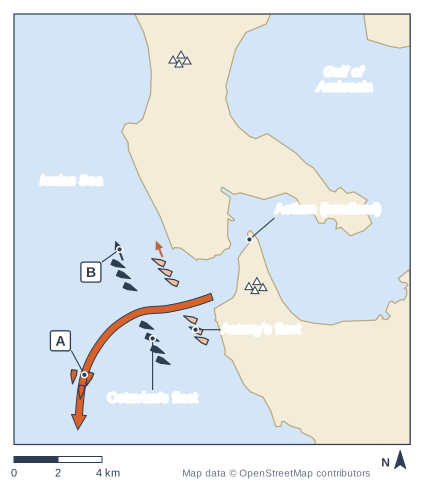
The map shows a later stage of the Battle of Actium (2 September 31 BC).

Describe what is happening at A and at B.

Map of the narrow entrance to an enclosed gulf, with fleets of ships. Map (north at the top; scale bar 0-4 km) of a narrow entrance between two headlands leading into a large enclosed stretch of water on the right; open sea lies to the left. Tents stand on the land south of the entrance and on high ground to the north. The pale line and the dark line have each split, their northern ends moving north (small arrows), leaving a gap in the middle of the pale line; a broad orange arrow runs from behind the pale line out through the gap and away to the south, with a few darker orange ships on it. The label "Antony's fleet" points to the pale ships outside the entrance to the gulf, split into two groups; the label "Octavian's fleet" points to the dark ships further out to sea; label A points to the broad orange arrow from behind the pale line out through the gap and away to the south; label B points to the small dark arrow pointing north at the northern end of the dark line; the label "Gulf of Ambracia" points to the large enclosed stretch of water on the right; the label "Ionian Sea" points to the open sea on the left; the label "Actium (headland)" points to the headland on the south side of the narrow entrance.

Model answer

At A, Cleopatra's squadron of 60 ships is breaking out through a gap in the centre of Antony's line and escaping south. At B, Agrippa is extending his wing northwards to get round the end of Antony's right wing.

Explanation

Plutarch says that as Agrippa extended his left wing to encircle the enemy, Antony's right was drawn out to meet him and a gap opened in the centre; Cleopatra's 60 ships then raised their sails and broke through it, heading for the Peloponnese. Each mark needs both who it is and what they are doing.

Mark scheme
  1. 2 marks

    A: Cleopatra's squadron (her 60 ships) breaks out through a gap in the centre of Antony's line and sails away south (towards the Peloponnese / Egypt) (1); B: Agrippa extends Octavian's left wing northwards to outflank / encircle Antony's right wing (1)

    1 mark for each different correct answer, max 2. Allow recognisable spellings. One mark for each. For A accept 'Cleopatra flees / escapes through the gap'; 'Cleopatra's ships' alone, without the movement, is not enough. For B accept 'Agrippa's ships try to get round the end of Antony's line'; 'Octavian's fleet' alone is not enough.

Question 2

5 marks

Passage C

Velleius Paterculus describes the Battle of Actium (2 September 31 BC). 'Caesar' is Octavian.

'The right wing of Caesar's fleet was given to Marcus Lurius, the left to Arruntius, and Agrippa had control of the whole sea battle. Caesar kept himself for whichever part of the battle fortune might call him to, and was present everywhere ... When the fighting began, one side had everything - commander, rowers and soldiers; the other had nothing but soldiers. Cleopatra was the first to flee. Antony chose to be the companion of the fleeing queen rather than of his fighting soldiers, and the commander who should have dealt harshly with deserters became a deserter from his own army. Even without their leader, his men fought bravely for a long time, and fought to the death when victory was hopeless. Caesar, wanting to win over with words the men he could have killed with the sword, kept shouting and pointing out that Antony had fled, and asking them for whom and with whom they were fighting.'

Velleius Paterculus, The Roman History 2.85 (adapted)

What can we learn from Passage C about the roles of the leaders in the Battle of Actium?

Model answer

Passage C shows that Octavian's side was well organised while Antony and Cleopatra failed as leaders. Octavian gave his wings to Lurius and Arruntius, and 'Agrippa had control of the whole sea battle', so Agrippa directed the fighting. Octavian himself was 'present everywhere', ready for whatever part of the battle needed him, which presents him as an active overall commander. Velleius claims that one side had 'commander, rowers and soldiers' while the other had 'nothing but soldiers', so Antony's leadership was the weakness. Cleopatra's part was to flee first, and Antony 'chose to be the companion of the fleeing queen' rather than stay with his men, so the commander 'became a deserter'. His men fought on 'to the death', which makes his desertion worse. Finally, Octavian tried to 'win over with words' men he could have killed, pointing out that Antony had fled, which shows his clemency, although Velleius clearly writes to flatter him.

Explanation

Top answers explain what the details show about each leader's role (Agrippa directing the sea battle, Octavian everywhere and winning over Antony's men, Cleopatra fleeing first, Antony following her) and may note how Velleius' pro-Octavian framing shapes the picture. Answers that only say 'they ran away' with no use of the passage's details stay in Level 1.

Mark scheme
  1. 5 marks

    Levels of response (5 marks, AO3).
    Level 3 (4-5 marks): Response uses a range of fully appropriate details from the passage, which are analysed to draw out relevant characteristics and features and give a detailed and sophisticated evaluation of what we can learn from the source about the specified issue in the question.
    Level 2 (2-3 marks): Response uses some appropriate details from the passage, which are analysed to draw out some of the characteristics and features and evaluate what we can learn from the source about the specified issue in the question.
    Level 1 (1 mark): Response uses few details from the passage and makes a very basic attempt to draw out any of the characteristics and features in relation to the question.
    0 marks: No response or no response worthy of credit.

    Max 1 if the answer makes no use of the passage (own knowledge alone does not answer this question). Details must be explained, not just copied: credit what each detail tells us about the issue. Candidates are likely to pick out and explain: 'right wing ... Marcus Lurius, the left to Arruntius': Octavian's wings were led by subordinate commanders; 'Agrippa had control of the whole sea battle': Agrippa, not Octavian, directed the fighting at sea, showing his central part in the victory; 'Caesar kept himself for whichever part of the battle fortune might call him to ... present everywhere': Octavian acted as overall commander, ready to go wherever he was needed, though the phrase also flatters him; 'one side had everything - commander, rowers and soldiers': Velleius claims Octavian's side was well led and well manned; 'the other had nothing but soldiers': Antony's side lacked good leadership and crews; 'Cleopatra was the first to flee': her flight began the collapse of Antony's side; 'Antony chose to be the companion of the fleeing queen': he put Cleopatra before his duty to his men; 'the commander who should have dealt harshly with deserters became a deserter': Velleius condemns Antony's flight as a betrayal; 'his men fought bravely for a long time ... to the death': Antony's soldiers were loyal and brave, which makes his desertion worse; 'win over with words the men he could have killed with the sword': Octavian is shown ending the battle by persuasion and mercy, the clemency Velleius praises; 'for whom and with whom they were fighting': Octavian used Antony's flight to show his men that their cause was lost. Comments on Velleius' pro-Octavian framing can be credited when linked to what the passage shows.

Question 3

5 marks

Passage C

Horace wrote this poem in 30 BC, soon after the news of Cleopatra's death reached Rome. 'Caesar' is Octavian.

'But her madness was lessened when scarcely a single ship escaped from the flames, and Caesar brought her mind, crazed with Mareotic wine [wine of Egypt], back to real fears, chasing her with his oars as she flew from Italy - as a hawk chases gentle doves, or a swift hunter a hare on the snowy plains of Thessaly - so that he might put in chains this deadly monster.'

Horace, Odes 1.37 (adapted)

Using details from Passage C, how accurate do you think Horace's account of the Battle of Actium and its aftermath is?

Model answer

Horace's account is not very accurate as history, because it is a celebratory poem written to glorify Octavian. He wrote in 30 BC, so he was close to the events, but his purpose was praise. The claim that 'scarcely a single ship escaped from the flames' is exaggerated: Cleopatra escaped with her 60 ships, and Antony with her, although fire was used and many ships were lost. Saying she 'flew from Italy' is simply wrong, since she fled from Actium in Greece; it makes her seem a direct threat to Italy. Apart from a brief chase by a few light ships, Octavian did not pursue her 'with his oars', and he reached Alexandria almost a year later. The 'Mareotic wine' and 'deadly monster' are propaganda insults, and the hawk-and-doves simile glorifies Octavian. However, Horace is right that Octavian wanted her 'in chains' for his triumph, as Plutarch confirms. Overall it is valuable for Roman attitudes, not for the battle.

Explanation

Top answers test specific lines against other evidence (Cleopatra's 60 ships, the flight from Greece, Octavian's slow pursuit, his wish to lead her in triumph) and explain the poem's purpose. A judgement that is not tied to these details stays at Level 1.

Mark scheme
  1. 5 marks

    Levels of response (5 marks, AO3).
    Level 3 (4-5 marks): Response analyses the source by using relevant detail from the source content or historical context to give a more detailed evaluation of the source within its historical context. It draws a thorough and convincing conclusion about its accuracy or reliability based on how the context in which it was created impacts on how it portrays issues or events.
    Level 2 (2-3 marks): Response analyses the source by using relevant detail from the source content or historical context to give a basic evaluation of the source within its historical context. It draws a basic conclusion about its accuracy or reliability based on how the context in which it was created impacts on how it portrays issues or events.
    Level 1 (1 mark): Response analyses the source in a basic way by selecting relevant detail from the source content or historical context.
    0 marks: No response or no response worthy of credit.

    Max 1 if the answer reaches no conclusion at all about how accurate or reliable the passage is. Full marks need the evaluation to be related to the particular events in the passage, not only general comments about the author. Candidates might comment on: Horace wrote in 30 BC, very soon after the events, but as a poet celebrating Octavian's victory in the circle of Maecenas, so his purpose is praise, not history; 'scarcely a single ship escaped from the flames' is exaggerated: Cleopatra escaped with her 60 ships, and Antony with her; fire was used in the battle and many ships were burned or captured (Plutarch says 300 were captured), so there is some truth behind the exaggeration; 'as she flew from Italy' is wrong: she fled from Actium in western Greece, and Italy was never threatened directly; the line makes her a threat to Italy itself; 'chasing her with his oars': only a few of Octavian's light ships briefly pursued her (Plutarch, Antony 67); Octavian himself went to Athens and Asia and reached Alexandria only in 30 BC; 'crazed with Mareotic wine': a drunken, mad queen is a propaganda stereotype, not evidence; the similes (hawk and doves, hunter and hare) are poetic devices that glorify Octavian; 'put in chains': accurate about Octavian's aim; Plutarch says he wanted her alive for his triumph; Antony is not mentioned at all, so the civil war is presented as a war against a foreign queen.

Question 4

20 marks

'Antony lost the Battle of Actium because of Cleopatra.'

How far do you agree with this view?

You must use and analyse the ancient sources you have studied as well as supporting your answer with your own knowledge.

Model answer

Cleopatra played an important part in Antony's defeat, but he lost mainly because Agrippa had already trapped him and because his own fleet was badly manned, so she was not the main cause.

The sources give strong grounds for blaming Cleopatra. Plutarch says Antony chose to fight at sea 'to please Cleopatra', although he was much stronger on land, and that her view prevailed over Canidius' advice to retreat and fight a land battle. He adds that she had already placed her ships where they could most easily escape. In the battle, her 60 ships hoisted their sails and broke through the centre of Antony's line, and Antony followed her. Velleius agrees that 'Cleopatra was the first to flee' and says Antony fled 'at her wish'. Her presence also cost Antony supporters: Plutarch says Plancus and Titius deserted after being abused by her, and Velleius says that Domitius, the only one of Antony's party who never addressed her as queen, went over to Octavian.

However, the military situation suggests that the battle was lost before Cleopatra fled. Velleius says Agrippa had stormed Leucas, captured Patrae, seized Corinth and twice defeated Antony's fleet, so Antony's supplies were cut off and his army trapped. Plutarch says his ships were so short of crews that his captains forced travellers and mule-drivers to row, and his giant ships were too slow to escape Octavian's light vessels. Kings and officers deserted daily. Antony himself made mistakes: Plutarch says delaying the war in 32 BC gave Octavian time to prepare. His order to carry sails suggests he planned to break out, not win, which makes Cleopatra's flight look like part of a plan rather than panic.

The reliability of the sources is central. Velleius and the Augustan poets had good reason to blame Cleopatra, because Octavian had presented the war as one against a foreign queen. Horace calls her a 'deadly monster' and Virgil shows Antony followed by his 'Egyptian wife', but these are celebrations, not histories. Velleius even contradicts himself, claiming victory was 'a certainty long before the battle' while blaming Cleopatra's flight. Plutarch is more detailed and used Augustus' own memoirs, but he moralises about Antony's passion; it is significant that he admits the battle was 'equally favourable to both sides' when she fled, which supports the idea that her flight mattered, but he also gives the military details that show Antony's weakness.

It is also worth remembering that none of these writers is known to have been present, and the only eyewitness account Plutarch mentions is Augustus' own, which had every reason to present the victory as complete.

Overall, Cleopatra's influence and flight helped to turn defeat into disaster, but Antony was already beaten by Agrippa's blockade, his undermanned fleet and his own decisions. I therefore largely disagree with the statement.

Explanation

High-level answers weigh Cleopatra's role (the choice of a sea battle, her flight, desertions she caused) against other causes (Agrippa's campaign, Antony's crews and ships, desertions, his own decisions) and analyse why Augustan sources blamed her. Answers that only retell the battle are capped at Level 2-3.

Mark scheme
  1. 20 marks

    Levels of response (20 marks: AO3 10, AO1 5, AO2 5).
    Level 5 (17-20 marks): Detailed evaluation of the ancient sources in their historical context, with thorough analysis of their reliability and accuracy in terms of the context in which they were created, used to make developed, supported judgements and fully convincing conclusions (AO3). A range of detailed, accurate knowledge and a developed understanding (AO1). Thorough, convincing analysis with substantiated, developed judgements (AO2). A sustained, coherent and logically structured line of reasoning.
    Level 4 (13-16 marks): Detailed evaluation of the ancient sources in their context, with some analysis of their reliability and accuracy, used to make supported judgements and reasonable conclusions (AO3). Accurate knowledge and a developed understanding (AO1). A full analysis; judgements are substantiated but not consistently well developed (AO2). A clear, logically structured line of reasoning.
    Level 3 (9-12 marks): Analyses examples from the ancient sources, with a basic analysis of the reliability and accuracy of at least one source in terms of its context, used to make basic judgements and simple conclusions (AO3). Accurate knowledge and some understanding (AO1). Analysis and explanation; judgements may not be explicit (AO2). A mostly relevant line of reasoning with some structure.
    Level 2 (5-8 marks): Uses examples from the ancient sources, with a very basic attempt to consider a source's reliability or accuracy that may border on assertion; no source analysis is used to reach judgements (AO3). Basic knowledge and some understanding (AO1). A basic explanation (AO2). Some relevance; limited structure.
    Level 1 (1-4 marks): Basic use of the sources, with no attempt to consider their reliability or accuracy (AO3). Basic knowledge (AO1). Little or no explanation, close to assertion (AO2). Basic, unstructured communication.
    0 marks: No response or no response worthy of credit.

    Max 8 if the answer makes no use of the ancient sources (it never names, quotes or discusses any ancient writer, work, inscription, coin or other object, and knowing the events is not using the sources). Max 8 if the answer never considers how reliable or accurate any ancient source is. Max 12 if the answer considers only one side of the statement and never addresses the other (the issue of extent). No set answer is expected. It is possible to reach the highest mark either by agreeing or disagreeing with the statement (providing the issue of extent is addressed by refuting the counter-argument), or anywhere between. To access Level 3 and above, answers discuss the ancient sources; at lower levels they may only retell stories from the sources or name them. Candidates do not have to quote directly or give precise references. Grounds for agreeing include: she persuaded him to fight at sea when he was stronger on land (Plutarch, Antony 62-63); she had arranged her ships for flight (Antony 63) and fled first; her ships threw the line into confusion (Antony 66); 'Cleopatra was the first to flee' (Velleius 2.85); Antony followed her, abandoning his men; Velleius says he fled 'at her wish'; her presence drove away supporters: Domitius and others urged that she be sent home, Plancus and Titius deserted after being abused by her (Antony 58, 63; Velleius 2.83-84); Augustan writers make her the enemy: Horace's 'deadly monster'; Virgil's 'Egyptian wife'. Grounds for disagreeing include: Agrippa's campaign before the battle (Leucas, Patrae, Corinth, two naval victories: Velleius 2.84) trapped Antony and cut his supplies; Antony's ships were undermanned, heavy and slow; Octavian's light ships and better crews (Antony 62, 65-66; Velleius 2.84); desertions by kings and officers (Velleius 2.84; Antony 63); Antony's own decisions: delay in 32 BC gave Octavian time (Antony 58); he carried sails, suggesting a planned breakout (Antony 64); Plutarch says the battle was still undecided when she fled (Antony 66), so it is uncertain that her flight decided it. Likely sources to be included: Plutarch, Life of Antony 56, 58, 61-68; Velleius Paterculus 2.83-85; Horace, Odes 1.37; Virgil, Aeneid 8.675-713. The source analysis is likely to address: Augustan writers needed a foreign enemy: blaming Cleopatra turned a civil war into a foreign war and spared Roman soldiers' reputations; Velleius writes under Tiberius and admires Augustus; his claim that victory was certain beforehand contradicts his blaming of Cleopatra; Plutarch uses Augustus' memoirs among other sources and moralises about Antony's passion, but preserves military details; the poets were writing celebration, not history.

Ready to try the rest? Every answer you write is marked against the mark scheme, so you can see exactly where the marks are.

Study Helper Hints first, answers after you try

Stuck on this one? Ask for a hint and I’ll point you in the right direction, without giving the answer away. Once you’ve checked your answer, I’ll show you how the marks are awarded.