
Level:
Correct: 0
Incorrect: 0
Marks: 0/0
Exam Practice
Course:
Topics:
OCR GCSE Ancient History (Rome and its neighbours) Smart practice A mixed round aimed at your weak spots
Unit 1
The foundations of Rome: from kingship to republic, 753-440 BC (longer period study)
Unit 2
Hannibal and the Second Punic War, 218-201 BC (depth study)
Unit 3
Cleopatra: Rome and Egypt, 69-30 BC (depth study)
Unit 4
Britannia: from conquest to province, AD 43-c.84 (depth study)
Avg
score:
–
Topics
done:
0/45

Trebia, Trasimene and Cannae

Practise 13 exam-style questions on Trebia, Trasimene and Cannae for OCR GCSE Ancient History (Rome and its neighbours). Write your answer as you would in the exam and get it marked in seconds against the mark scheme, point by point, with the Study Helper on hand if you get stuck.

  • 13 questions
  • 1–20 marks each
  • Instant marking
  • No sign-up needed
13 questions, marked as you go

Sample questions with model answers

Here are 4 of the questions in this topic, each with a model answer, an explanation of why it earns the marks and the mark scheme an examiner would use.

Question 1

2 marks

Give two ways in which Hannibal used the weather or the landscape to help him win battles in 218-216 BC.

Model answer

At Lake Trasimene he hid his army on the hills around a narrow valley and attacked in the morning mist. At Cannae he chose flat open ground where his cavalry could be used, and the wind blew dust into the Romans' faces.

Explanation

Hannibal chose his battlefields carefully: the overgrown stream bed and icy river at the Trebia, the hills, lake and mist at Trasimene, and the open plain and dusty wind at Cannae. A common error is to give general answers such as 'he used the land' without saying how.

Mark scheme
  1. 2 marks

    Any two of: at the Trebia he hid troops (Mago's force) in a stream bed overgrown with bushes; at the Trebia he drew the Romans across an icy river in winter, so they were cold, wet and hungry; at Trasimene he hid his army on the hills around a narrow valley beside the lake; at Trasimene the morning mist hid his troops; at Cannae he fought on flat, open ground suited to his cavalry; at Cannae the wind (the Volturnus) blew dust into the Romans' faces; at Cannae the river protected one flank / hemmed in the Roman cavalry

    1 mark for each different correct answer, max 2. Allow recognisable spellings. The two answers may come from the same battle if they are different features. Credit any other historically valid answer.
    Livy (22.46) and Polybius (3.114) both say the sun did not shine in the face of either army at Cannae, so 'the sun in the Romans' eyes' does not score on its own; an answer that joins it to a valid feature (for example the wind blowing dust into the Romans' faces) is credited for that feature.
Question 2

3 marks

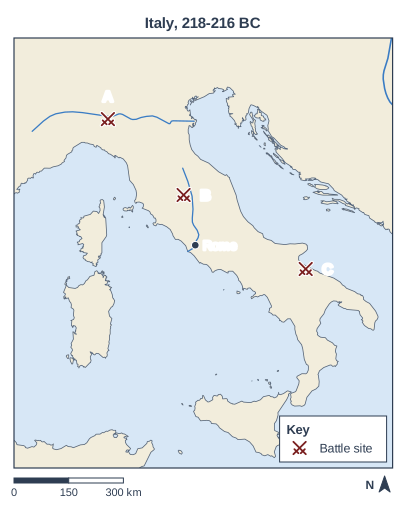
The map shows Italy at the time of Hannibal's invasion.

Name the battles fought at the places marked A, B and C.

Map of Italy and Sicily, titled "Italy, 218-216 BC", drawn with real coastlines (land pale buff, sea pale blue) and no modern borders; a north arrow shows north at the top; the scale bar is 300 km long. Blue lines show rivers. Points: a dot labelled "Rome" (inland); a crossed-swords symbol (battle) labelled A inland, in the top left of the map (about 25% of the way across and 20% of the way down); a crossed-swords symbol (battle) labelled B inland, near the centre of the map (about 45% of the way across and 35% of the way down), about 140 km north of the point labelled "Rome"; a crossed-swords symbol (battle) labelled C on the coast, towards the right of the map (about 75% of the way across and 55% of the way down), about 310 km east of the point labelled "Rome". The key (in a box on the map) shows: "Battle site".

Model answer

A is the Trebia, B is Lake Trasimene and C is Cannae.

Explanation

Hannibal won at the Trebia in northern Italy (December 218 BC), at Lake Trasimene in Etruria (217 BC) and at Cannae in Apulia, in the south-east (216 BC). The map follows his advance from the Po valley towards the south. Students sometimes confuse the Trebia with the earlier cavalry battle at the Ticinus.

Mark scheme
  1. 3 marks

    A: the (River) Trebia; B: Lake Trasimene; C: Cannae

    1 mark for each correct answer, max 3. Allow recognisable spellings (Trasumennus, Trasimeno, Thrasymene). Do not credit the Ticinus for A (fought near the Ticinus, further west, before the Trebia), Zama or the Metaurus.

Question 3

5 marks

Passage B

Livy describes how Hannibal drew up his army at Cannae in 216 BC and what happened when the infantry met.

'Hannibal crossed the river and placed each division in the line as it came over. He posted the Gallic and Spanish cavalry near the bank on the left wing, facing the Roman cavalry; the right wing was given to the Numidian horsemen. The centre was strengthened with infantry, with Africans at both ends and the Gauls and Spaniards placed between them in the middle ... At last the Romans pushed forward in a dense, level line against the enemy's wedge, which jutted out from the rest of the line and was too thin to be strong. They followed the enemy as they fell back, until they reached the Africans, who stood on both wings, drawn back. As the wedge was pushed back it first made the front level, and then, as it gave way further, a hollow in the middle. The Africans had now formed horns on either side, and as the Romans rushed carelessly into the middle, they closed round them and, extending their wings, shut them in from behind.'

Livy, The History of Rome 22.46.1-3 and 22.47.5-9 (adapted)

Using details from Passage B, how accurate do you think Livy's account of Hannibal's tactics at Cannae is?

Model answer

Livy's account of the tactics at Cannae seems largely accurate. His description of the formation, with 'the Gallic and Spanish cavalry near the bank', 'the Numidian horsemen' on the right and the 'Africans at both ends' of the infantry line, agrees closely with Polybius, who wrote much nearer the time, questioned survivors and understood war. The sequence he describes, the Romans pushing back the 'wedge', the line becoming level and then forming 'a hollow in the middle', and the Africans closing round them 'from behind', also explains the result: most of the Roman army was surrounded and destroyed. However, Livy was not a soldier and wrote two hundred years later, so some details, such as how the 'wedge' was shaped, are vague. His comment that the Romans 'rushed carelessly' also fits his wish to blame the consuls' rashness. Overall, the account is reliable because it follows a good source.

Explanation

The best answers compare Livy's account with Polybius' and with the known outcome of the battle, and also consider Livy's own aims (blaming Roman rashness, explaining a disaster to a Roman audience). Comments that do not refer to the tactics in the passage stay in Level 1.

Mark scheme
  1. 5 marks

    Levels of response (5 marks, AO3).
    Level 3 (4-5 marks): Response analyses the source by using relevant detail from the source content or historical context to give a more detailed evaluation of the source within its historical context. It draws a thorough and convincing conclusion about its accuracy or reliability based on how the context in which it was created impacts on how it portrays issues or events.
    Level 2 (2-3 marks): Response analyses the source by using relevant detail from the source content or historical context to give a basic evaluation of the source within its historical context. It draws a basic conclusion about its accuracy or reliability based on how the context in which it was created impacts on how it portrays issues or events.
    Level 1 (1 mark): Response analyses the source in a basic way by selecting relevant detail from the source content or historical context.
    0 marks: No response or no response worthy of credit.

    Max 1 if the answer reaches no conclusion at all about how accurate or reliable the passage is.
    Full marks need the evaluation to be related to the particular events in the passage, not only general comments about the author. A conclusion that the passage is accurate, inaccurate or partly accurate can all reach Level 3 if it is supported. Treat bare assertions such as 'he was not there' or 'he was biased' with care: on their own they are Level 1.
    Candidates might comment on: the formation (Gallic and Spanish cavalry by the river on the left, Numidians on the right, Africans at both ends, Gauls and Spaniards in a forward wedge in the centre) agrees closely with Polybius (3.113-116), who wrote much closer to the time, questioned survivors and was an experienced soldier; Livy probably followed him; the result (most of the Roman army surrounded and destroyed) confirms the encirclement described; Livy is not a soldier, and parts of his description are hard to follow (how the 'wedge' worked), but the main sequence - centre pushed back, hollow formed, Africans closing in - is clear and consistent; 'rushed carelessly into the middle' places the blame on Roman rashness, which fits Livy's theme that the consuls' recklessness caused the disaster; Livy wrote about two hundred years later under Augustus for Roman readers; Cannae was Rome's worst defeat, so he had reason to stress Hannibal's cunning rather than Roman weakness; Livy elsewhere admits uncertainty (whether the sun's position was planned or chance), which suggests care; possible sources: Fabius Pictor (a Roman senator of the time) and the Greek writers who travelled with Hannibal (Silenus, Sosylus), used by Polybius.

Question 4

20 marks

'Hannibal's victories at the Trebia, Trasimene and Cannae were won by his cavalry.'

To what extent do you agree with this view?

You must use and analyse the ancient sources you have studied as well as supporting your answer with your own knowledge.

Model answer

Hannibal's cavalry was vital in all three victories, but it was only one part of his tactics, so I agree only partly with the statement.

The case for the cavalry is strong. At the Trebia, Livy says Hannibal sent his Numidian horsemen to ride up to the Roman camp, hurl javelins and then fall back, drawing Sempronius' army across the freezing river. In the battle, Polybius says the Carthaginian cavalry and elephants drove off the Roman wings, and Mago's hidden force, half of it cavalry, attacked from behind. At Trasimene, Polybius says the cavalry and Gauls closed the narrow entrance between the hills and the lake, sealing the trap, and afterwards Maharbal's horsemen destroyed the 4,000 cavalry sent by the consul Servilius. At Cannae the cavalry were decisive: Livy says Hannibal wanted open ground because cavalry was the arm in which he was strongest, and Hasdrubal's Gallic and Spanish horsemen routed the Roman cavalry and then struck the rear of the Roman infantry. Polybius, who had commanded cavalry for the Achaean League and questioned survivors, draws exactly this lesson: the side with superior cavalry has the advantage.

However, the cavalry could only win because of the rest of Hannibal's plan. The Trebia depended on careful preparation: choosing a hidden stream bed, feeding his own men while the Romans arrived cold and hungry. Trasimene was won by the choice of ground and the night-time placing of the whole army; Polybius' description shows Spaniards, Africans and light troops as important as the horsemen. At Cannae the infantry played the central part. Livy describes how the Gallic and Spanish centre gave ground, forming a hollow, and the Africans closed in from both sides; without this, the cavalry attack on the rear would not have trapped the legions. Livy was not a soldier and some of his description is vague, but because it agrees with Polybius it is probably reliable.

The Romans also contributed to their own defeats. Polybius shows Flaminius ignoring his officers' advice, and Livy shows Sempronius sending his men out without food and the consuls at Cannae quarrelling. Livy wanted to blame individual commanders rather than Roman soldiers, so he may exaggerate their faults, but Polybius agrees about Flaminius. Livy also adds a trick at Cannae, Numidians pretending to desert and then attacking from behind, which Polybius does not mention, so it may be a Roman story about 'Punic deceit'.

The elephants at the Trebia, which Polybius says helped to break the Roman wings, also show that Hannibal used every arm of his army, not just his horsemen.

In conclusion, Hannibal's cavalry was the most reliable weapon in his army and made each victory more complete, but the victories were won by the way he combined cavalry, infantry, terrain and surprise, and by the mistakes of the Roman commanders.

Explanation

A top answer discusses all three battles, explaining what the cavalry did in each and weighing it against planning, infantry tactics, conditions and Roman errors, with source evaluation such as Polybius' military experience and Livy's emphasis on Roman rashness and Carthaginian trickery.

Mark scheme
  1. 20 marks

    Levels of response (20 marks: AO3 10, AO1 5, AO2 5).
    Level 5 (17-20 marks): Detailed evaluation of the ancient sources in their historical context, with thorough analysis of their reliability and accuracy in terms of the context in which they were created, used to make developed, supported judgements and fully convincing conclusions (AO3). A range of detailed, accurate knowledge and a developed understanding (AO1). Thorough, convincing analysis with substantiated, developed judgements (AO2). A sustained, coherent and logically structured line of reasoning.
    Level 4 (13-16 marks): Detailed evaluation of the ancient sources in their context, with some analysis of their reliability and accuracy, used to make supported judgements and reasonable conclusions (AO3). Accurate knowledge and a developed understanding (AO1). A full analysis; judgements are substantiated but not consistently well developed (AO2). A clear, logically structured line of reasoning.
    Level 3 (9-12 marks): Analyses examples from the ancient sources, with a basic analysis of the reliability and accuracy of at least one source in terms of its context, used to make basic judgements and simple conclusions (AO3). Accurate knowledge and some understanding (AO1). Analysis and explanation; judgements may not be explicit (AO2). A mostly relevant line of reasoning with some structure.
    Level 2 (5-8 marks): Uses examples from the ancient sources, with a very basic attempt to consider a source's reliability or accuracy that may border on assertion; no source analysis is used to reach judgements (AO3). Basic knowledge and some understanding (AO1). A basic explanation (AO2). Some relevance; limited structure.
    Level 1 (1-4 marks): Basic use of the sources, with no attempt to consider their reliability or accuracy (AO3). Basic knowledge (AO1). Little or no explanation, close to assertion (AO2). Basic, unstructured communication.
    0 marks: No response or no response worthy of credit.

    Max 8 if the answer makes no use of the ancient sources (it never names, quotes or discusses any ancient writer, work, inscription, coin or other object, and knowing the events is not using the sources). Max 8 if the answer never considers how reliable or accurate any ancient source is. Max 12 if the answer considers only one side of the statement and never addresses the other (the issue of extent).
    No set answer is expected. It is possible to reach the highest mark either by agreeing or disagreeing with the statement (providing the issue of extent is addressed by refuting the counter-argument), or anywhere between. To access Level 3 and above, answers discuss the ancient sources; at lower levels they may only retell stories from the sources or name them. Candidates do not have to quote directly or give precise references.
    Grounds for agreeing include: Trebia: the Numidians provoked the Romans and drew them over the river; cavalry and elephants beat the Roman wings and Mago's horsemen attacked the rear (Livy 21.54; Polybius 3.72-74); Trasimene: the cavalry closed the entrance by the lake, trapping the column; Maharbal's horsemen then destroyed Centenius' 4,000 cavalry (Polybius 3.83-86); Cannae: Hannibal wanted open ground for cavalry (Livy 22.44); Hasdrubal's horsemen routed the Roman cavalry and attacked the infantry from behind (Livy 22.47-48); Hannibal had about 10,000 cavalry at Cannae against about 6,000 Roman cavalry; Roman cavalry was weaker and less experienced.
    Grounds for disagreeing include: Hannibal's planning, ambushes and use of ground were decisive (Livy 21.54; Polybius 3.83); the infantry did the decisive work at Cannae: the Gallic and Spanish centre gave ground and the Africans closed in (Livy 22.47); at Trasimene the Spaniards and Africans blocked the valley; weather and terrain: the icy river at the Trebia, the mist at Trasimene, the wind and dust at Cannae; Roman mistakes: rash consuls (Sempronius, Flaminius, Varro) gave Hannibal battle on his terms; Livy's false deserters at Cannae (22.48) and the elephants at the Trebia show other factors.
    Likely sources to be included: Livy 21.54 (the Trebia); Polybius, The Histories 3.80-3.86 (Trasimene and Centenius); Livy 22.44-22.48 (Cannae).
    The source analysis is likely to address: Polybius was a cavalry commander (hipparch) of the Achaean League, interviewed survivors and walked battlefields, so his military analysis is valuable; he stresses Hannibal's cavalry superiority as a lesson for Greek readers; Livy, writing under Augustus without military experience, sometimes gives unclear descriptions, and he stresses Roman rashness and Carthaginian trickery; both used earlier writers, including Fabius Pictor and Hannibal's Greek companions; their agreement on the main events is strong evidence.
    Reductive comments ('Livy is Roman so biased', 'Polybius was not there') are basic analysis on their own.

Ready to try the rest? Every answer you write is marked against the mark scheme, so you can see exactly where the marks are.

Study Helper Hints first, answers after you try

Stuck on this one? Ask for a hint and I’ll point you in the right direction, without giving the answer away. Once you’ve checked your answer, I’ll show you how the marks are awarded.