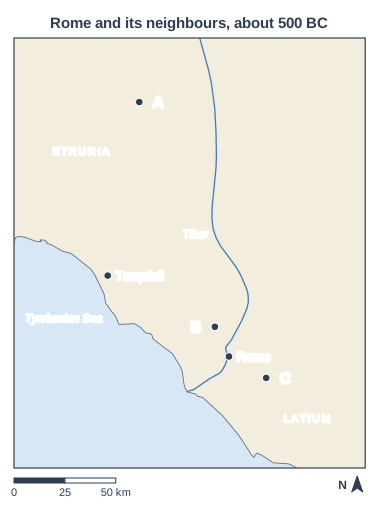
'Tarquinius Superbus was a greater danger to Rome after he was driven out than when he was king.'
To what extent do you agree with this view?
Spelling, punctuation and grammar and the use of specialist terminology will be assessed in this answer
Model answer
Whether Tarquinius Superbus was more dangerous in exile depends on what 'danger to Rome' means. As a threat to the survival of the Roman state, he was certainly more dangerous after 509 BC. Within months, he had organised the conspiracy of the young nobles, including Brutus' own sons, to let the Tarquins back into the city. He then persuaded Veii and Tarquinii to attack, and at Silva Arsia the Republic lost its founder, Brutus. Next he brought Lars Porsena, the powerful king of Clusium, who captured the Janiculum, besieged Rome and caused famine; Horatius Cocles only just stopped the Etruscans crossing the Sublician bridge. Tacitus even says that Rome surrendered to Porsena, and Pliny that the treaty forbade the Romans to use iron except for farming. Finally, his son-in-law Octavius Mamilius united thirty Latin cities against Rome, and at Lake Regillus the Romans needed a dictator to win. The danger lasted until Tarquinius died at Cumae in 495 BC, and the patricians feared throughout that the plebeians might accept him back, which is why they made concessions in 508.
By contrast, as king Superbus made Rome stronger as a state. He captured Gabii, fought the Volsci, founded colonies at Signia and Circeii and led the Latins; the treaty with Carthage of about 509 BC shows Rome controlling much of the coast of Latium. He completed the Cloaca Maxima and built the great temple of Jupiter on the Capitol.
However, as a danger to the Romans themselves, he was worse as king. He seized power by having Servius Tullius murdered, killed leading senators, ruled with a bodyguard, stopped consulting the Senate and judged capital cases alone. Brutus' brother was among his victims. The plebeians were forced into hard labour digging sewers, and his family's crimes, from Tullia's treatment of her father's body to Sextus' assault on Lucretia, brought shame on the city. For individual Romans, his reign meant fear, forced labour and the loss of their rights.
It can also be argued that his danger in exile was limited. Every attempt failed: the conspiracy was betrayed by a slave, the Etruscans withdrew from Silva Arsia, Porsena made peace and abandoned the Tarquins, and Lake Regillus was a defeat. His allies had their own reasons for fighting: Veii wanted revenge, Porsena wanted Etruscan influence and the Latins wanted independence, so Tarquinius was only part of the danger. The threats also united the Romans and strengthened the Republic, which created the dictatorship and passed Valerius' laws. We should remember too that these stories of heroism come from much later sources that wanted to glorify the young Republic.
Overall, I agree with the statement if danger means the threat to Rome's survival: the wars of 509-496 BC brought the city closer to defeat than anything in Superbus' reign. But for the lives and freedom of ordinary Romans, the tyrant on the throne had been the greater danger.
Explanation
Strong essays distinguish between danger to the state and danger to the people, use evidence from both the reign and the exile, and reach a clear judgement. Answers that only narrate the wars of 509-496 BC without comparing them with Superbus' reign are capped, because the question spans two eras.