Level:
Correct: 0
Incorrect: 0
Marks: 0/0
Exam Practice
Course:
Topics:
OCR GCSE Ancient History (Rome and its neighbours) Smart practice A mixed round aimed at your weak spots
Unit 1
The foundations of Rome: from kingship to republic, 753-440 BC (longer period study)
Unit 2
Hannibal and the Second Punic War, 218-201 BC (depth study)
Unit 3
Cleopatra: Rome and Egypt, 69-30 BC (depth study)
Unit 4
Britannia: from conquest to province, AD 43-c.84 (depth study)
Avg
score:
–
Topics
done:
0/45

Rome 753-440 BC: change, continuity, myth and reality

Practise 14 exam-style questions on Rome 753-440 BC: change, continuity, myth and reality for OCR GCSE Ancient History (Rome and its neighbours). Write your answer as you would in the exam and get it marked in seconds against the mark scheme, point by point, with the Study Helper on hand if you get stuck.

  • 14 questions
  • 2–25 marks each
  • Instant marking
  • No sign-up needed
14 questions, marked as you go

Sample questions with model answers

Here are 4 of the questions in this topic, each with a model answer, an explanation of why it earns the marks and the mark scheme an examiner would use.

Question 1

3 marks

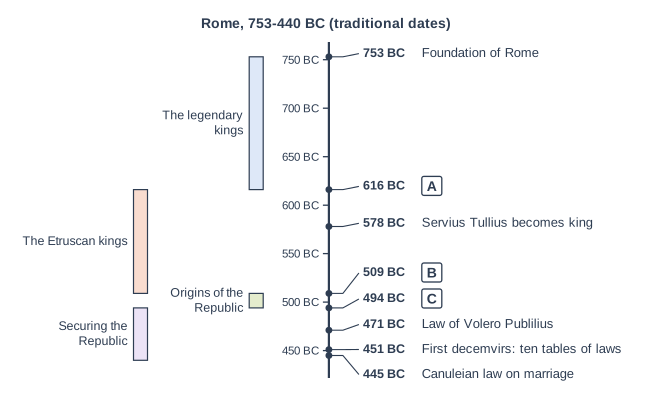
The timeline below shows the traditional dates of some events between 753 and 440 BC, and the four eras of the period.

Identify the events labelled A, B and C.

Vertical timeline titled "Rome, 753-440 BC (traditional dates)", running from 760 BC at the top to 430 BC at the bottom, with the years marked every 50 years (750 BC to 450 BC). Events marked by dots on the line, in date order: 753 BC: Foundation of Rome; 616 BC: label A; 578 BC: Servius Tullius becomes king; 509 BC: label B; 494 BC: label C; 471 BC: Law of Volero Publilius; 451 BC: First decemvirs: ten tables of laws; 445 BC: Canuleian law on marriage. Periods shown as bars to the left of the line, each bar as long as the period: The legendary kings (753 BC to 616 BC); The Etruscan kings (616 BC to 509 BC); Origins of the Republic (509 BC to 494 BC); Securing the Republic (494 BC to 440 BC).

Model answer

A is Tarquinius Priscus becoming king, the first of the Etruscan kings. B is the expulsion of Tarquinius Superbus and the start of the Republic with two consuls. C is the First Secession of the plebeians, which led to the creation of the tribunes of the plebs.

Explanation

The four eras of the specification begin with these turning points: 616 BC (the first Etruscan king), 509 BC (the Republic) and 494 BC (the First Secession and the tribunes). These dates are traditional, worked out by later Roman scholars, so they are approximate, especially for the kings.

Mark scheme
  1. 3 marks

    A (616 BC): Tarquinius Priscus became king (the first Etruscan king). B (509 BC): Tarquinius Superbus was driven out and the Republic began (the first consuls). C (494 BC): the First Secession of the plebeians / the creation of the tribunes of the plebs.

    1 mark for each correct event, max 3. For A accept 'Tarquinius Priscus / Lucumo becomes king' or 'the start of the Etruscan kings' if Priscus is named or clearly meant; do not accept Tarquinius Superbus or Servius Tullius. For B accept the expulsion of the kings, the founding of the Republic, the first consuls (Brutus and Collatinus), or the fall of Tarquinius Superbus. For C accept the First Secession (to the Sacred Mount) or the creation of the tribunes; do not accept the Second Secession or the Twelve Tables.

Question 2

10 marks

Passage A

In 445 BC the tribune Canuleius argued that plebeians should be allowed to become consuls. Livy gives his speech.

'But, you say, no plebeian has been consul since the kings were driven out. What of it? Must nothing new ever be introduced? ... In the reign of Romulus there were no pontiffs and no augurs; Numa Pompilius created them. There was no census in the state and no division into centuries and classes; Servius Tullius made it. There had never been consuls; they were elected when the kings had been driven out. Neither the power nor the name of dictator had existed; it began in our fathers' time. There were no tribunes of the plebs, no aediles, no quaestors; it was decided to have them. Within the last ten years we have both created decemvirs to write the laws and removed them from the state. Who can doubt that in a city founded to last for ever, and growing without limit, new offices, priesthoods and rights must be established?'

Livy, The History of Rome 4.4.1-4 (adapted)

Using details from Passage A and your own knowledge, what can we learn about how Rome's institutions changed between the reign of Romulus and 445 BC?

Model answer

The passage suggests that Rome's institutions developed step by step over the whole period. Canuleius claims that 'in the reign of Romulus there were no pontiffs and no augurs; Numa Pompilius created them', so religious institutions were added by the kings. From own knowledge, Numa is also said to have created the flamens, the Vestal Virgins and the calendar, although other accounts say Romulus himself founded the city by taking the auspices, so the claim is not entirely accurate. Political and military institutions also developed under the kings: there was 'no census... and no division into centuries and classes' until 'Servius Tullius made it'. This was the basis of the army and of the assembly of the centuries, in which the richest had most votes.

The biggest change came in 509: 'there had never been consuls; they were elected when the kings had been driven out'. The early Republic then created new offices to meet new needs. 'Neither the power nor the name of dictator had existed', but one was appointed in 501 or 498 for military emergencies, while 'tribunes of the plebs' and 'aediles' were created after the First Secession of 494 to protect the plebeians, and quaestors to manage money. The passage also shows that institutions could be tried and removed: 'within the last ten years we have both created decemvirs to write the laws and removed them'.

Canuleius' point is that 'no plebeian has been consul since the kings were driven out', but that change is natural in 'a city founded to last for ever, and growing without limit'. This shows that in 445 the consulship was still closed to plebeians. From own knowledge, his campaign won the right of intermarriage and the compromise of military tribunes with consular power in 444. However, the speech was written by Livy centuries later, so it presents a tidy version of Roman history that suits his argument.

Explanation

Top answers work through the passage era by era (the kings' religious and census reforms, the consuls, the dictator, the plebeian offices, the decemvirs) and explain what each change shows, adding own knowledge, and may note that the speech is Livy's composition. Answers that list institutions without linking them to the passage stay in Level 3.

Mark scheme
  1. 10 marks

    Levels of response (10 marks: AO1 5, AO3 5).
    Level 5 (9-10 marks): A range of detailed and accurate knowledge and a developed understanding that is fully relevant to the question (AO1). Uses a range of fully appropriate details from the passage, which are analysed to draw out relevant characteristics and features and give a detailed and sophisticated evaluation of what we can learn from the source about the specified issue (AO3).
    Level 4 (7-8 marks): Accurate knowledge and a developed understanding that is fully relevant to the question (AO1). Uses a range of fully appropriate details from the passage, which are analysed to draw out most of the relevant characteristics and features and evaluate what we can learn from the source about the specified issue (AO3).
    Level 3 (5-6 marks): Accurate knowledge and some understanding that is relevant to the question (AO1). Uses some appropriate details from the passage, which are analysed to draw out some of the characteristics and features and evaluate what we can learn from the source about the specified issue (AO3).
    Level 2 (3-4 marks): Basic knowledge and some understanding that is relevant to the question (AO1). Uses some appropriate details from the passage, which are analysed to draw out a few of the characteristics and features (AO3).
    Level 1 (1-2 marks): Basic knowledge that is relevant to the topic of the question (AO1). Uses few details from the passage and makes a very basic attempt to draw out any of the characteristics and features (AO3).
    0 marks: No response or no response worthy of credit.

    Max 6 if the answer uses only the passage, with no own knowledge. Max 6 if the answer makes no use of the passage. Quotations from the passage are credited only when linked to the question. A Level 4 or 5 answer typically uses details from the start, middle and end of the passage. There is no requirement to judge the passage's reliability, but relevant evaluation can be credited under AO3. Credit evaluation, e.g. that the speech is Livy's own composition, or that Canuleius' claim that Romulus had no augurs differs from other accounts of Romulus taking the auspices. Valid features the answer could identify from the passage: 'no plebeian has been consul since the kings were driven out' - the consulship was still closed to plebeians in 445; 'Must nothing new ever be introduced?' - Canuleius presents Roman history as a story of constant change; 'In the reign of Romulus there were no pontiffs and no augurs; Numa Pompilius created them' - religious institutions developed under the kings (other sources say Romulus used augury); 'no census... no division into centuries and classes; Servius Tullius made it' - the Etruscan kings reorganised citizens by wealth for war and voting; 'There had never been consuls; they were elected when the kings had been driven out' - the Republic replaced monarchy with elected magistrates; 'Neither the power nor the name of dictator had existed' - a new emergency office in the early Republic; 'no tribunes of the plebs, no aediles, no quaestors' - plebeian and financial offices were added later; 'created decemvirs to write the laws and removed them' - institutions could be tried and abolished; 'a city founded to last for ever, and growing without limit' - Romans saw their growth as continuous and expected change to go on. Other valid features from own knowledge: Romulus: the Senate, the curiae, the three tribes and the army; Livy says he took the auspices himself; Numa: the pontifex, flamens, Vestal Virgins, Salii and the calendar; Servius: five classes, 193 centuries, the assembly of the centuries; new tribes; 509: two annual consuls, the rex sacrorum, Valerius' law of appeal; quaestors for the treasury (Plutarch); 501 or 498: the first dictator; 494: tribunes and aediles; 471: the tribal assembly elects the tribunes; 451-449: the decemvirs and the Twelve Tables; 449: the Valerio-Horatian laws; 445: the Canuleian law; 444: military tribunes with consular power; 443: censors; Livy composed this speech himself, so it reflects his view of Roman history.

Question 3

15 marks

Passage A

At the start of Book 2, Livy looks back on the rule of the kings before describing the Republic.

'The arrogance of the last king had made liberty all the more welcome. For the earlier kings ruled in such a way that all of them in turn can fairly be counted as founders of at least parts of the city, which they added as new homes for the people whose numbers they had increased. There is no doubt that the same Brutus who won such glory by driving out the proud king would have done the state great harm if, from a desire for liberty that came too early, he had taken the kingdom from any of the earlier kings. For what would have happened if that crowd of shepherds and refugees... had been freed from fear of a king and stirred up by the storms of tribunes, before wives, children and love of the land had bound them together? ... But the calm and moderate rule of the kings nursed them until they were strong enough to bear the good fruit of liberty.'

Livy, The History of Rome 2.1.1-6 (adapted)

Using details from Passage A and your own knowledge, explain the importance of the kings in preparing Rome for the Republic.

Model answer

The passage shows that Livy believed the kings were essential preparation for the Republic. He says 'all of them in turn can fairly be counted as founders of at least parts of the city', adding 'new homes for the people whose numbers they had increased'. From own knowledge, Romulus opened an asylum to attract settlers and united with the Sabines, Tullus Hostilius brought the people of Alba Longa to Rome, and Ancus Marcius settled conquered Latins on the Aventine. The kings therefore built up a population large enough to form a state.

Livy also argues that the people needed time under firm rule. The early Romans were 'that crowd of shepherds and refugees', and if they had been 'stirred up by the storms of tribunes' too early, before 'wives, children and love of the land had bound them together', the state would have fallen apart. Instead, 'the calm and moderate rule of the kings nursed them' until they were ready for 'the good fruit of liberty'. This suggests the kings created the unity and loyalty a free state needed.

The kings also left the institutions the Republic used. Romulus created the Senate, and the patres and patrons and clients continued. Numa's priesthoods and calendar remained, with the rex sacrorum taking over the kings' own religious role. Most importantly, Servius Tullius' census and the assembly of the centuries were the means by which the first consuls were elected in 509. The consuls also kept the kings' fasces, lictors and curule chair. The Etruscan kings built the city itself: the Cloaca Maxima, the Forum and the temple of Jupiter on the Capitol, which was dedicated in the Republic's first year. Superbus' conquests also left Rome dominant in Latium, as the treaty with Carthage shows, which helped the Republic survive its first wars.

Finally, the passage says 'the arrogance of the last king had made liberty all the more welcome'. Superbus' tyranny gave the Republic a lasting fear of kingship, which shaped its rules on annual office, colleagues and appeal.

However, the kings also left problems: the division between patricians and plebeians and the power of the rich, which caused the conflicts after 509. Livy's view is also a later interpretation, shaped by his belief in steady progress.

Overall, the kings were very important: they built the city, its population and the institutions the Republic took over, and even the last king's tyranny helped to define what the Republic would be.

Explanation

Strong answers use the passage's argument (the kings as founders, the people needing time, the moderate rule of the kings, the welcome of liberty after Superbus) and develop it with own knowledge across both the legendary and Etruscan kings, including the institutions the Republic inherited, before weighing benefits against problems and reaching a judgement.

Mark scheme
  1. 15 marks

    Levels of response (15 marks: AO1 5, AO2 5, AO3 5).
    Level 5 (13-15 marks): Uses a range of fully appropriate examples from the passage and analyses them to make developed, supported judgements and draw fully convincing conclusions about what the source tells us (AO3). A range of detailed and accurate knowledge and a developed understanding that is fully relevant to the question (AO1). A full explanation and thorough, convincing analysis of the issue, arriving at substantiated and developed judgements (AO2).
    Level 4 (10-12 marks): Uses a range of appropriate examples from the passage and analyses them to make supported judgements and draw reasonable conclusions (AO3). Accurate knowledge and a developed understanding that is fully relevant to the question (AO1). A full explanation and analysis of the issue, arriving at substantiated judgements, but these are not consistently well developed (AO2).
    Level 3 (7-9 marks): Uses some appropriate examples from the passage and analyses them to make simple judgements and draw basic conclusions (AO3). Accurate knowledge and some understanding that is relevant to the question (AO1). Linked to an analysis and explanation of the issue, but judgements may not always be made explicit (AO2).
    Level 2 (4-6 marks): Uses some examples from the passage, making a very basic attempt to draw conclusions (AO3). Basic knowledge and some understanding that is relevant to the question (AO1). A basic explanation of the issue (AO2).
    Level 1 (1-3 marks): Uses few examples from the passage, with no attempt to draw conclusions from it (AO3). Basic knowledge that is relevant to the topic of the question (AO1). Little or no attempt at a very basic explanation, which may be close to assertion (AO2).
    0 marks: No response or no response worthy of credit.

    Max 9 if the answer uses only the passage, with no own knowledge. Max 9 if the answer makes no use of the passage. A typical Level 4 or 5 answer refers to two or more reasons/factors, with evidence from the start, middle and end of the passage, and reaches a judgement. There is no requirement to judge the passage's reliability. Details from the passage that answers could use: 'all of them in turn can fairly be counted as founders of at least parts of the city' - each king added to the city's growth; 'new homes for the people whose numbers they had increased' - the kings increased the population (asylum, absorbing Alba Longa and other conquered peoples); 'Brutus... would have done the state great harm' if he had acted earlier - Livy thinks Rome was not ready for liberty under the earlier kings; 'that crowd of shepherds and refugees' - the early population was mixed and needed firm rule; 'stirred up by the storms of tribunes' - Livy thinks freedom too early would have led to conflict; 'before wives, children and love of the land had bound them together' - time under the kings created a united people; 'the calm and moderate rule of the kings nursed them' - the kings provided stability; 'the arrogance of the last king' made liberty welcome. Own knowledge that could be used: Romulus: the Senate (patres), the curiae, patrons and clients, the asylum; union with the Sabines; Numa: religion, priesthoods and the calendar, which continued under the Republic; Tullus and Ancus: absorbing Alba Longa and the Latins; the Aventine; Ostia; the fetial law; the Etruscan kings: the Cloaca Maxima, the Forum, the Capitoline temple (dedicated in 509), the Circus; Servius: the census, classes and centuries, and the assembly of the centuries, which elected the first consuls in 509; insignia of power (fasces, lictors, the curule chair) passed to the consuls; Rome's power in Latium under Superbus (the treaty with Carthage) helped the Republic survive; Superbus' tyranny gave the Romans a model of what to avoid, shaping the Republic's fear of kingship; the kings also left problems: patrician privilege and the gap between rich and poor. Second-order concepts in play: change and continuity; consequence; similarity and difference between the kings and the Republic.

Question 4

25 marks

'The stories of early Rome, from Romulus to the decemvirs, tell us more about Livy's own time than about what really happened.'

To what extent do you agree with this view?

Spelling, punctuation and grammar and the use of specialist terminology will be assessed in this answer

Model answer

There is good reason to think that Livy's stories reflect his own time. In his preface he says his aim is to show 'what life and morals were like' and how they declined to the present, 'when we can bear neither our vices nor their cures', and he offers examples to imitate and to avoid. He wrote under Augustus, after decades of civil war, so the story of Romulus killing his brother Remus, or Brutus putting the Republic before his own sons, carried messages for readers who had just lived through Romans fighting Romans. The conflict of the orders is often described in the language of the late Republic, with tribunes' 'storms', land laws and men accused of aiming at kingship such as Spurius Cassius and Spurius Maelius, who look rather like later popular politicians. The speeches of Brutus, Menenius Agrippa and Canuleius were composed by Livy himself, and his sources, annalists such as Valerius Antias and Licinius Macer, wrote in the first century BC with their own political and family loyalties. Livy himself admits that most records were destroyed when the Gauls burned Rome, that dates are confused, and that Horatius' deed won 'more fame than belief'.

However, the stories are not simply a reflection of Livy's time. Archaeology supports parts of the tradition: huts on the Palatine date from the eighth century, the Forum was drained and paved around 600, and the podium of the Capitoline temple fits a great building project by the Etruscan kings. The Lapis Niger inscription probably mentions a king, and the Lapis Satricanus of about 500 names companions of a Publius Valerius. Some documents also survived: Polybius saw a treaty with Carthage from the first year of the Republic, and Cicero says that as a boy he learned the Twelve Tables by heart. Institutions that existed in Livy's day, such as the rex sacrorum, the tribunes and the assembly of the centuries, must have had real origins. Livy is also more critical than he is sometimes given credit for: he gives alternative versions, for example of Spurius Cassius' death, and questions miracles.

The answer also depends on the era. The stories of Romulus, Numa and the Horatii are mostly legend, shaped to explain Roman customs and values. The fifth century is better supported, because the outline of the conflict of the orders and the dates of the Twelve Tables and the tribunes fit the institutions that survived.

Overall, I partly agree. The details of the stories, especially the speeches, characters and moral lessons, tell us a lot about Livy's own time and purpose. But the broad outline of change from kings to Republic and the struggle between patricians and plebeians is supported by documents and archaeology, so the stories are not only about Livy's age.

Explanation

Strong essays use Livy's preface and his own admissions, examples of stories from several eras, and evidence from documents and archaeology to weigh what the stories reveal about Livy's time against what they reveal about the past, often concluding that the answer differs between the kings and the fifth century.

Mark scheme
  1. 20 marks

    Levels of response (20 marks: AO1 10, AO2 10).
    Level 5 (17-20 marks): A wide range of fully relevant and accurate knowledge, with a good level of detail throughout, showing a thorough understanding of all the key features and characteristics discussed (AO1). A full explanation and thorough, convincing analysis of the issue in the question, arriving at substantiated and developed judgements (AO2). A well-developed and sustained line of reasoning which is coherent, relevant and logically structured.
    Level 4 (13-16 marks): A good range of fully relevant and accurate knowledge, detailed in places, showing a good understanding of most of the key features and characteristics discussed (AO1). A full explanation and analysis of the issue, arriving at substantiated judgements, but these are not consistently well developed (AO2). A well-developed line of reasoning which is clear, relevant and logically structured.
    Level 3 (9-12 marks): A wider selection of relevant, generally accurate knowledge, which lacks detail, showing some understanding of the key features and characteristics discussed (AO1). Linked to an analysis and explanation of the issue, but judgements may not always be made explicit (AO2). A line of reasoning which is mostly relevant and has some structure.
    Level 2 (5-8 marks): A limited amount of relevant knowledge, which may be inaccurate in places and lacks detail, showing limited understanding of the key features and characteristics (AO1). A basic explanation of the issue (AO2). A line of reasoning which has some relevance, presented with limited structure.
    Level 1 (1-4 marks): Very basic knowledge and basic understanding that is relevant to the topic of the question (AO1). Little or no attempt at a very basic explanation of the issue, which may be close to assertion (AO2). The information is communicated in a basic, unstructured way.
    0 marks: No response or no response worthy of credit.

    Max 12 if the answer considers only one side of the statement and never addresses the other (the issue of extent). Max 12 if all the events the answer discusses come from only one of these eras: the legendary kings (753-616 BC), the Etruscan kings (616-509 BC), the origins of the Republic (509-494 BC) or securing the Republic (494-440 BC). No set answer is expected. It is possible to reach the highest marks either by agreeing or disagreeing with the statement (providing the issue of extent is addressed by refuting the counter-argument), or anywhere between. No reference to ancient sources is expected, but discussion of how far the events in the sources really happened can be credited under AO2. Grounds for agreeing include: Livy's preface: a moral purpose, examples to imitate and avoid, decline to times 'when we can bear neither our vices nor their cures'; he wrote under Augustus after civil wars: Romulus' killing of Remus, the 'second founder', liberty and Brutus all had meaning for his readers; the conflict of the orders may be described in the language of the late Republic (land laws, tribunes' 'storms', would-be kings like Spurius Cassius and Spurius Maelius); speeches (Brutus, Menenius, Canuleius) were composed by Livy; his sources were late annalists (Valerius Antias, Licinius Macer) and family traditions with their own aims; Livy admits that the records were destroyed (Book 6), that dates are confused, and that some stories won 'more fame than belief'. Grounds for disagreeing include: archaeology supports parts of the tradition: huts on the Palatine (8th century), the Forum drained and paved about 600, the Capitoline temple podium, the Lapis Niger inscription, which probably refers to a king (rex), the Lapis Satricanus (about 500); documents survived: the treaty with Carthage (Polybius), the Latin treaty on bronze, the Twelve Tables, lists of magistrates; institutions in Livy's day were genuinely old: the rex sacrorum, the tribunes, the assembly of the centuries, the temple of Castor; Livy is often critical: he gives alternative versions and doubts miracles; the broad outline (kings, an Etruscan dynasty, the Republic about 509, the conflict of the orders, written laws about 450) is widely accepted; the balance changes over time: the stories of the kings are more legendary than those of the fifth century. A top answer would typically examine stories from several eras, use Livy's preface and his own admissions, compare the literary tradition with documents and archaeology, and reach a judgement that may differ between eras.

  2. 5 marks

    SPaG. Spelling, punctuation and grammar and the use of specialist terminology (5 marks).
    High performance (4-5 marks): Learners spell and punctuate with consistent accuracy. Learners use rules of grammar with effective control of meaning overall. Learners use a wide range of specialist terms as appropriate.
    Intermediate performance (2-3 marks): Learners spell and punctuate with considerable accuracy. Learners use rules of grammar with general control of meaning overall. Learners use a good range of specialist terms as appropriate.
    Threshold performance (1 mark): Learners spell and punctuate with reasonable accuracy. Learners use rules of grammar with some control of meaning and any errors do not significantly hinder meaning overall. Learners use a limited range of specialist terms as appropriate.
    0 marks: The learner writes nothing, the response does not relate to the question, or the learner's SPaG does not reach the threshold performance level, for example errors in spelling, punctuation and grammar severely hinder meaning.

    Specialist terms suited to this question include: myth, legend, annalist, oral tradition, archaeology, inscription, Fasti, Twelve Tables, moral exemplum, Augustus, patrician, plebeian. Credit accurate use of other specialist terms; spelling of names and terms (plebeian, patrician, Tarquinius) counts towards the spelling mark.

Ready to try the rest? Every answer you write is marked against the mark scheme, so you can see exactly where the marks are.

Study Helper Hints first, answers after you try

Stuck on this one? Ask for a hint and I’ll point you in the right direction, without giving the answer away. Once you’ve checked your answer, I’ll show you how the marks are awarded.