
Level:
Correct: 0
Incorrect: 0
Marks: 0/0
Exam Practice
Course:
Topics:
OCR GCSE Maths (Foundation non-calculator) Smart practice A mixed round aimed at your weak spots
Unit 1
Number Operations and Integers
Unit 2
Fractions, Decimals and Percentages
Unit 3
Indices and Surds
Unit 4
Approximation and Estimation
Unit 5
Ratio, Proportion and Rates of Change
Unit 6
Algebra
Unit 7
Graphs of Equations and Functions
Unit 8
Basic Geometry
Unit 9
Congruence and Similarity
Unit 10
Mensuration
Unit 11
Probability
Unit 12
Statistics
Avg
score:
–
Topics
done:
0/100

Writing expressions and formulae

Practise 14 exam-style questions on Writing expressions and formulae for OCR GCSE Maths (Foundation non-calculator). Write your answer as you would in the exam and get it marked in seconds against the mark scheme, point by point, with the Study Helper on hand if you get stuck.

  • 14 questions
  • 1–4 marks each
  • Instant marking
  • No sign-up needed
14 questions, marked as you go

Sample questions with model answers

Here are 4 of the questions in this topic, each with a model answer, an explanation of why it earns the marks and the mark scheme an examiner would use.

Question 1

1 mark

Rosie shares \(s\) sweets equally between herself and 3 friends.

Write an expression for the number of sweets each person gets.

Model answer

There are 4 people altogether (Rosie and 3 friends).
Each person gets \(\dfrac{s}{4}\) sweets.

Explanation

Count the people sharing: Rosie plus 3 friends makes 4 people. Sharing equally means dividing, so each gets \(s \div 4\). The common error is to divide by 3 and forget to include Rosie.

Mark scheme
  1. 1 mark

    B1 for \(\dfrac{s}{4}\)

    Accept \(s \div 4\), \(\dfrac{1}{4}s\) or \(0.25s\). Do not accept \(\dfrac{s}{3}\), \(4s\) or \(s - 4\).
Question 2

2 marks

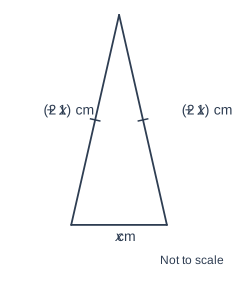
The diagram shows an isosceles triangle.
The lengths of the sides are in centimetres.

Write a formula for the perimeter, \(P\) cm, of the triangle.
Give your answer in its simplest form.

Geometry diagram, marked "Not to scale". An isosceles triangle (its vertices are not labelled). The unlabelled side going downwards is labelled (2x + 1) cm. The unlabelled side going upwards is labelled (2x + 1) cm. The unlabelled side going to the right is labelled x cm. An unlabelled line going downwards and an unlabelled line going downwards are each marked with one short dash (equal lengths).

Model answer

\(P = (2x + 1) + (2x + 1) + x\)
\(P = 5x + 2\)

Explanation

The perimeter is the total length of all three sides. The two equal sides are both \(2x + 1\), so add them and the base, then collect like terms: \(2x + 2x + x = 5x\) and \(1 + 1 = 2\). A common error is to include only one of the equal sides.

Mark scheme
  1. 2 marks

    B2 for \(P = 5x + 2\)

    Accept \(P = 2 + 5x\). B1 for \(5x + 2\) without \(P =\), or for \(P = 5x + k\) or \(P = kx + 2\), or for \(P = 2(2x + 1) + x\) not simplified.

Question 3

2 marks

It takes 6 decorators \(h\) hours to paint a school hall.
All the decorators work at the same rate.

Write an expression for the number of hours it would take 4 decorators to paint the same hall.
Give your answer in its simplest form.

Model answer

One decorator would take \(6 \times h = 6h\) hours.
4 decorators take \(6h \div 4 = \dfrac{6h}{4} = \dfrac{3h}{2}\) hours (or \(1.5h\) hours).

Explanation

This is inverse proportion: fewer decorators take longer. Find how long one decorator would take (\(6h\) hours), then share that work between 4. A common error is to multiply by \(\dfrac{4}{6}\), which wrongly gives a shorter time.

Mark scheme
  1. 1 mark

    M1 for \(6h\) (the time for one decorator) or \(6h \div 4\)

    Seen or implied, e.g. \(\dfrac{6h}{4}\) unsimplified; correct answer with no working scores full marks

  2. 1 mark

    A1 for \(\dfrac{3h}{2}\) oe

    Accept \(1.5h\) or \(\dfrac{3}{2}h\). \(\dfrac{6h}{4}\) as the final answer scores M1 A0. \(\dfrac{4h}{6}\) or \(\dfrac{2h}{3}\) (fewer workers taking less time) scores 0.

Question 4

4 marks

Lena is paid £\(p\) per hour for the first 30 hours she works in a week.
For each hour she works over 30 hours, she is paid one and a half times her normal hourly rate.

One week Lena works \(h\) hours, where \(h\) is greater than 30.

Write a formula for Lena's total pay, \(T\) pounds, for this week.

Model answer

Pay for the first 30 hours \(= 30p\)
Extra hours \(= h - 30\)
Higher rate \(= 1.5p\) pounds per hour
Pay for extra hours \(= 1.5p(h - 30)\)
\(T = 30p + 1.5p(h - 30)\)
which simplifies to \(T = 1.5ph - 15p\)

Explanation

Split the week into the first 30 hours at the normal rate and the rest at the higher rate. The number of extra hours is \(h - 30\), not \(h\), and one and a half times \(p\) is \(1.5p\). Check with numbers: £10 an hour for 40 hours gives \(300 + 150 = 450\), and \(1.5 \times 10 \times 40 - 150 = 450\).

Mark scheme
  1. 1 mark

    B1 for \(30p\)

    Pay for the first 30 hours; correct answer with no working scores full marks

  2. 1 mark

    M1 for \(h - 30\)

    The number of hours paid at the higher rate, seen or implied.

  3. 1 mark

    M1 for \(1.5p \times (h - 30)\) oe

    FT their number of extra hours; the higher rate \(1.5p\) must be used. Accept \(\dfrac{3p}{2}(h - 30)\).

  4. 1 mark

    A1 for \(T = 30p + 1.5p(h - 30)\) oe

    Accept \(T = 1.5ph - 15p\) or \(T = 30p + 1.5ph - 45p\). Correct expression without \(T =\) scores B1 M1 M1 A0. \(T = 30p + 1.5ph\) scores B1 M0 M0 A0.

Ready to try the rest? Every answer you write is marked against the mark scheme, so you can see exactly where the marks are.

Study Helper Hints first, answers after you try

Stuck on this one? Ask for a hint and I’ll point you in the right direction, without giving the answer away. Once you’ve checked your answer, I’ll show you how the marks are awarded.