Question 1
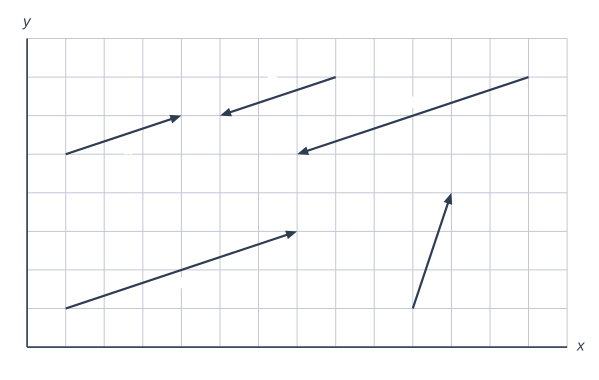
1 markThe diagram shows the vector \(\mathbf{a}\) and four arrows, P, Q, R and S, on a grid.
Which arrow represents the vector \(-\mathbf{a}\)?
Model answer
\(\mathbf{a}\) goes 3 right and 1 up.
\(-\mathbf{a}\) is the same length as \(\mathbf{a}\) but in the opposite direction: 3 left and 1 down.
P goes 3 left and 1 down.
P
Explanation
Multiplying a vector by −1 keeps its length the same and reverses its direction. Q and S are parallel to a but twice as long, and R goes in a different direction. The position of an arrow on the grid does not matter, only its length and direction.
Mark scheme
-
1 mark
B1 for P
Q is \(2\mathbf{a}\), S is \(-2\mathbf{a}\) and R is not parallel to \(\mathbf{a}\): each scores 0.