Practise 13 exam-style questions on Properties of quadrilaterals for OCR GCSE Maths (Foundation non-calculator). Write your answer as you would in the exam and get it marked in seconds against the mark scheme, point by point, with the Study Helper on hand if you get stuck.
13 questions
1–4 marks each
Instant marking
No sign-up needed
13 questions, marked as you go
Sample questions with model answers
Here are 4 of the questions in this topic, each with a model answer, an explanation of why it earns the marks and the mark scheme an examiner would use.
Question 1
1 mark
A quadrilateral has exactly one pair of parallel sides.
Write down the mathematical name of this quadrilateral.
Model answer
Trapezium
Explanation
A trapezium has exactly one pair of parallel sides. A parallelogram (and so also a rectangle, rhombus or square) has two pairs of parallel sides.
Mark scheme
1 mark
B1 for trapezium
Condone poor spelling if the word is recognisable. Do not accept parallelogram.
Question 2
2 marks
Lucy says,
"My quadrilateral has four equal sides, so it must be a square."
Explain why Lucy is not correct.
Model answer
A rhombus also has four equal sides, but its angles do not have to be 90°. Lucy's quadrilateral is a square only if all its angles are right angles, so it could be a rhombus that is not a square.
Explanation
A square has four equal sides and four right angles. A rhombus has four equal sides, but its angles need not be right angles, so equal sides alone do not make a square. Every square is a rhombus, but not every rhombus is a square.
Mark scheme
1 mark
B1 for it could be a rhombus
Accept 'it could be a diamond shape that is not a square'.
1 mark
B1 for a rhombus does not have to have right angles / the angles might not be 90°
Accept 'a square needs four right angles as well as four equal sides'.
Question 3
3 marks
A kite has a perimeter of 30 cm. Each of the two longer sides is 3 cm longer than each of the two shorter sides.
Work out the length of a shorter side and the length of a longer side.
Model answer
A kite has two pairs of equal sides. Let a shorter side be \(s\) cm. \(2s + 2(s + 3) = 30\) \(4s + 6 = 30\) \(4s = 24\) \(s = 6\) Shorter side = 6 cm, longer side = 9 cm. (Check: 6 + 6 + 9 + 9 = 30)
Explanation
A kite has two short sides that are equal and two long sides that are equal, so the perimeter is two of each. Form an equation and solve it, then add 3 for the longer side. A common error is to use only one short side and one long side.
Mark scheme
1 mark
M1 for 2s + 2(s + 3) = 30 oe
Or 4s + 6 = 30, or (30 − 6) ÷ 4, or a correct trial such as 2 × 6 + 2 × 9 = 30; correct answer with no working scores full marks
1 mark
A1 for 6 (cm)
The shorter side.
1 mark
A1 for 9 (cm)
FT their shorter side + 3. 7.5 and 10.5 (from 30 ÷ 4 = 7.5, then adding 3) scores 0.
Question 4
4 marks
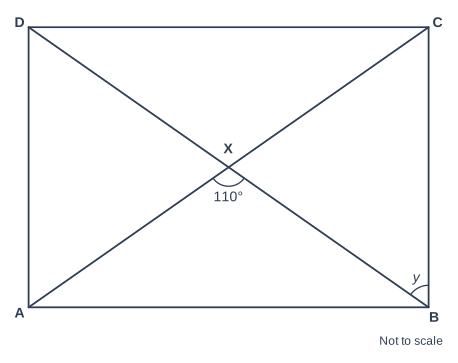
The diagram shows a rectangle ABCD. The diagonals AC and BD cross at X.
Angle AXB = 110°.
Work out the size of angle XBC, marked \(y\). Give reasons for your working.
Model answer
The diagonals of a rectangle are equal in length and bisect each other, so XA = XB and triangle AXB is isosceles. Angle XBA = angle XAB = \((180 - 110) \div 2 = 35^\circ\) Angle ABC = 90° (angle of a rectangle). \(y = 90 - 35 = 55^\circ\)
Explanation
Because the diagonals of a rectangle are the same length and cut each other in half, X is the same distance from all four corners, giving isosceles triangles. Then use the right angle at B. A common error is to stop at 35°, which is angle XBA, not angle XBC. Another route: angle BXC = 180° − 110° = 70°, and triangle BXC is also isosceles, so y = (180 − 70) ÷ 2 = 55°.
Mark scheme
1 mark
B1 for XA = XB (or XB = XC) because the diagonals of a rectangle are equal and bisect each other
Accept 'triangle AXB (or triangle BXC) is isosceles' with a reason about the diagonals.
1 mark
M1 for (180 − 110) ÷ 2, or for (180 − 70) ÷ 2 using angle BXC = 180 − 110 = 70
Base angles of triangle AXB. Alternative method: angle BXC = 70 (angles on a straight line add up to 180°) and triangle BXC is isosceles (XB = XC), so its base angles are (180 − 70) ÷ 2.
1 mark
A1 for angle XBA = 35, or angle BXC = 70 in the alternative method
1 mark
A1 for 55
From 90 − their 35 (the angles of a rectangle are 90°), or from (180 − 70) ÷ 2 in triangle BXC. Accept y = 55. 35 as the final answer does not score this mark.
Ready to try the rest? Every answer you write is marked against the mark scheme, so you can see exactly where the marks are.
Ctrl + Enter to check
Study HelperHints first, answers after you try
Stuck on this one? Ask for a hint and I’ll point you in the right direction, without giving the answer away. Once you’ve checked your answer, I’ll show you how the marks are awarded.