
Level:
Correct: 0
Incorrect: 0
Marks: 0/0
Exam Practice
Course:
Topics:
OCR GCSE Maths (Foundation non-calculator) Smart practice A mixed round aimed at your weak spots
Unit 1
Number Operations and Integers
Unit 2
Fractions, Decimals and Percentages
Unit 3
Indices and Surds
Unit 4
Approximation and Estimation
Unit 5
Ratio, Proportion and Rates of Change
Unit 6
Algebra
Unit 7
Graphs of Equations and Functions
Unit 8
Basic Geometry
Unit 9
Congruence and Similarity
Unit 10
Mensuration
Unit 11
Probability
Unit 12
Statistics
Avg
score:
–
Topics
done:
0/100

Inverse proportion

Practise 13 exam-style questions on Inverse proportion for OCR GCSE Maths (Foundation non-calculator). Write your answer as you would in the exam and get it marked in seconds against the mark scheme, point by point, with the Study Helper on hand if you get stuck.

  • 13 questions
  • 1–4 marks each
  • Instant marking
  • No sign-up needed
13 questions, marked as you go

Sample questions with model answers

Here are 4 of the questions in this topic, each with a model answer, an explanation of why it earns the marks and the mark scheme an examiner would use.

Question 1

1 mark

Here are four situations.

A The number of pens bought and the total cost of the pens
B The number of people sharing a £60 prize equally and the amount each person gets
C The length of a piece of rope and its mass
D A person's age and their height

Which situation is an example of inverse proportion?

Choose your answer.

  • A
  • B
  • C
  • D

Model answer

B
If twice as many people share the £60, each person gets half as much, so the amount each gets is inversely proportional to the number of people.

Explanation

In inverse proportion, when one quantity is multiplied by a number the other is divided by the same number. Doubling the number of people sharing £60 halves each share. A and C are direct proportion (double one, double the other), and D is not a proportion at all.

Mark scheme
  1. 1 mark

    B1 for B

    Any other answer scores 0.
Question 2

2 marks

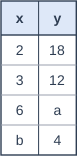
\(y\) is inversely proportional to \(x\).
The table shows some values of \(x\) and \(y\).

Work out the value of \(a\) and the value of \(b\).

Table with columns "x", "y". x: 2; y: 18 | x: 3; y: 12 | x: 6; y: a | x: b; y: 4.

Model answer

\(xy\) is the same for every pair: \(2 \times 18 = 36\) and \(3 \times 12 = 36\).
\(6 \times a = 36\), so \(a = 6\)
\(b \times 4 = 36\), so \(b = 9\)

Explanation

When y is inversely proportional to x, \(y = \dfrac{k}{x}\), so \(x \times y\) is always the same number \(k\). Here k = 36. Divide 36 by the known value in each row to find the missing one. A common error is to look for a pattern going down the columns.

Mark scheme
  1. 1 mark

    B1 for \(a = 6\)

    correct answer with no working scores full marks

  2. 1 mark

    B1 for \(b = 9\)

    If 0 scored, SC1 for \(xy = 36\) or \(y = \dfrac{36}{x}\) seen.

Question 3

3 marks

The cost of hiring a coach for a school trip is shared equally between the students who go.
When 40 students go, each student pays £15.

50 students go on the trip.

How much less does each student pay?

Model answer

Cost of the coach = \(40 \times 15 = 600\), so £600
With 50 students: \(600 \div 50 = 12\), so each pays £12.
\(15 - 12 = 3\)
Each student pays £3 less.

Explanation

The total cost of the coach stays the same, so more students means a smaller share each: inverse proportion. Find the total (£600), share it between 50 students (£12 each) and compare with £15. Remember the question asks how much less, not the new amount.

Mark scheme
  1. 1 mark

    M1 for \(40 \times 15\) (= 600)

    The cost of hiring the coach, £600; correct answer with no working scores full marks

  2. 1 mark

    M1 for their \(600 \div 50\) (= 12)

  3. 1 mark

    A1 for £3

    Accept 3. £12 as the final answer scores M1 M1 A0. £18.75 (from \(15 \div 40 \times 50\)) scores 0.

Question 4

4 marks

It takes 5 people 6 hours to paint a fence.
All the people work at the same rate.

The fence needs painting again.
This time the painting will start at 9 am and must be finished by 11 am.

How many more than 5 people are needed?

Model answer

1 person would take \(5 \times 6 = 30\) hours.
From 9 am to 11 am is 2 hours.
People needed = \(30 \div 2 = 15\)
Extra people = \(15 - 5 = 10\)

Explanation

The job takes 30 person-hours in total. To finish in 2 hours, \(30 \div 2 = 15\) people are needed, which is 10 more than the 5 already there. A common error is to give the total number of people, 15, instead of how many more.

Mark scheme
  1. 1 mark

    M1 for \(5 \times 6\) (= 30)

    1 person would take 30 hours; correct answer with no working scores full marks

  2. 1 mark

    B1 for 2 hours available

    From 9 am to 11 am.

  3. 1 mark

    M1 for their \(30 \div\) their 2 (= 15)

    Or 6 hours to 2 hours is divided by 3, so the number of people is multiplied by 3.

  4. 1 mark

    A1 for 10

    10 with no working scores 4 marks. 15 (the total number of people) scores M1 B1 M1 A0.

Ready to try the rest? Every answer you write is marked against the mark scheme, so you can see exactly where the marks are.

Study Helper Hints first, answers after you try

Stuck on this one? Ask for a hint and I’ll point you in the right direction, without giving the answer away. Once you’ve checked your answer, I’ll show you how the marks are awarded.