Practise 16 exam-style questions on Converting units for OCR GCSE Maths (Foundation non-calculator). Write your answer as you would in the exam and get it marked in seconds against the mark scheme, point by point, with the Study Helper on hand if you get stuck.
16 questions
1–4 marks each
Instant marking
No sign-up needed
16 questions, marked as you go
Sample questions with model answers
Here are 4 of the questions in this topic, each with a model answer, an explanation of why it earns the marks and the mark scheme an examiner would use.
Question 1
2 marks
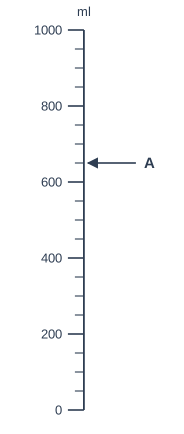
The diagram shows the scale on a measuring jug. Arrow A shows the level of the water in the jug.
Write down the amount of water in the jug. Give your answer in litres.
Model answer
Each small division on the scale is 50 ml. Arrow A is at 650 ml. 1 litre = 1000 ml \(650 \div 1000 = 0.65\) The jug contains 0.65 litres.
Explanation
There are 4 small divisions between 600 ml and 800 ml, so each one is 50 ml and the arrow is at 650 ml. To change millilitres into litres, divide by 1000. A common error is to divide by 100, giving 6.5 litres, which is far more than the jug holds.
Mark scheme
1 mark
B1 for 650 (ml) seen
The reading from the scale; correct answer with no working scores full marks
1 mark
B1 for 0.65 (litres)
FT their reading in ml divided by 1000. 6.5 or 65 scores B0 for this mark.
Question 2
2 marks
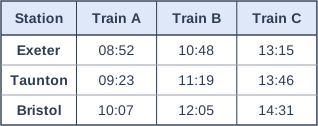
Part of a train timetable is shown.
Kim catches the train that leaves Exeter at 10:48. She travels to Bristol.
How long is her journey? Give your answer in hours and minutes.
Model answer
The 10:48 train from Exeter arrives at Bristol at 12:05. 10:48 to 11:48 is 1 hour. 11:48 to 12:00 is 12 minutes, and 12:00 to 12:05 is 5 minutes. Journey time = 1 hour 17 minutes
Explanation
Read down the column for the train that leaves Exeter at 10:48 to find that it reaches Bristol at 12:05. Count on from 10:48 in steps: a whole hour to 11:48, then 17 minutes to 12:05. Times cannot be subtracted like decimals, because an hour has 60 minutes.
Mark scheme
1 mark
M1 for a correct method to find the time from 10:48 to 12:05
E.g. 10:48 to 11:48 is 1 hour and 11:48 to 12:05 is 17 minutes, or 12 minutes to 11:00 then 1 hour 5 minutes, or 77 minutes seen; correct answer with no working scores full marks
1 mark
A1 for 1 hour 17 minutes
Accept 77 minutes. 1 hour 57 minutes (from \(12.05 - 10.48 = 1.57\)) scores 0. Using the wrong train or station scores 0.
Question 3
2 marks
Pencils cost \(x\) pence each.
Write an expression, in terms of \(x\), for the cost of 8 pencils in pounds.
Model answer
Cost of 8 pencils in pence = \(8 \times x = 8x\) 100 pence = £1, so divide by 100. Cost in pounds = \(\dfrac{8x}{100}\)
Explanation
First write the cost in pence, 8x, then change pence into pounds by dividing by 100. Check with a number: if a pencil costs 50p, 8 pencils cost 400p = £4, and \(8 \times 50 \div 100 = 4\). A common error is to multiply by 100 instead of dividing.
Mark scheme
1 mark
M1 for \(8x\) seen
The cost in pence. Or for dividing an expression in x by 100; correct answer with no working scores full marks
1 mark
A1 for \(\dfrac{8x}{100}\) oe
Accept \(0.08x\) or \(\dfrac{2x}{25}\) or \(8x \div 100\). \(8x\) as the final answer scores M1 A0. \(800x\) scores M1 A0.
Question 4
4 marks
A piece of wood 2.3 m long is cut into three pieces. The lengths of the pieces are \(x\) cm, \(2x\) cm and 0.5 m.
Find the value of \(x\).
Model answer
2.3 m = 230 cm and 0.5 m = 50 cm \(x + 2x + 50 = 230\) \(3x + 50 = 230\) \(3x = 180\) \(x = 60\)
Explanation
Put every length into centimetres, because x is measured in centimetres. The three pieces add up to the whole piece of wood, which gives the equation 3x + 50 = 230. A common error is to mix units, for example writing 3x + 0.5 = 2.3.
Mark scheme
1 mark
B1 for 2.3 m = 230 cm
correct answer with no working scores full marks
1 mark
B1 for 0.5 m = 50 cm
1 mark
M1 for \(x + 2x + 50 = 230\) oe
FT their conversions. Or \(3x = 180\). Working in metres: \(0.01x + 0.02x + 0.5 = 2.3\) oe.
1 mark
A1 for 60
Accept x = 60. 60 with no working scores 4 marks. 0.6 (finding x in metres) scores B1 B1 M1 A0.
Ready to try the rest? Every answer you write is marked against the mark scheme, so you can see exactly where the marks are.
Ctrl + Enter to check
Study HelperHints first, answers after you try
Stuck on this one? Ask for a hint and I’ll point you in the right direction, without giving the answer away. Once you’ve checked your answer, I’ll show you how the marks are awarded.