
Level:
Correct: 0
Incorrect: 0
Marks: 0/0
Exam Practice
Course:
Topics:
OCR GCSE Maths (Foundation non-calculator) Smart practice A mixed round aimed at your weak spots
Unit 1
Number Operations and Integers
Unit 2
Fractions, Decimals and Percentages
Unit 3
Indices and Surds
Unit 4
Approximation and Estimation
Unit 5
Ratio, Proportion and Rates of Change
Unit 6
Algebra
Unit 7
Graphs of Equations and Functions
Unit 8
Basic Geometry
Unit 9
Congruence and Similarity
Unit 10
Mensuration
Unit 11
Probability
Unit 12
Statistics
Avg
score:
–
Topics
done:
0/100

Loci

Practise 13 exam-style questions on Loci for OCR GCSE Maths (Foundation non-calculator). Write your answer as you would in the exam and get it marked in seconds against the mark scheme, point by point, with the Study Helper on hand if you get stuck.

  • 13 questions
  • 1–4 marks each
  • Instant marking
  • No sign-up needed
13 questions, marked as you go

Sample questions with model answers

Here are 4 of the questions in this topic, each with a model answer, an explanation of why it earns the marks and the mark scheme an examiner would use.

Question 1

2 marks

A security light is fixed at the point L in a garden.
The light comes on when a person is anywhere within 6 m of L.

A straight path goes through the garden.
The shortest distance from L to the path is 4.5 m.

Danny walks along the whole length of the path.

Does the light come on?
Give a reason for your answer.

Model answer

The points within 6 m of L are inside a circle with centre L and radius 6 m.
The nearest point of the path is 4.5 m from L, and 4.5 m is less than 6 m.
So part of the path is inside the circle.
Yes, the light comes on.

Explanation

The region within 6 m of L is a circle of radius 6 m centred on L. The shortest distance from L to the path is the perpendicular distance, 4.5 m, so the path passes inside this circle and Danny will be close enough at some point. A common error is to think Danny must pass L itself.

Mark scheme
  1. 1 mark

    B1 for the closest point of the path is 4.5 m from L, and 4.5 < 6 (so part of the path is within 6 m of L)

    Accept '4.5 m is less than 6 m' or 'the path passes inside the circle of radius 6 m around L'.

  2. 1 mark

    B1 for Yes (the light comes on)

    Dependent on the first B1. 'Yes' with no reason, or with a wrong reason, scores 0.
Question 2

2 marks

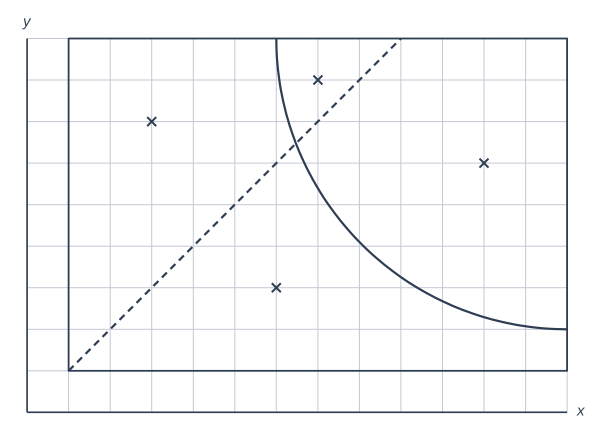
The grid shows a plan of a rectangular garden ABCD.
1 unit on the grid represents 1 m.

The dashed line is the bisector of angle DAB.
The arc is part of a circle with centre C and radius 7 m.

A pond is to be dug at one of the points P, Q, R or S.
The pond must be
• closer to side AD than to side AB, and
• less than 7 m from C.

Which point should be used for the pond?
Give a reason for your answer.

A coordinate grid with x from 0 to 13 and y from 0 to 9; each grid square is 1 unit across, and the axes cross at the origin O. Quadrilateral ABCD (unshaded) is drawn with vertices A(1, 1), B(13, 1), C(13, 9) and D(1, 9). The dashed line is a straight line sloping upwards from left to right drawn from x = 1 to x = 9 passing through (3, 3) and (7, 7). The circle is a circle with centre (13, 9) and radius 7. The dashed line and the circle cross at about (6.5, 6.5). Point P is marked with a cross at (3, 7). Point Q is marked with a cross at (7, 8). Point R is marked with a cross at (11, 6). Point S is marked with a cross at (6, 3).

Model answer

Points closer to AD than to AB lie on the D side of the bisector of angle DAB: these are P and Q.
Points less than 7 m from C lie inside the arc: these are Q and R.
Only Q is in both regions.
The pond should be at Q.

Explanation

The bisector of angle DAB is the locus of points equidistant from AD and AB, so points on the D side of it are closer to AD. Points less than 7 m from C are inside the circle with centre C. Q is the only point that satisfies both conditions; R is within 7 m of C but is closer to AB.

Mark scheme
  1. 1 mark

    B1 for Q

    Q only. P, R or S, or more than one letter, scores 0 for this mark.

  2. 1 mark

    B1 for a reason: Q is above (on the D side of) the dashed line and inside the arc

    Accept e.g. 'P is too far from C, and R and S are closer to AB than to AD' or 'Q is the only point on the AD side of the bisector and inside the circle'. Allow this mark for a correct reason even if the letter is wrong only through a slip in naming.

Question 3

3 marks

Triangle PQR has sides PQ = 7 cm, PR = 5 cm and QR = 6 cm.

Describe the steps you would take to make an accurate drawing of triangle PQR, using only a ruler and a pair of compasses.

Model answer

Step 1: Use the ruler to draw a straight line PQ, 7 cm long.
Step 2: Set the compasses to 5 cm, put the point on P and draw an arc.
Step 3: Set the compasses to 6 cm, put the point on Q and draw an arc that crosses the first arc.
Step 4: The crossing point is R. Join R to P and R to Q with the ruler.

Explanation

R must be 5 cm from P, so it lies on a circle of radius 5 cm centred on P; it must also be 6 cm from Q, so it lies on a circle of radius 6 cm centred on Q. The point where the arcs cross satisfies both. A common error is to swap the radii, which gives a triangle with PR = 6 cm and QR = 5 cm.

Mark scheme
  1. 1 mark

    B1 for drawing (measuring) a line PQ of length 7 cm with the ruler

    Any side may be drawn first, e.g. PR = 5 cm, provided the arcs then match.

  2. 1 mark

    B1 for an arc of radius 5 cm centred on P and an arc of radius 6 cm centred on Q

    Both arcs with the correct centres and radii. Radii the wrong way round (6 cm from P, 5 cm from Q) scores 0 for this mark.

  3. 1 mark

    B1 for R is where the arcs cross, and join R to P and to Q

    Accept 'join the crossing point to each end of PQ'. Using a protractor scores 0 for any mark that depends on it.

Question 4

4 marks

A field is a square ABCD with sides of length 10 m.

One goat is tied to a post at corner A by a rope 6 m long.
Another goat is tied to a post at corner C by a rope 6 m long.
The goats stay inside the field.

Can the two goats reach the same patch of grass?
Show how you decide.

Model answer

The goats get closest to each other along the diagonal AC.
\(AC^2 = 10^2 + 10^2 = 200\), so \(AC = \sqrt{200}\)
Together the ropes reach \(6 + 6 = 12\) m along AC, and \(12^2 = 144\).
\(200 > 144\), so \(\sqrt{200} > 12\).
The circles of grass the goats can reach do not meet.
No, the goats cannot reach the same patch of grass.

Explanation

Each goat can reach the points within 6 m of its post, which is part of a circle. The two regions are closest along the diagonal AC, so compare AC with 6 + 6 = 12 m. AC = √200, which is about 14.1 m, so there is a gap of about 2.1 m. A common error is to compare with the side of 10 m instead of the diagonal.

Mark scheme
  1. 1 mark

    M1 for 10² + 10² or 100 + 100

    Pythagoras' theorem for the diagonal AC.

  2. 1 mark

    A1 for AC² = 200 or AC = √200 or AC = 14.1 to 14.2

  3. 1 mark

    M1 for 6 + 6 = 12 (or 12² = 144) compared with AC

    Or for 6 + 6 + their gap, or 'each goat reaches 6 m along AC'.

  4. 1 mark

    A1 for No, with √200 > 12 (or 200 > 144 or 14.1 > 12) oe

    Dependent on the previous M1 and on a correct value for AC. 'No' with no correct comparison scores 0 for this mark. Comparing 10 + 10 = 20 with 12 is M0.

Ready to try the rest? Every answer you write is marked against the mark scheme, so you can see exactly where the marks are.

Study Helper Hints first, answers after you try

Stuck on this one? Ask for a hint and I’ll point you in the right direction, without giving the answer away. Once you’ve checked your answer, I’ll show you how the marks are awarded.