Practise 15 exam-style questions on Factorising for OCR GCSE Maths (Foundation non-calculator). Write your answer as you would in the exam and get it marked in seconds against the mark scheme, point by point, with the Study Helper on hand if you get stuck.
15 questions
1–4 marks each
Instant marking
No sign-up needed
15 questions, marked as you go
Sample questions with model answers
Here are 4 of the questions in this topic, each with a model answer, an explanation of why it earns the marks and the mark scheme an examiner would use.
Question 1
1 mark
Factorise.
\(p^2 + 7p\)
Model answer
Both terms have a factor of \(p\). \(p^2 + 7p = p(p + 7)\)
Explanation
\(p^2\) is \(p \times p\) and \(7p\) is \(7 \times p\), so \(p\) is a common factor. Taking it out leaves \(p\) and 7 inside the bracket. Expanding \(p(p + 7)\) gets back to \(p^2 + 7p\), which checks the answer.
Mark scheme
1 mark
B1 for \(p(p + 7)\)
Accept \(p(7 + p)\). Do not accept \(p(p + 7p)\) or \(p^2(1 + 7)\).
Question 2
2 marks
Use factorising to work out the value of
\(7 \times 23 + 7 \times 77\)
You must show your working.
Model answer
Both products have a factor of 7. \(7 \times 23 + 7 \times 77 = 7 \times (23 + 77)\) \(= 7 \times 100\) \(= 700\)
Explanation
The 7 is a common factor of both parts, so it can be taken outside a bracket, just as \(7a + 7b = 7(a + b)\). Adding \(23 + 77\) first gives 100, which makes the multiplication easy. Working out \(161 + 539\) gets the right value but does not use factorising.
Mark scheme
1 mark
M1 for \(7 \times (23 + 77)\) or \(7 \times 100\)
Accept \(7(23 + 77)\).
1 mark
A1 for 700
If 0 scored, SC1 for 700 with no factorising seen (e.g. \(161 + 539 = 700\)).
Question 3
2 marks
Factorise.
\(x^2 - 3x - 28\)
Model answer
Find two numbers that multiply to \(-28\) and add to \(-3\): \(-7\) and \(4\). \(x^2 - 3x - 28 = (x - 7)(x + 4)\) Check: \(x^2 + 4x - 7x - 28 = x^2 - 3x - 28\)
Explanation
The product is negative, so the two numbers have opposite signs; the sum is negative, so the bigger number is the negative one. \(-7 \times 4 = -28\) and \(-7 + 4 = -3\). The common error \((x + 7)(x - 4)\) gives \(+3x\), so always check by expanding.
Mark scheme
2 marks
B2 for \((x - 7)(x + 4)\)
Brackets in either order. B1 for \((x + 7)(x - 4)\), or for \((x + a)(x + b)\) where \(ab = -28\) or \(a + b = -3\).
Question 4
4 marks
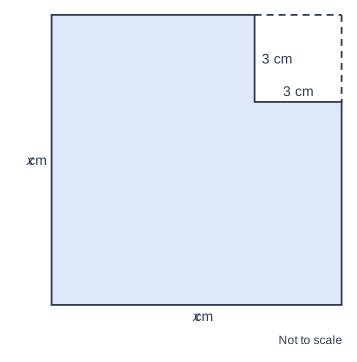
The diagram shows a square of side \(x\) cm with a square of side 3 cm cut from one corner.
Show that the area of the shaded shape that is left is \((x + 3)(x - 3)\) cm².
Use this to work out the area of the shaded shape when \(x = 103\).
Model answer
Shaded area \(= x^2 - 3^2 = x^2 - 9\) This is a difference of two squares, so \(x^2 - 9 = (x + 3)(x - 3)\) Check: \((x + 3)(x - 3) = x^2 - 3x + 3x - 9 = x^2 - 9\) When \(x = 103\): area \(= (103 + 3)(103 - 3) = 106 \times 100 = 10\,600\) cm²
Explanation
The shaded shape is the big square with a small square removed, so its area is \(x^2 - 9\), a difference of two squares. The factorised form makes the calculation easy: \(106 \times 100\) is much simpler than \(103^2 - 9\). A common error is to write \((x - 3)^2\), which is a different expression.
Mark scheme
1 mark
M1 for \(x^2 - 3^2\) or \(x^2 - 9\)
Area of the large square minus the area of the small square. Accept splitting into two rectangles, e.g. \(x(x - 3) + 3(x - 3)\).
1 mark
A1 for \(x^2 - 9 = (x + 3)(x - 3)\) shown
By recognising the difference of two squares, or by expanding \((x + 3)(x - 3)\) to \(x^2 - 9\), or \(x(x - 3) + 3(x - 3) = (x + 3)(x - 3)\).
1 mark
M1 for \((103 + 3)(103 - 3)\) or \(106 \times 100\) or \(103^2 - 9\)
Independent of the first two marks.
1 mark
A1 for 10 600
Ignore units. Accept 10600.
Ready to try the rest? Every answer you write is marked against the mark scheme, so you can see exactly where the marks are.
Ctrl + Enter to check
Study HelperHints first, answers after you try
Stuck on this one? Ask for a hint and I’ll point you in the right direction, without giving the answer away. Once you’ve checked your answer, I’ll show you how the marks are awarded.