Practise 13 exam-style questions on Congruent triangles for OCR GCSE Maths (Foundation non-calculator). Write your answer as you would in the exam and get it marked in seconds against the mark scheme, point by point, with the Study Helper on hand if you get stuck.
13 questions
1–4 marks each
Instant marking
No sign-up needed
13 questions, marked as you go
Sample questions with model answers
Here are 4 of the questions in this topic, each with a model answer, an explanation of why it earns the marks and the mark scheme an examiner would use.
Question 1
1 mark
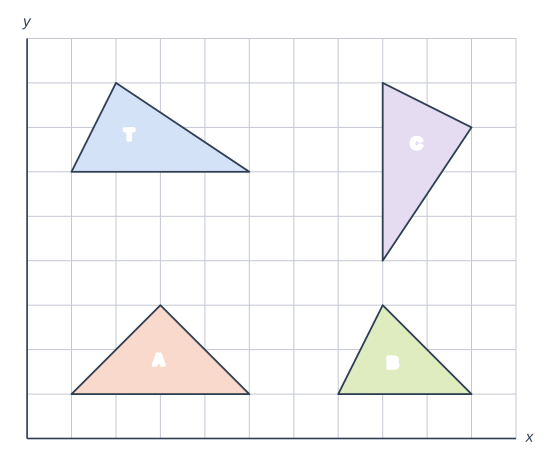
The diagram shows triangle T and three other triangles, A, B and C, on a grid.
Which triangle is congruent to triangle T?
Model answer
T has a side 4 units long, and from the end of this side the third vertex is 1 unit across and 2 units up. C is T turned through a quarter turn: it has a side 4 units long and the same shape. C
Explanation
Congruent triangles are exactly the same shape and size, even if one has been turned round or flipped over. Tracing paper is a good way to check: trace T and see which triangle it fits on exactly. A only matches the length of one side, which is not enough.
Mark scheme
1 mark
B1 for C
A has the same base as T but a different shape, and B is a different size: each scores 0.
Question 2
2 marks
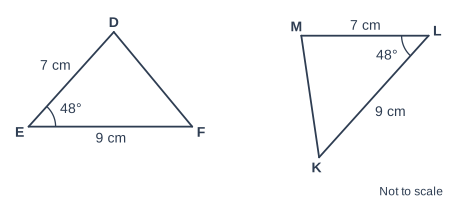
The diagram shows triangle DEF and triangle KLM.
Explain why the two triangles are congruent.
Model answer
DE = LM = 7 cm EF = KL = 9 cm Angle DEF = angle KLM = \(48^\circ\), and in each triangle this angle is between the 7 cm side and the 9 cm side. Two sides and the included angle are equal, so the triangles are congruent (SAS).
Explanation
For SAS the equal angle must be the included angle: the angle between the two equal sides. Here the 48° angle is between the 7 cm and 9 cm sides in both triangles. The second triangle is turned over, which does not stop the triangles being congruent.
Mark scheme
1 mark
B1 for the \(48^\circ\) angle is between the 7 cm and 9 cm sides in both triangles oe
Accept 'two pairs of equal sides and the angle between them is equal', 'DE = LM, EF = KL and angle E = angle L'.
1 mark
B1 for SAS
Accept 'side, angle, side'. SSS, ASA or RHS scores B0.
Question 3
2 marks
Two right-angled triangles each have one side of length 8 cm and one side of length 5 cm.
Ali says,
'The two triangles must be congruent.'
Is Ali correct? Explain your answer.
Model answer
No, Ali is not correct. In one triangle the 8 cm and 5 cm sides could both be next to the right angle; then the hypotenuse is longer than 8 cm. In the other triangle the 8 cm side could be the hypotenuse, with 5 cm as one of the shorter sides. These two triangles are not the same, so they need not be congruent.
Explanation
For RHS the hypotenuse must be one of the equal sides, and for SAS the right angle must be between the two equal sides. Knowing just 'a side of 8 cm and a side of 5 cm' does not tell us which case we have, so the two triangles can be different. A useful way to show a statement is wrong is to describe two triangles that fit the information but are different.
Mark scheme
1 mark
B1 for an explanation that the 8 cm side could be the hypotenuse in one triangle but not in the other oe
Accept a correct pair of different triangles, e.g. 'one has sides 5 and 8 next to the right angle, the other has hypotenuse 8 and a side of 5'. Accept 'we do not know which sides are the hypotenuse'.
1 mark
B1 for No (Ali is not correct)
Depends on the first mark.
Question 4
4 marks
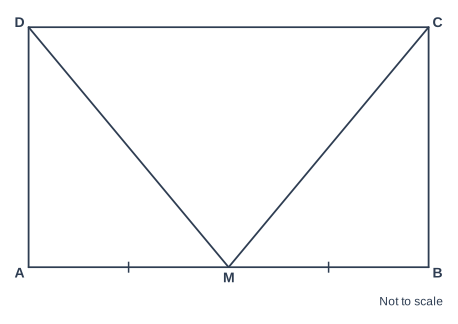
The diagram shows a rectangle ABCD. M is the midpoint of AB.
Prove that triangle AMD is congruent to triangle BMC.
Model answer
AM = BM, because M is the midpoint of AB. Angle DAM = angle CBM = \(90^\circ\), because all the angles in a rectangle are right angles. AD = BC, because opposite sides of a rectangle are equal. So two sides and the included angle are equal. Triangle AMD is congruent to triangle BMC (SAS).
Explanation
A congruence proof needs three clear statements, each with a reason, and then the condition. Here the angle at A and the angle at B are the included angles between the equal sides, so the condition is SAS. Reasons such as 'opposite sides are equal' must say which shape they belong to: opposite sides of a rectangle.
Mark scheme
3 marks
M3 for three correct statements with reasons: AM = BM (M is the midpoint of AB); angle DAM = angle CBM \(= 90^\circ\) (angles in a rectangle are right angles); AD = BC (opposite sides of a rectangle are equal)
M2 for two correct statements with reasons, or three correct statements with missing or incorrect reasons. M1 for one correct statement with a reason, or two correct statements without reasons. Statements must name pairs of sides or angles clearly; annotation on a diagram alone does not count. Accept 'angle A = angle B'. For AD = BC do not accept 'opposite sides are equal' without 'rectangle' or 'parallel sides are equal'; accept 'given' only for M being the midpoint.
1 mark
A1 for SAS
Depends on M3. The condition must fit the statements given. Accept 'two sides and the included angle'. RHS scores A0 (the hypotenuses MD and MC are not known to be equal).
Ready to try the rest? Every answer you write is marked against the mark scheme, so you can see exactly where the marks are.
Ctrl + Enter to check
Study HelperHints first, answers after you try
Stuck on this one? Ask for a hint and I’ll point you in the right direction, without giving the answer away. Once you’ve checked your answer, I’ll show you how the marks are awarded.