Practise 13 exam-style questions on Error intervals and bounds for OCR GCSE Maths (Foundation non-calculator). Write your answer as you would in the exam and get it marked in seconds against the mark scheme, point by point, with the Study Helper on hand if you get stuck.
13 questions
1–4 marks each
Instant marking
No sign-up needed
13 questions, marked as you go
Sample questions with model answers
Here are 4 of the questions in this topic, each with a model answer, an explanation of why it earns the marks and the mark scheme an examiner would use.
Question 1
1 mark
The length of a book is 23 cm, correct to the nearest centimetre.
Could the actual length of the book be 23.5 cm? Give a reason for your answer.
Model answer
No. To the nearest centimetre, 23.5 cm rounds up to 24 cm, not 23 cm. The length \(L\) cm satisfies \(22.5 \leqslant L < 23.5\), so it is less than 23.5 cm.
Explanation
A length of exactly 23.5 cm is halfway between 23 cm and 24 cm, and halfway values round up. So the actual length can be as close to 23.5 cm as you like, but it cannot be 23.5 cm itself. This is why the upper end of an error interval uses \(<\), not \(\leqslant\).
Mark scheme
1 mark
B1 for No, because 23.5 cm would round to 24 cm
Accept 'No, the length must be less than 23.5 cm', or 'No, the error interval is \(22.5 \leqslant L < 23.5\)'. 'No' with no reason, or 'Yes', scores 0.
Question 2
2 marks
Here are five numbers.
5.079 5.085 5.09 5.0899 5.008
Which of these numbers give 5.08 when they are truncated to 2 decimal places?
Model answer
Truncating to 2 decimal places means cutting off every digit after the second decimal place. 5.079 \(\to\) 5.07 5.085 \(\to\) 5.08 5.09 \(\to\) 5.09 5.0899 \(\to\) 5.08 5.008 \(\to\) 5.00 The numbers are 5.085 and 5.0899.
Explanation
Truncating never rounds up: you simply cut off the extra digits. So any number from 5.08 up to (but not including) 5.09 truncates to 5.08, which means \(5.08 \leqslant x < 5.09\). Rounding 5.079 would give 5.08, but truncating it gives 5.07.
Mark scheme
2 marks
B2 for 5.085 and 5.0899 and no others
B1 for one of them with no incorrect number, or both with one incorrect number. 5.079 truncates to 5.07, 5.09 to 5.09 and 5.008 to 5.00.
Question 3
3 marks
\(x = 4.7\), rounded to 1 decimal place. \(z = 4.7\), truncated to 1 decimal place.
Write down the error interval for \(x\) and the error interval for \(z\). Could 4.66 be the value of \(x\)? Could it be the value of \(z\)?
Model answer
Rounded to 1 decimal place: \(4.65 \leqslant x < 4.75\) Truncated to 1 decimal place: \(4.7 \leqslant z < 4.8\) 4.66 is in the first interval, so it could be \(x\) (4.66 rounds to 4.7). 4.66 is less than 4.7, so it could not be \(z\) (4.66 truncates to 4.6).
Explanation
Rounding gives an interval centred on 4.7, from 4.65 up to 4.75. Truncating only ever removes digits, so the number must be at least 4.7 and less than 4.8. That is why 4.66 works for rounding but not for truncation.
Mark scheme
1 mark
B1 for \(4.65 \leqslant x < 4.75\)
Accept 4.65 <= x < 4.75; correct answer with no working scores full marks
1 mark
B1 for \(4.7 \leqslant z < 4.8\)
Accept 4.7 <= z < 4.8.
1 mark
B1 for 4.66 could be \(x\) but could not be \(z\)
FT their error intervals. Both decisions needed.
Question 4
4 marks
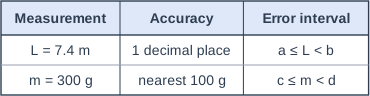
The table shows two measurements and the accuracy each one is given to.
Work out the values of \(a\), \(b\), \(c\) and \(d\) in the error intervals.
Model answer
L = 7.4 m to 1 decimal place: half of 0.1 is 0.05. \(a = 7.4 - 0.05 = 7.35\) and \(b = 7.4 + 0.05 = 7.45\) \(m\) = 300 g to the nearest 100 g: half of 100 is 50. \(c = 300 - 50 = 250\) and \(d = 300 + 50 = 350\)
Explanation
Each error interval goes from half a unit of accuracy below the rounded value up to half a unit above it. For 1 decimal place the unit is 0.1, so the half-unit is 0.05; for the nearest 100 g it is 50 g. The upper value is not included, but it is still written as the exact half-way value (7.45, not 7.449).
Mark scheme
1 mark
B1 for \(a = 7.35\)
7.3 scores B0; correct answer with no working scores full marks
1 mark
B1 for \(b = 7.45\)
7.44 or 7.449 score B0.
1 mark
B1 for \(c = 250\)
200 (from \(300 - 100\)) scores B0.
1 mark
B1 for \(d = 350\)
349 or 349.9 score B0.
Ready to try the rest? Every answer you write is marked against the mark scheme, so you can see exactly where the marks are.
Ctrl + Enter to check
Study HelperHints first, answers after you try
Stuck on this one? Ask for a hint and I’ll point you in the right direction, without giving the answer away. Once you’ve checked your answer, I’ll show you how the marks are awarded.