Practise 12 exam-style questions on Standard form for OCR GCSE Maths (Foundation non-calculator). Write your answer as you would in the exam and get it marked in seconds against the mark scheme, point by point, with the Study Helper on hand if you get stuck.
12 questions
1–4 marks each
Instant marking
No sign-up needed
12 questions, marked as you go
Sample questions with model answers
Here are 4 of the questions in this topic, each with a model answer, an explanation of why it earns the marks and the mark scheme an examiner would use.
Question 1
1 mark
Write fifty-two million in standard form.
Model answer
Fifty-two million = 52 000 000 The decimal point moves 7 places to give 5.2. \(52\,000\,000 = 5.2 \times 10^7\)
Explanation
First write the number in figures: one million is 1 000 000, so 52 million is 52 000 000. Then place the decimal point after the first digit, 5.2, and count how many places it has moved: 7. A common error is \(52 \times 10^6\), which is the right value but not in standard form.
Mark scheme
1 mark
B1 for \(5.2 \times 10^7\)
Do not accept \(52 \times 10^6\) (not standard form) or 52 000 000 (not standard form).
Question 2
2 marks
Write these numbers in order of size, starting with the largest.
Change each number to the same form (all ordinary numbers, or all standard form) before comparing. The number with the highest power of 10 is the largest, whatever its first part. When the powers are the same, compare the first parts: 6.1 is larger than 6.08. A common error is to think \(6.1 \times 10^5\) is larger than \(5.9 \times 10^6\) because 6.1 is larger than 5.9.
Numbers may be written as ordinary numbers. B1 for four in the correct order with one out of place, or the correct order smallest first, or all three standard form numbers written correctly as ordinary numbers (5 900 000, 610 000, 608 000).
Two of the numbers are not in standard form, so change all four to ordinary numbers before comparing. \(420 \times 10^2\) and \(0.42 \times 10^5\) both equal 42 000, which is \(4.2 \times 10^4\) in standard form. 4200 and 4020 look alike but are different numbers.
Mark scheme
1 mark
M1 for at least two of the numbers written correctly as ordinary numbers
A1 for \(420 \times 10^2\) and \(0.42 \times 10^5\)
Both equal 42 000. Choosing \(4.2 \times 10^3\) and 4020 scores M0 A0 unless conversions are seen.
Question 4
4 marks
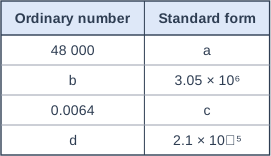
The table shows four numbers written as ordinary numbers and in standard form.
Work out the values of \(a\), \(b\), \(c\) and \(d\).
Model answer
\(a\): 48 000 = 4.8 with the point moved 4 places, so \(a = 4.8 \times 10^4\) \(b\): \(3.05 \times 10^6 = 3.05 \times 1\,000\,000 = 3\,050\,000\) \(c\): 0.0064 = 6.4 with the point moved 3 places to the right, so \(c = 6.4 \times 10^{-3}\) \(d\): \(2.1 \times 10^{-5}\): move the point 5 places to the left, \(d = 0.000\,021\)
Explanation
For large numbers the power of 10 is positive and counts how many places the decimal point moves. For numbers less than 1 the power is negative: 0.0064 needs the point to move 3 places right to make 6.4, so the power is \(-3\). Check by counting: \(2.1 \times 10^{-5}\) has 4 zeros after the decimal point before the 2.
Mark scheme
1 mark
B1 for \(a = 4.8 \times 10^4\)
Do not accept \(48 \times 10^3\); correct answer with no working scores full marks
1 mark
B1 for \(b = 3\,050\,000\)
Accept 3050000 or 3,050,000. 305 000 000 scores B0.
1 mark
B1 for \(c = 6.4 \times 10^{-3}\)
\(6.4 \times 10^3\) or \(6.4 \times 10^{-2}\) score B0.
1 mark
B1 for \(d = 0.000\,021\)
Accept 0.000021. 0.0000021 or 210 000 score B0.
Ready to try the rest? Every answer you write is marked against the mark scheme, so you can see exactly where the marks are.
Ctrl + Enter to check
Study HelperHints first, answers after you try
Stuck on this one? Ask for a hint and I’ll point you in the right direction, without giving the answer away. Once you’ve checked your answer, I’ll show you how the marks are awarded.