Practise 20 exam-style questions on Linear equations for OCR GCSE Maths (Foundation non-calculator). Write your answer as you would in the exam and get it marked in seconds against the mark scheme, point by point, with the Study Helper on hand if you get stuck.
20 questions
1–4 marks each
Instant marking
No sign-up needed
20 questions, marked as you go
Sample questions with model answers
Here are 4 of the questions in this topic, each with a model answer, an explanation of why it earns the marks and the mark scheme an examiner would use.
Question 1
1 mark
Solve.
\(x - 13 = -5\)
Model answer
\(x = -5 + 13\) \(x = 8\)
Explanation
13 is subtracted from x, so add 13 to both sides: −5 + 13 = 8. Check: 8 − 13 = −5. A common error is to subtract 13 again and get −18.
Either divide both sides by 3 first (x − 4 = 7), or expand the bracket to get 3x − 12 = 21 and then 3x = 33. Both give x = 11. A common error is to multiply only the x by 3 and write 3x − 4.
Mark scheme
1 mark
M1 for \(3x - 12 = 21\) or \(x - 4 = 7\)
Either expanding the bracket correctly or dividing both sides by 3 first; correct answer with no working scores full marks
1 mark
A1 for \(x = 11\)
Accept 11. Correct answer with no working scores 2 marks. \(\dfrac{25}{3}\) or 8.33... (from 3x − 4 = 21) scores 0. 3 (from x − 4 = 7 then 7 − 4) scores M1 A0.
Question 3
3 marks
A plumber charges a call-out fee of £45 and then £30 for each hour she works. One job costs £180 altogether.
Work out how long the plumber worked on this job. Give your answer in hours and minutes.
Model answer
Let \(h\) be the number of hours. \(45 + 30h = 180\) \(30h = 135\) \(h = 135 \div 30 = 4.5\) 4.5 hours = 4 hours 30 minutes
Explanation
Subtract the fixed call-out fee first, then divide by the cost per hour: 135 ÷ 30 = 4.5. The question asks for hours and minutes, and 0.5 of an hour is 30 minutes, not 50 minutes. Check: 45 + 4.5 × 30 = 45 + 135 = 180.
Mark scheme
1 mark
M1 for \(45 + 30h = 180\) oe or \(180 - 45\) or 135
Any letter may be used; correct answer with no working scores full marks
1 mark
M1 for their 135 ÷ 30 or 4.5
FT their 135 if from 180 − 45 or 180 + 45 only.
1 mark
A1 for 4 hours 30 minutes
Accept 4 h 30 min or 270 minutes. 4.5 hours or 4 hours 50 minutes as the final answer scores M1 M1 A0. 7 hours 30 minutes (from (180 + 45) ÷ 30) scores M0 M1 A0.
Question 4
4 marks
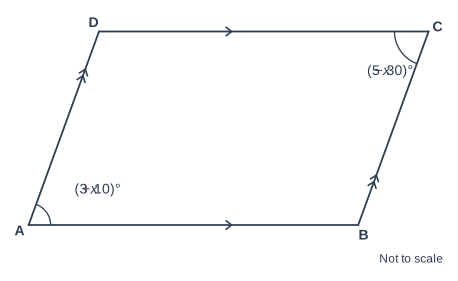
The diagram shows a parallelogram ABCD.
Angle DAB = \((3x + 10)^\circ\) and angle BCD = \((5x - 30)^\circ\).
Show that angle ABC = 110°.
Model answer
Opposite angles of a parallelogram are equal, so \(3x + 10 = 5x - 30\) \(10 + 30 = 5x - 3x\) \(40 = 2x\) \(x = 20\) Angle DAB = \(3 \times 20 + 10 = 70^\circ\) Angles DAB and ABC are co-interior angles (AD is parallel to BC), so they add up to 180°. Angle ABC = \(180^\circ - 70^\circ = 110^\circ\)
Explanation
Angles DAB and BCD are opposite angles of the parallelogram, so they are equal: this gives the equation. Once you know angle DAB = 70°, the next angle round the parallelogram makes 180° with it. Another way: the angles of the quadrilateral add up to 360°, so the two obtuse angles are (360 − 140) ÷ 2 = 110° each.
Mark scheme
1 mark
M1 for \(3x + 10 = 5x - 30\) oe
Uses opposite angles of a parallelogram are equal.
1 mark
A1 for \(x = 20\)
1 mark
A1 for angle DAB = 70 or angle BCD = 70
From \(3 \times 20 + 10\) or \(5 \times 20 - 30\).
1 mark
B1 for 180 − 70 = 110 to complete the argument
FT 180 − their 70 for the method, but the final mark needs 110 from correct working. Accept 'co-interior angles add up to 180°' or 'adjacent angles in a parallelogram add up to 180°', or (360 − 70 − 70) ÷ 2 = 110 (angles in a quadrilateral). Answer only scores 0 (show that question). Substituting x values into 110 without finding x scores 0.
Ready to try the rest? Every answer you write is marked against the mark scheme, so you can see exactly where the marks are.
Ctrl + Enter to check
Study HelperHints first, answers after you try
Stuck on this one? Ask for a hint and I’ll point you in the right direction, without giving the answer away. Once you’ve checked your answer, I’ll show you how the marks are awarded.