Level:
Correct: 0
Incorrect: 0
Marks: 0/0
Exam Practice
Course:
Topics:
OCR GCSE Maths (Foundation non-calculator) Smart practice A mixed round aimed at your weak spots
Unit 1
Number Operations and Integers
Unit 2
Fractions, Decimals and Percentages
Unit 3
Indices and Surds
Unit 4
Approximation and Estimation
Unit 5
Ratio, Proportion and Rates of Change
Unit 6
Algebra
Unit 7
Graphs of Equations and Functions
Unit 8
Basic Geometry
Unit 9
Congruence and Similarity
Unit 10
Mensuration
Unit 11
Probability
Unit 12
Statistics
Avg
score:
–
Topics
done:
0/100

Solving equations using graphs

Practise 14 exam-style questions on Solving equations using graphs for OCR GCSE Maths (Foundation non-calculator). Write your answer as you would in the exam and get it marked in seconds against the mark scheme, point by point, with the Study Helper on hand if you get stuck.

  • 14 questions
  • 1–4 marks each
  • Instant marking
  • No sign-up needed
14 questions, marked as you go

Sample questions with model answers

Here are 4 of the questions in this topic, each with a model answer, an explanation of why it earns the marks and the mark scheme an examiner would use.

Question 1

1 mark

The graph of \(y = 5 - 2x\) is drawn on the grid.

Use the graph to solve the equation \(5 - 2x = -1\).
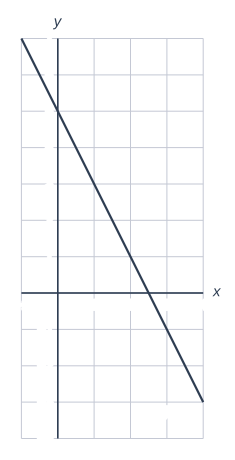
A coordinate grid with x from −1 to 4 and y from −4 to 7; each grid square is 1 unit across, and the axes cross at the origin O. The line labelled "y = 5 − 2x" is a straight line sloping downwards from left to right; its position can be read from the grid.

Model answer

Find where the line has \(y = -1\).
Go across from \(-1\) on the y-axis to the line, then up to the x-axis.
The line passes through \((3, -1)\).
\(x = 3\)

Explanation

The solution of 5 − 2x = −1 is the x-coordinate of the point on the line y = 5 − 2x where y = −1. Check: 5 − 2 × 3 = −1. Take care to start on the y-axis, because the −1 is a value of y.

Mark scheme
  1. 1 mark

    B1 for \(x = 3\)

    Accept 3. Do not accept 7 (the value of y when x = −1) or −1.
Question 2

2 marks

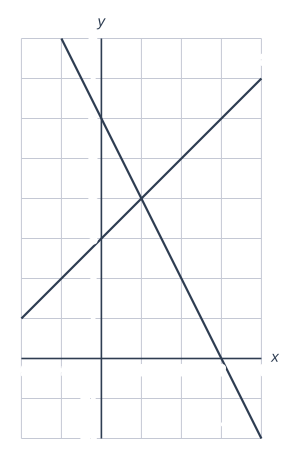
The lines \(y = x + 3\) and \(y = 6 - 2x\) are drawn on the grid.

Ben uses the graph to solve the simultaneous equations

\(y = x + 3\)
\(y = 6 - 2x\)

Ben says,

"The solution is \(x = 4\) and \(y = 1\)."

Is Ben correct?
Show how you decide.

A coordinate grid with x from −2 to 4 and y from −2 to 8; each grid square is 1 unit across, and the axes cross at the origin O. The line labelled "y = x + 3" is a straight line sloping upwards from left to right; its position can be read from the grid. The line labelled "y = 6 − 2x" is a straight line sloping downwards from left to right; its position can be read from the grid. The line labelled "y = x + 3" and the line labelled "y = 6 − 2x" cross at one point, which can be read from the grid.

Model answer

The lines cross at the point \((1, 4)\).
So the solution is \(x = 1\), \(y = 4\).
Ben is not correct: he has swapped the x-coordinate and the y-coordinate.
(Check: when \(x = 4\), \(y = x + 3 = 7\), not 1.)

Explanation

The solution is the crossing point of the two lines, and a coordinate is written (x, y) with the x-value first. Ben has read the point correctly but swapped the values. Check: 1 + 3 = 4 and 6 − 2 × 1 = 4.

Mark scheme
  1. 1 mark

    M1 for the lines crossing at \((1, 4)\), or for substituting \(x = 4\) into one equation to get \(y = 7\) or \(y = -2\)

    Either reading the crossing point or checking Ben's values.

  2. 1 mark

    A1 for No, with the correct solution \(x = 1\), \(y = 4\) or a correct check showing Ben's values do not fit

    Accept 'No, he has swapped x and y' with (1, 4) seen. 'No' with no working scores 0.

Question 3

2 marks

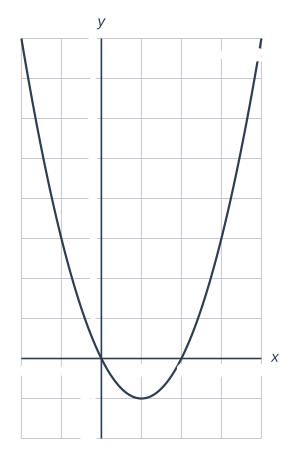
The graph of \(y = x^2 - 2x\) is drawn on the grid.

Use the graph to solve the equation \(x^2 - 2x = 3\).

A coordinate grid with x from −2 to 4 and y from −2 to 8; each grid square is 1 unit across, and the axes cross at the origin O. The curve labelled "y = x² − 2x" is a U-shaped parabola; its key points can be read from the grid.

Model answer

Find where the curve has \(y = 3\).
The line \(y = 3\) meets the curve at \((-1, 3)\) and \((3, 3)\).
\(x = -1\) or \(x = 3\)

Explanation

Solving x² − 2x = 3 means finding the x-values on the curve y = x² − 2x where y = 3. Go across from 3 on the y-axis: the horizontal line meets the curve twice. Check: (−1)² − 2 × (−1) = 1 + 2 = 3 and 3² − 2 × 3 = 3.

Mark scheme
  1. 1 mark

    B1 for \(x = -1\)

    correct answer with no working scores full marks

  2. 1 mark

    B1 for \(x = 3\)

    0 and 2 (where the curve crosses the x-axis) score 0. If 0 scored, SC1 for reading across at y = 3 shown or stated.

Question 4

4 marks

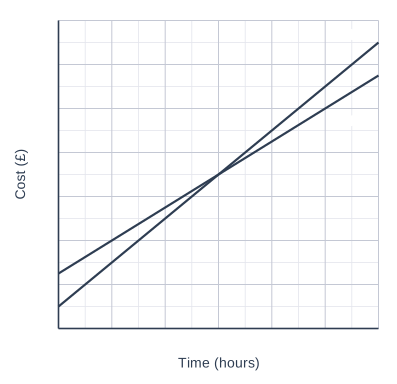
The graph shows the cost of hiring a bike from two firms, Firm A and Firm B, for up to 6 hours.

Jo has £20 to spend on hiring a bike.

Use the graph to decide which firm lets Jo hire a bike for longer.
How much longer?

A graph of Cost (£) (vertical axis, 0 to 28, marked every 4) against Time (hours) (horizontal axis, 0 to 6, marked every 1), on a grid with 2 small squares to each large square. The graph labelled "Firm A" is a straight line; its values can be read from the grid. The graph labelled "Firm B" is a straight line; its values can be read from the grid. The graph labelled "Firm A" and the graph labelled "Firm B" cross at one point, which can be read from the grid.

Model answer

Go across from £20 on the cost axis to each line, then down to the time axis.
Firm A: £20 buys 5 hours.
Firm B: £20 buys 4.5 hours.
5 − 4.5 = 0.5 hours
Firm A lets Jo hire the bike for longer, by 30 minutes.

Explanation

For each firm, read the time when the cost is £20; this solves 'cost = 20' for each line. Firm B is cheaper for short hires but its line is steeper, so for £20 Firm A gives more time. Convert 0.5 hours to 30 minutes.

Mark scheme
  1. 1 mark

    B1 for 5 (hours) for Firm A

    Accept 4.9 to 5.1. Reading across from £20 to the line for Firm A; correct answer with no working scores full marks

  2. 1 mark

    B1 for 4.5 (hours) for Firm B

    Accept 4.4 to 4.6, or 4 hours 30 minutes.

  3. 1 mark

    M1 for their 5 − their 4.5

    Comparing their two times.

  4. 1 mark

    A1 for Firm A, 30 minutes longer

    Accept 0.5 hours or half an hour. Firm A must be named. 'Firm A' with no times scores 0. Reading the costs at a time (e.g. at 5 hours) instead of the times at £20 scores 0.

Ready to try the rest? Every answer you write is marked against the mark scheme, so you can see exactly where the marks are.

Study Helper Hints first, answers after you try

Stuck on this one? Ask for a hint and I’ll point you in the right direction, without giving the answer away. Once you’ve checked your answer, I’ll show you how the marks are awarded.