Level:
Correct: 0
Incorrect: 0
Marks: 0/0
Exam Practice
Course:
Topics:
OCR GCSE Maths (Foundation non-calculator) Smart practice A mixed round aimed at your weak spots
Unit 1
Number Operations and Integers
Unit 2
Fractions, Decimals and Percentages
Unit 3
Indices and Surds
Unit 4
Approximation and Estimation
Unit 5
Ratio, Proportion and Rates of Change
Unit 6
Algebra
Unit 7
Graphs of Equations and Functions
Unit 8
Basic Geometry
Unit 9
Congruence and Similarity
Unit 10
Mensuration
Unit 11
Probability
Unit 12
Statistics
Avg
score:
–
Topics
done:
0/100

Reflections

Practise 13 exam-style questions on Reflections for OCR GCSE Maths (Foundation non-calculator). Write your answer as you would in the exam and get it marked in seconds against the mark scheme, point by point, with the Study Helper on hand if you get stuck.

  • 13 questions
  • 1–4 marks each
  • Instant marking
  • No sign-up needed
13 questions, marked as you go

Sample questions with model answers

Here are 4 of the questions in this topic, each with a model answer, an explanation of why it earns the marks and the mark scheme an examiner would use.

Question 1

1 mark

Kerry plots the point \((5, 2)\) on a coordinate grid.
She reflects the point in the y-axis.

Write down the coordinates of her new point.

Model answer

The y-axis is the line \(x = 0\).
\((5, 2)\) is 5 units to the right of the y-axis, so the new point is 5 units to the left of it, at the same height.
\((-5, 2)\)

Explanation

Reflecting in the y-axis keeps the y-coordinate the same and changes the sign of the x-coordinate. Reflecting in the x-axis would do the opposite, giving (5, −2), which is the most common wrong answer.

Mark scheme
  1. 1 mark

    B1 for \((-5, 2)\)

    Condone missing brackets. \((5, -2)\), a reflection in the x-axis, scores 0. \((-5, -2)\) scores 0.
Question 2

2 marks

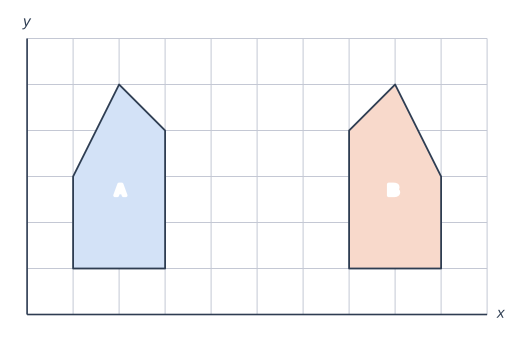
Mia draws pentagon A on a coordinate grid.
She then uses one transformation to make pentagon B.

Describe fully the transformation Mia uses.

A coordinate grid with x from 0 to 10 and y from 0 to 6; each grid square is 1 unit across, and the axes cross at the origin O. Shape A is a shaded pentagon with vertices (1, 1), (3, 1), (3, 4), (2, 5) and (1, 3). Shape B is a shaded pentagon with vertices (9, 1), (7, 1), (7, 4), (8, 5) and (9, 3).

Model answer

The shapes are mirror images of each other, so the transformation is a reflection.
Matching vertices: \((1, 1) \rightarrow (9, 1)\) and \((3, 4) \rightarrow (7, 4)\).
Halfway between \(x = 1\) and \(x = 9\) is \(x = 5\), and halfway between \(x = 3\) and \(x = 7\) is also \(x = 5\).
Reflection in the line \(x = 5\)

Explanation

A reflection is described fully by the word reflection and the equation of the mirror line. The mirror line is halfway between each vertex and its image; here it is vertical, so its equation is x = something. A common error is to write y = 5, which is a horizontal line.

Mark scheme
  1. 1 mark

    B1 for reflection

    Accept reflect or reflected. Do not accept flip or mirror on its own. If more than one transformation is described, score 0 for the whole question.

  2. 1 mark

    B1 for (in the line) \(x = 5\)

    Accept 'mirror line x = 5'. Do not accept y = 5, '5' on its own, or 'a vertical line' without its equation.

Question 3

2 marks

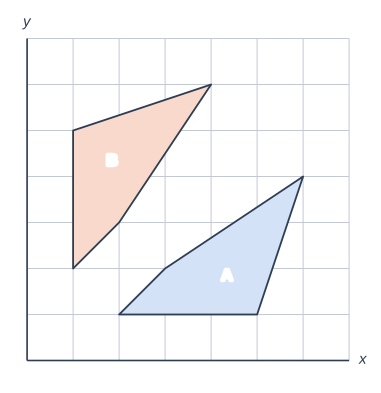
The diagram shows shape A and shape B on a coordinate grid.

Shape B is the image of shape A after a single transformation.

Describe fully this transformation.

A coordinate grid with x from 0 to 7 and y from 0 to 7; each grid square is 1 unit across, and the axes cross at the origin O. Shape A is a shaded quadrilateral with vertices (2, 1), (5, 1), (6, 4) and (3, 2). Shape B is a shaded quadrilateral with vertices (1, 2), (1, 5), (4, 6) and (2, 3).

Model answer

B is a mirror image of A, so the transformation is a reflection.
Matching vertices: \((2, 1) \rightarrow (1, 2)\), \((5, 1) \rightarrow (1, 5)\), \((6, 4) \rightarrow (4, 6)\), \((3, 2) \rightarrow (2, 3)\).
Each point \((a, b)\) maps to \((b, a)\): the coordinates are swapped.
Reflection in the line \(y = x\)

Explanation

When the x- and y-coordinates of every vertex are swapped, the shape has been reflected in the diagonal line y = x, which passes through (0, 0), (1, 1), (2, 2) and so on. A full description needs the word reflection and the equation of the line. A common error is to give y = −x, the other diagonal line.

Mark scheme
  1. 1 mark

    B1 for reflection

    Accept reflect or reflected. Do not accept flip or mirror on its own. If more than one transformation is described, score 0 for the whole question.

  2. 1 mark

    B1 for (in the line) \(y = x\)

    Accept x = y. Do not accept y = −x, 'the diagonal' or 'a line through the origin' without the equation.

Question 4

4 marks

Ayesha is designing a badge on a coordinate grid.
One unit on each axis represents 1 cm.
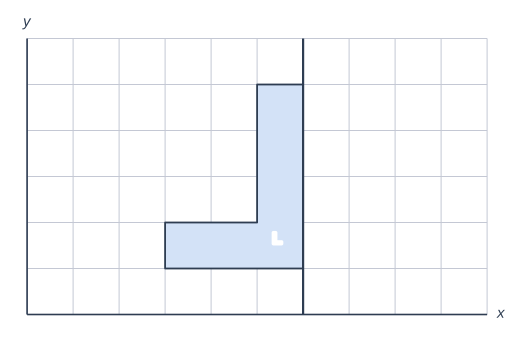
The diagram shows shape L and the line \(x = 6\).

She reflects shape L in the line \(x = 6\).
The badge is the shape made by L and its image together.

Work out the perimeter and the area of the badge.

A coordinate grid with x from 0 to 10 and y from 0 to 6; each grid square is 1 unit across, and the axes cross at the origin O. Shape L is a shaded hexagon with vertices (3, 1), (6, 1), (6, 5), (5, 5), (5, 2) and (3, 2). The line labelled "x = 6" is a vertical straight line crossing the x-axis at (6, 0).

Model answer

L has vertices \((3, 1)\), \((6, 1)\), \((6, 5)\), \((5, 5)\), \((5, 2)\), \((3, 2)\).
Reflecting in \(x = 6\): \((3, 1) \rightarrow (9, 1)\), \((3, 2) \rightarrow (9, 2)\), \((5, 2) \rightarrow (7, 2)\), \((5, 5) \rightarrow (7, 5)\); \((6, 1)\) and \((6, 5)\) are on the line.
The badge is an upside-down T: a bar 6 cm long and 1 cm high, with a block 2 cm wide and 3 cm high on top.
Perimeter \(= 6 + 1 + 2 + 3 + 2 + 3 + 2 + 1 = 20\) cm
Area of L \(= 3 \times 1 + 1 \times 3 = 6\) cm\(^2\)
Area of badge \(= 2 \times 6 = 12\) cm\(^2\)

Explanation

A reflection does not change lengths or areas, so the badge has twice the area of L. The perimeter is not simply doubled: the edge of L along the mirror line (4 cm) is inside the badge, so it is not part of the perimeter. 2 × 14 − 2 × 4 = 20 cm. A common error is to give 28 cm.

Mark scheme
  1. 1 mark

    M1 for the image of L correctly found, e.g. vertices \((9, 1)\), \((9, 2)\), \((7, 2)\) and \((7, 5)\) seen, or for \(2 \times 14 - 2 \times 4\) oe

    Accept a correct description of the badge (a bar 6 by 1 with a block 2 wide and 3 tall on top). Perimeter of L = 14 seen alone is not enough for M1; correct answer with no working scores full marks

  2. 1 mark

    A1 for perimeter 20 (cm)

    28 (double the perimeter of L, counting the shared edge twice) scores A0.

  3. 1 mark

    M1 for area of L = 6 or for \(2 \times\) their area of L, or for counting the squares of the badge

    Independent of the perimeter marks.

  4. 1 mark

    A1 for area 12 (cm\(^2\))

    Units not required. Perimeter and area may be in either order, but must be clearly identified. A fully correct answer with no working (not from wrong working) scores full marks (4).

Ready to try the rest? Every answer you write is marked against the mark scheme, so you can see exactly where the marks are.

Study Helper Hints first, answers after you try

Stuck on this one? Ask for a hint and I’ll point you in the right direction, without giving the answer away. Once you’ve checked your answer, I’ll show you how the marks are awarded.