Practise 15 exam-style questions on Estimation for OCR GCSE Maths (Foundation non-calculator). Write your answer as you would in the exam and get it marked in seconds against the mark scheme, point by point, with the Study Helper on hand if you get stuck.
15 questions
1–4 marks each
Instant marking
No sign-up needed
15 questions, marked as you go
Sample questions with model answers
Here are 4 of the questions in this topic, each with a model answer, an explanation of why it earns the marks and the mark scheme an examiner would use.
Question 1
1 mark
Use the symbol \(\approx\) to write a statement that gives an estimate for \(19.7 \times 5.2\). Show how you get your estimate.
Model answer
19.7 rounds to 20 and 5.2 rounds to 5. \(19.7 \times 5.2 \approx 20 \times 5 = 100\)
Explanation
The symbol \(\approx\) means 'is approximately equal to'. Use it between the exact calculation and the estimate, because \(19.7 \times 5.2\) is not exactly 100 (it is 102.44). Writing = would be wrong.
The \(\approx\) symbol must be used correctly, between the original calculation and the estimate (e.g. \(19.7 \times 5.2 \approx 100\)). Accept 'approx' written for the symbol. \(19.7 \times 5.2 = 100\) scores 0.
Question 2
2 marks
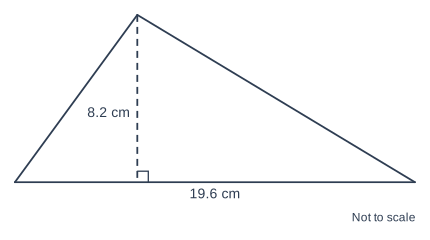
The diagram shows a triangle. The base of the triangle is 19.6 cm and its height is 8.2 cm.
By rounding each length to 1 significant figure, estimate the area of the triangle.
Model answer
19.6 rounds to 20 and 8.2 rounds to 8. Area of a triangle \(= \dfrac{1}{2} \times\) base \(\times\) height \(\approx \dfrac{1}{2} \times 20 \times 8 = 80\) cm²
Explanation
Round the base and height to 1 significant figure, then use the area of a triangle, half of base times height. The exact area is 80.36 cm², so the estimate of 80 cm² is very close. A common error is to forget to halve.
Mark scheme
1 mark
M1 for \(\dfrac{1}{2} \times 20 \times 8\) oe
Or \(20 \times 8 \div 2\). \(20 \times 8 = 160\) (forgetting the half) scores M0.
1 mark
A1 for 80 (cm²)
80.36 (the exact area) scores M0 A0. A correct answer with no working scores 2 marks.
Question 3
2 marks
Estimate the value of
\(0.51 \times 789\)
You must show your working.
Model answer
0.51 rounds to 0.5 and 789 rounds to 800. \(0.51 \times 789 \approx 0.5 \times 800\) Multiplying by 0.5 is the same as halving: half of 800 is 400. \(0.51 \times 789 \approx 400\)
Explanation
Round 0.51 to 1 significant figure (0.5) and 789 to 800. Multiplying by 0.5 means finding half, so the estimate is 400. A common error is to think multiplying always makes a number bigger and give an answer such as 4000.
Mark scheme
1 mark
M1 for \(0.5 \times 800\)
Or half of 800, or \(0.5 \times 789\) or \(0.51 \times 800\) with a correct result.
1 mark
A1 for 400
Accept 394.5 or 408 from the alternative methods. 402.39 (exact) scores 0. Answer only scores 0.
Question 4
4 marks
A square playground has an area of 395 m².
A fence is put all the way round the edge of the playground. The fence costs £18.70 per metre.
Estimate the cost of the fence.
Model answer
Side length \(= \sqrt{395} \approx \sqrt{400} = 20\) m Perimeter \(\approx 4 \times 20 = 80\) m Cost (£) \(\approx 80 \times 20 = 1600\) The fence costs about £1600.
Explanation
The side of a square is the square root of its area, and 400 is a square number close to 395, so the side is about 20 m. The fence goes round all four sides, about 80 m, and £18.70 is about £20 per metre. Common errors are to divide the area by 4 to get the side, or to multiply the area by the price.
Mark scheme
1 mark
M1 for \(\sqrt{400}\) or 20 as the estimated side length
Accept any estimate of \(\sqrt{395}\) from 19.5 to 20.
1 mark
M1 for \(4 \times\) their 20 (\(= 80\))
The perimeter. \(395 \div 4\) (about 100) as a side length scores M0.
1 mark
M1 for their 80 \(\times 20\) oe
18.70 rounded to 20 (or 19).
1 mark
A1 for an estimate from £1480 to £1600
e.g. £1600 from \(80 \times 20\), £1520 from \(80 \times 19\), £1496 from \(80 \times 18.7\). The exact cost is about £1487. An answer in the range with no working scores 4 marks.
Ready to try the rest? Every answer you write is marked against the mark scheme, so you can see exactly where the marks are.
Ctrl + Enter to check
Study HelperHints first, answers after you try
Stuck on this one? Ask for a hint and I’ll point you in the right direction, without giving the answer away. Once you’ve checked your answer, I’ll show you how the marks are awarded.